Clear Sky Science · en
Ancient DNA reconstruction of late holocene ecosystems within the Carpathian basin from paleo-meanders and archaeological deposits
Reading River Mud Like a History Book
The Danube River once wound lazily through today’s Serbia, leaving behind cut-off bends, marshes and rich fishing grounds that fed people for thousands of years. Yet the bones, seeds and other visible traces of these past worlds often rot away. This study shows that the mud itself still holds a genetic memory: fragments of ancient DNA that reveal which plants and animals lived there, how people reshaped the landscape, and even which now-vanished sturgeon once swam up the river. 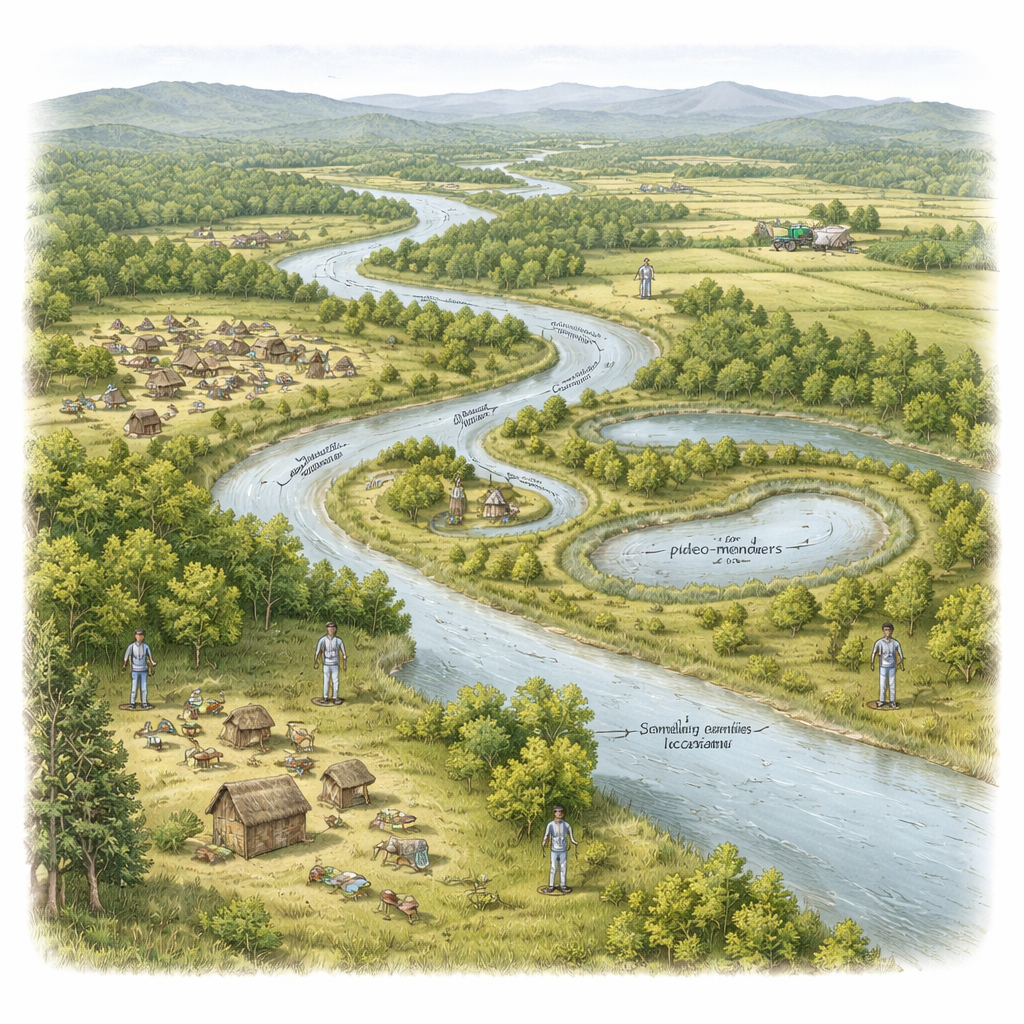
Hidden Clues in Old River Bends
As the Danube changed course over the Holocene, some of its loops were cut off, forming quiet oxbow lakes and wetlands that gradually filled with fine sediments. Nearby, open-air villages and farmsteads grew on river terraces. Archaeologists have long known that these places were important fishing and farming hubs, but the usual remains—fish bones, seeds, charcoal—are patchy and biased toward things that preserve well. Large cartilaginous fish such as sturgeon, for example, leave few durable bones. The authors turned to sedimentary ancient DNA ("sedaDNA") preserved in buried river bends and archaeological layers to recover a more complete ecological picture of the Carpathian Basin floodplain.
Collecting Time Capsules from the Ground
Researchers drilled two-meter-long sediment cores from three ancient Danube meanders and sampled layers from two Neolithic settlements, Donja Branjevina and Vinča-Belo Brdo. Each layer in these cores is a thin slice of time, built up by floods, slow deposition in oxbow lakes, or activities on the river terrace. In clean labs, the team extracted and sequenced billions of DNA fragments from these sediments, then compared the sequences to large reference databases. They focused on patterns of chemical damage in the DNA to distinguish truly ancient fragments from modern contamination and grouped the results at the family level to avoid overconfident species-level claims where reference genomes are incomplete. 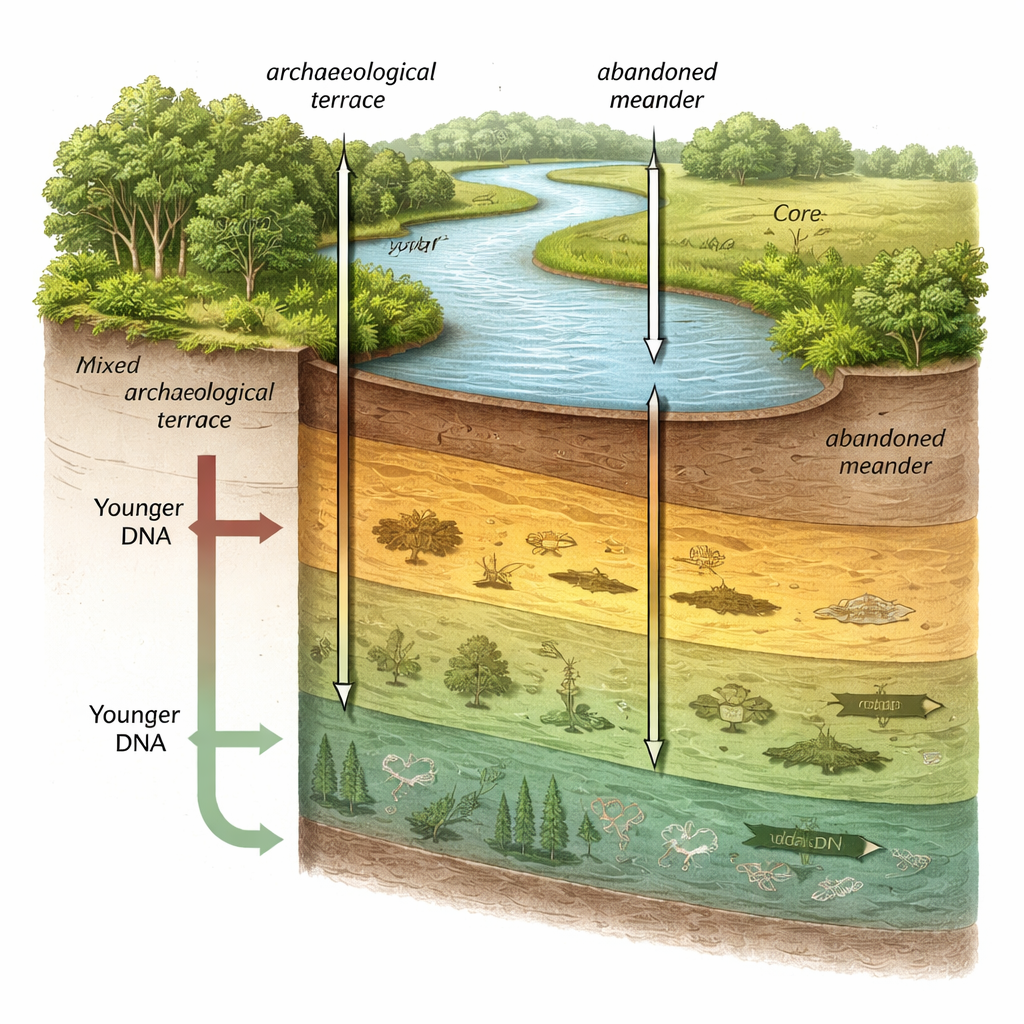
Reconstructing Lost Forests, Fields, and Fisheries
The genetic signals from the Neolithic house floors and nearby meanders reveal a landscape of mixed deciduous forest interwoven with open grasslands and disturbed ground. Families that include maples, elms, oaks and beeches sit alongside grasses, daisies and other wildflowers typical of grazed or farmed fields. DNA from shrubs and trees with edible fruits—such as elderberry, wild apples, pears and grapes—matches what charred seeds and pollen have hinted at, confirming that people gathered and likely managed these wild food plants. Through medieval and modern layers, elm and other woodland signals fade while grasses and weedy plants surge, capturing a long-term shift toward more open, farmed terrain. In the meander sediments, tiny traces of fish DNA show that ancient waters teemed with carp, catfish and, crucially, several species of migratory sturgeon that are now gone from this stretch of the river.
Tracking Vanished Giants of the Danube
Among the most striking discoveries is genetic evidence for three Danube sturgeon species—including beluga and Russian sturgeon—in layers dating from the Neolithic through later historical times. These fish once migrated from the Black Sea deep into the interior of Europe and were central to river fisheries, yet today they are critically endangered or regionally extinct, their routes blocked by 20th-century dams and harmed by overfishing and pollution. The sturgeon DNA, found together with traces of pigs, cattle and other mammals, indicates that riverside communities exploited rich freshwater resources for millennia. It also demonstrates that sediment DNA can record the former presence of species long before their populations crashed, offering a new tool for conservationists trying to understand how far and how recently such animals ranged.
Promise and Pitfalls of Reading Ancient DNA in the Open
Working in open floodplains poses challenges. Riverbanks erode, channels shift, and floods can mix older material into younger deposits, scrambling the age order of layers. The study shows that low-energy, clay-rich oxbow basins tend to preserve clearer time sequences but are dominated by local plant DNA, while active channels produce stronger aquatic signals at the cost of more complicated layering. By combining careful dating, sediment analysis and conservative DNA filters, the authors argue that most of the genetic signal they see is local rather than washed in from far away. Even so, they stress that better reference genomes—especially for poorly sampled groups like sturgeon and many regional plants—will be essential for finer-grained reconstructions.
Why This Matters Today
For non-specialists, the message is that ordinary-looking river mud can now reveal who lived in and around a landscape long after bones and wood have vanished. In the Danube’s abandoned bends and buried house floors, ancient DNA captures the rise of farming, the thinning of forests, and the long history of fishing for species that no longer reach these waters. The work points toward a future where archaeologists and ecologists routinely pair genetic traces with traditional digs to understand how people transformed ecosystems—and how today’s endangered wildlife once used rivers and floodplains that we might still restore.
Citation: Zampirolo, G., H. Ruter, A., Živaljević, I. et al. Ancient DNA reconstruction of late holocene ecosystems within the Carpathian basin from paleo-meanders and archaeological deposits. Sci Rep 16, 4301 (2026). https://doi.org/10.1038/s41598-026-35509-2
Keywords: ancient DNA, Danube River, sturgeon, Neolithic farming, floodplain ecosystems