Clear Sky Science · en
Comparative assessment of groundwater quality and stability around active and closed dumpsites in Ibadan, Nigeria
Why Trash Heaps Matter for Your Drinking Water
Across many growing cities, household wells sit just a short walk from towering piles of rubbish. This study from Ibadan, Nigeria, asks a deceptively simple question with big implications: how safe is the water beneath our feet when it lies next to an active garbage dump or one that has been shut and even built over? By comparing groundwater around both an operating dumpsite and a long-closed one, the researchers show that what happens to our trash can affect not only whether water is safe to drink, but also whether it will slowly eat away metal pipes or clog them with mineral crusts.
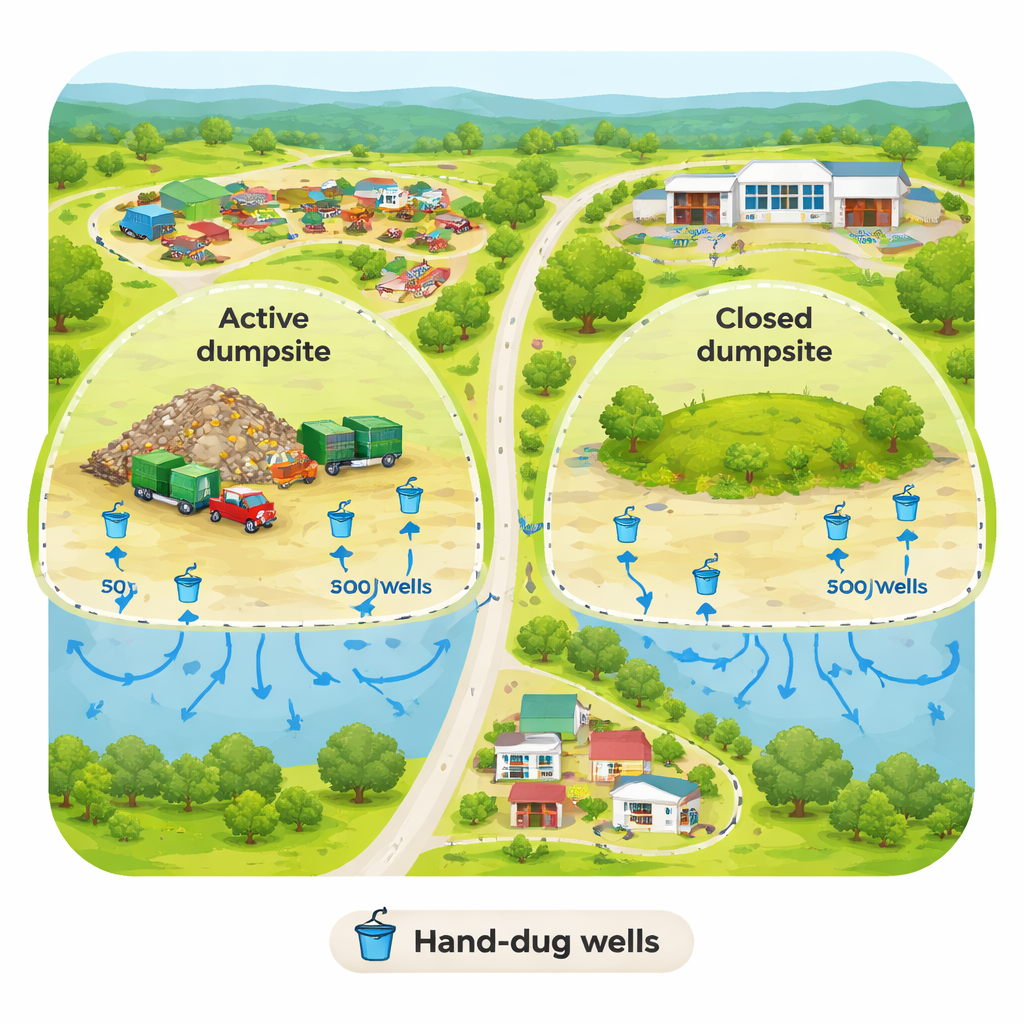
Two Neighborhoods, Two Dumps
The team focused on two peri-urban neighborhoods in Ibadan, a fast-growing city in southwest Nigeria. One area hosts the Aba Eku dumpsite, which is still receiving waste. The other contains an older dumpsite that has been officially closed and partly covered by a shopping mall. In each area, the researchers collected water from ten shallow hand-dug wells, all within about 500 meters of the dump. They measured common indicators of water quality—such as acidity, dissolved salts and key ions like calcium, magnesium, sodium, and nitrate—as well as how likely the water is to corrode pipes or form hard mineral scale.
Safe to Drink? A Mixed Picture
For households, the most pressing issue is whether their well water is drinkable. Using World Health Organization guidelines and a combined “water quality index,” the study found that all samples around the active dumpsite technically met basic drinking-water limits. Roughly 90% of these wells fell into the “excellent to good” category, although one well just 20 meters from the active dump showed signs of poorer quality. The story was very different near the closed dumpsite: 90% of those wells were rated “poor to unsuitable” for drinking, mainly because levels of calcium, magnesium, and nitrate were too high. Average concentrations of most dissolved substances (except chloride) were higher near the closed site than near the active one, showing that contamination does not simply vanish when a dump is shut down or built over.
Water for Farms and Fields
The researchers also asked whether this groundwater could safely irrigate crops. Here the answer depended on which indicator you look at. Around the active dumpsite, many measures—such as total dissolved solids and a standard salinity index called SAR—suggested the water could be used for irrigation. Yet other indicators warned of trouble: several wells had too much sodium or magnesium relative to calcium, which can damage soil structure, reduce its ability to absorb water, and ultimately lower crop yields. By contrast, most wells near the closed dumpsite scored well on these irrigation indices, despite being less suitable for drinking. In other words, the older, closed dump appears to threaten people more than plants.
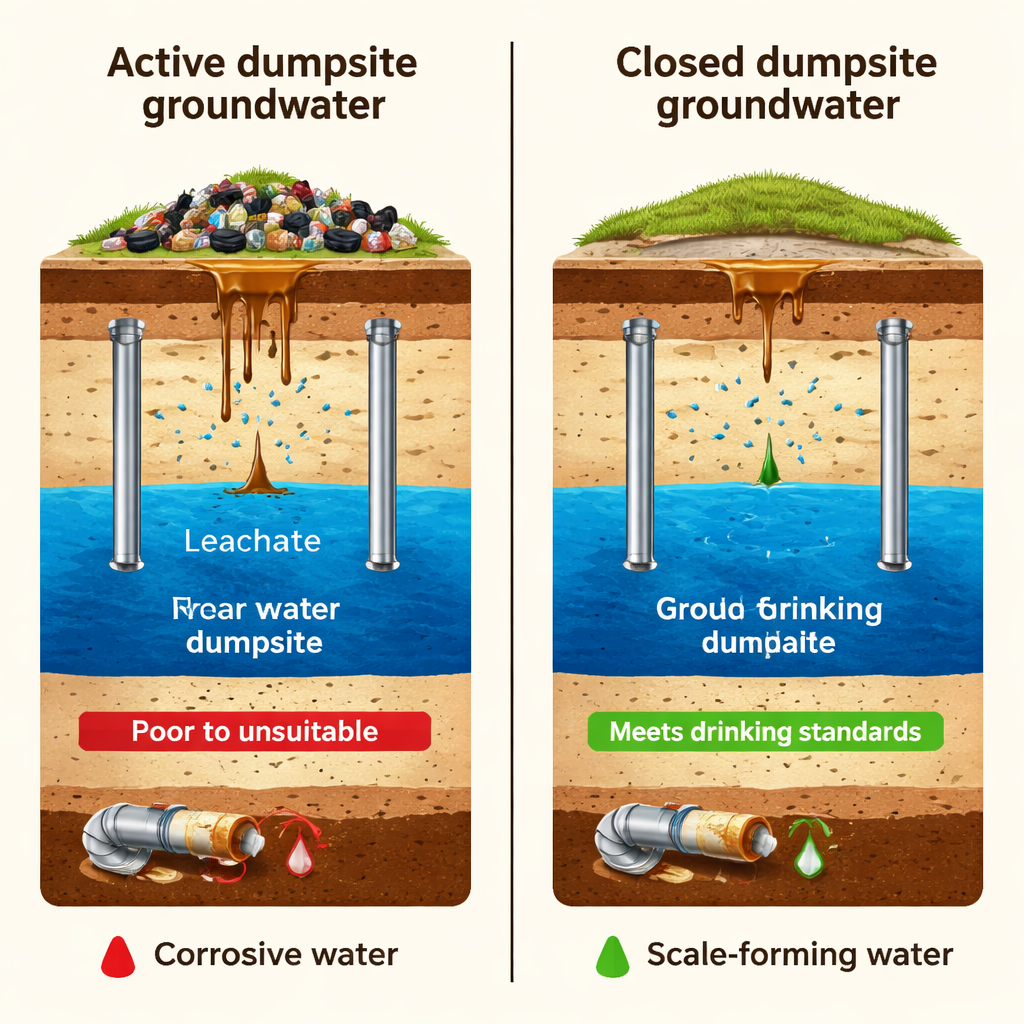
Rusty Pipes or Rock-Hard Scale
Beyond taste and safety, groundwater chemistry also determines how it behaves inside pipes. Using several standard “stability” indices, the team found that water near the active dumpsite tends to be corrosive: it can dissolve metals and shorten the life of household and distribution pipes, and may help release toxic metals where old plumbing is present. Water near the closed dumpsite showed the opposite tendency. There, the chemistry favors scale formation—the buildup of hard mineral layers inside pipes and heaters. Scale can narrow pipes, reduce flow, and make heating systems less efficient. Both situations cost communities money, either through leaks and pipe failures or through extra energy and maintenance.
What This Means for Communities
For residents living around these dumpsites, the takeaway is straightforward but urgent. Wells around the active dump currently produce water that mostly meets drinking standards, but it is chemically aggressive toward pipes and should be monitored and treated, ideally with corrosion inhibitors. Wells around the closed dump often produce water that is no longer safe to drink, even though the site looks inactive and partly rehabilitated; that water may still be usable for irrigation, but not for the kitchen tap. The broader lesson is that both operating and closed waste sites can shape groundwater for many years, so regular, long-term testing and appropriate treatment are essential to protect health, infrastructure, and the limited freshwater stored underground.
Citation: Ganiyu, S.A., Olutoki, J.O., Alkahtani, M.Q. et al. Comparative assessment of groundwater quality and stability around active and closed dumpsites in Ibadan, Nigeria. Sci Rep 16, 5561 (2026). https://doi.org/10.1038/s41598-026-35506-5
Keywords: groundwater pollution, landfill leachate, drinking water safety, water pipe corrosion, irrigation water quality