Clear Sky Science · en
Multi-scale wind speed prediction model based on improved escape algorithm for optimizing time-varying filtering empirical modal decomposition
Why predicting the wind matters
As more of our electricity comes from wind farms, keeping the lights on depends on knowing how hard the wind will blow in the next few minutes and hours. If forecasts are off, grid operators must scramble to balance supply and demand, wasting clean energy or risking blackouts. This article presents a new way to predict wind speed more accurately, especially over short time horizons that are critical for real-time grid control.
Untangling messy wind signals
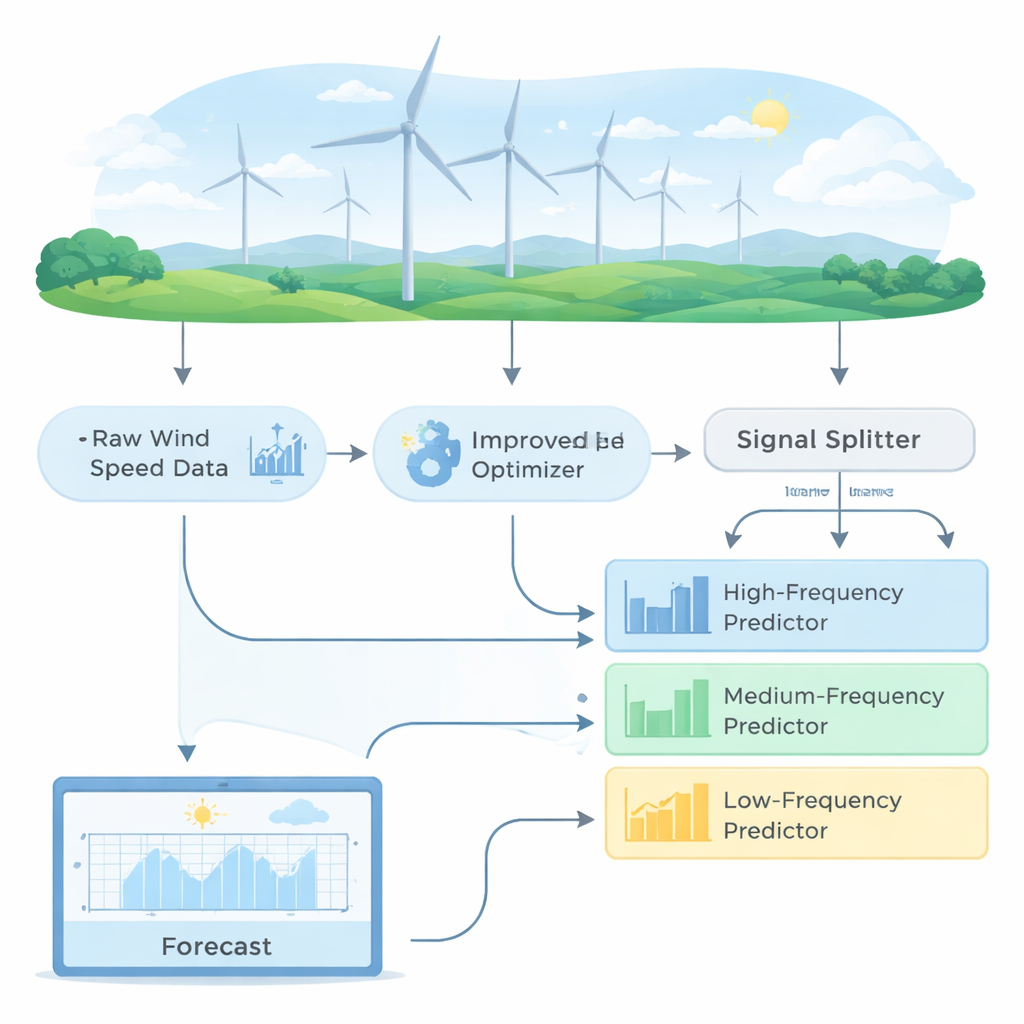
Wind speed measured at a turbine is a jumble of fast gusts, slower swings, and gentle long-term trends. Traditional forecasting methods often treat this tangle as a single stream, which makes it hard for computer models to spot clear patterns. The authors start by separating the raw wind data into several layers, each representing different time scales of motion. This is done with a technique called time-varying filter empirical mode decomposition, which acts like a smart sieve: it pulls apart high-frequency noise, medium-frequency swings, and low-frequency trends so that each can be studied and predicted on its own.
Teaching an algorithm to escape bad guesses
However, this smart sieve only works well when its settings are just right. Choosing those settings by hand or with off-the-shelf search methods can be slow and unreliable, especially for complex, highly changeable wind data. To solve this, the authors design an “improved escape algorithm,” inspired by how crowds find exits in an unfamiliar building. The algorithm starts from many possible settings, stirs them with a dose of controlled randomness, and then steadily nudges weaker options toward better ones. By adding chaotic initialization, an evolving pool of elite candidates, targeted mutation steps, and a mechanism that pulls the population toward the best solutions, the improved algorithm converges faster and more reliably than several popular competitors.
Different tools for different kinds of motion
Once the wind signal is split into its high-, medium-, and low-frequency parts, the team assigns a different forecasting tool to each. The most turbulent, high-frequency part is given to an advanced deep-learning network that specializes in remembering intricate, rapid changes over time. The smoother, medium-frequency variations are handled by a more modest memory-based model that balances flexibility with stability. The slow, almost trend-like low-frequency component is entrusted to a lightweight neural network that trains quickly and avoids overfitting to noise. After each piece is predicted separately, the forecasts are added back together to produce a single, time-based wind speed forecast.
Putting the model to the test
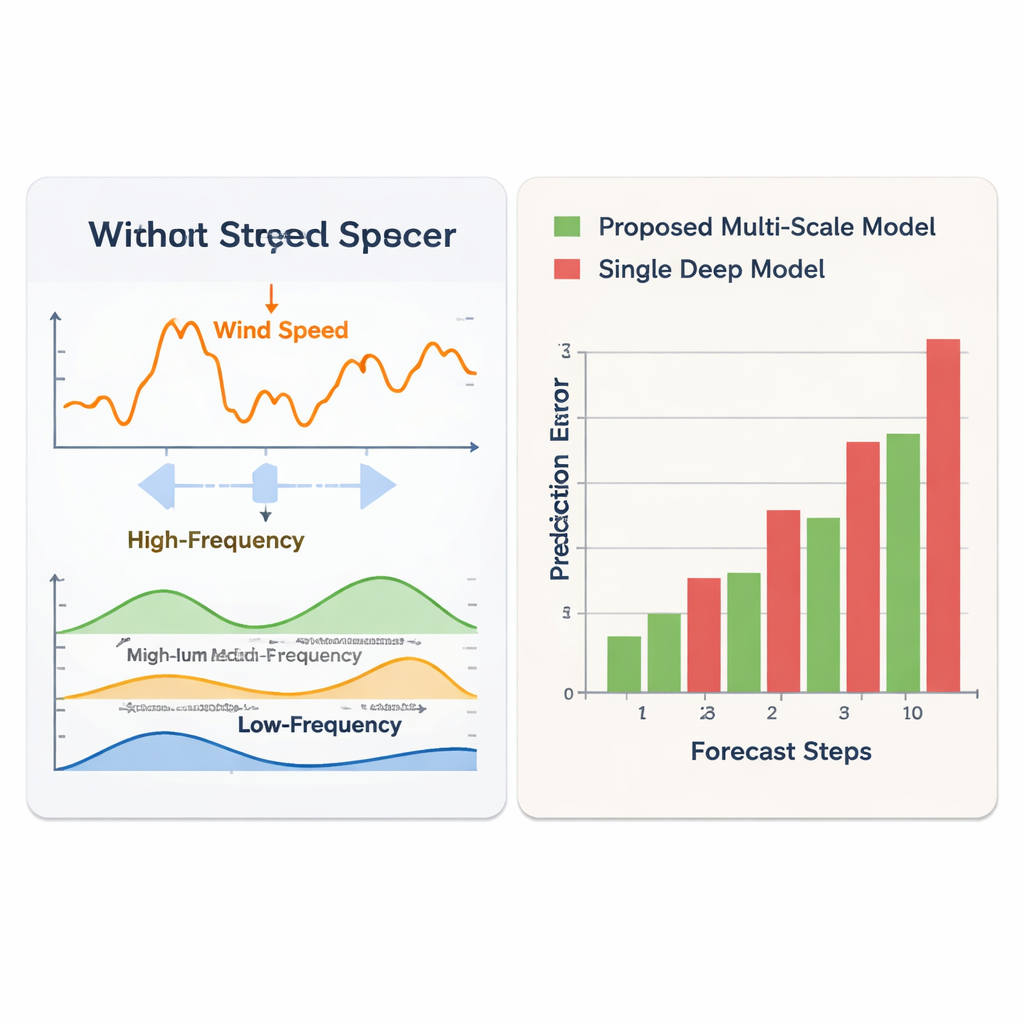
To check whether this multi-layered approach actually helps in practice, the authors use detailed data from a wind farm in Xinjiang, China, with measurements taken every 15 minutes at several heights. They compare their system against a range of popular forecasting models, from simple neural networks to state-of-the-art deep learning methods. Across forecasts that look from one step ahead up to 15 steps ahead—covering nearly four hours—the new model consistently produces smaller errors. Notably, when looking 15 steps into the future, it keeps its fit to reality far better than even a strong single deep model: its error grows more slowly, and it avoids the rapid degradation that often plagues longer-horizon predictions.
What this means for future power grids
In plain terms, the study shows that treating wind as a multi-layered signal—and matching each layer to the right kind of prediction engine—can give grid operators a sharper, more stable look into the near future. The improved optimization algorithm ensures that the signal-splitting step is finely tuned, while the mix of specialized predictors keeps errors from ballooning as the forecast horizon extends. Together, these advances can help power systems accommodate more wind energy without sacrificing reliability, easing the path toward cleaner, more resilient electricity networks.
Citation: Zheng, H., Wu, Q., Lv, X. et al. Multi-scale wind speed prediction model based on improved escape algorithm for optimizing time-varying filtering empirical modal decomposition. Sci Rep 16, 4958 (2026). https://doi.org/10.1038/s41598-026-35505-6
Keywords: wind energy, renewable power forecasting, time series decomposition, deep learning models, electric grid stability