Clear Sky Science · en
Predictive use of environmental regularities requires action relevance
Why this matters for everyday movement
Everyday life is full of decisions we make on the move: stepping into a crosswalk, choosing a side of a crowded hallway, or weaving through a busy shop. We rarely have perfect information, yet we often act as if we “know” what is likely to happen next. This study asks when people actually use such hidden patterns in the environment to plan their movements in advance, and when they instead wait to react at the last moment.
A walk through a virtual museum
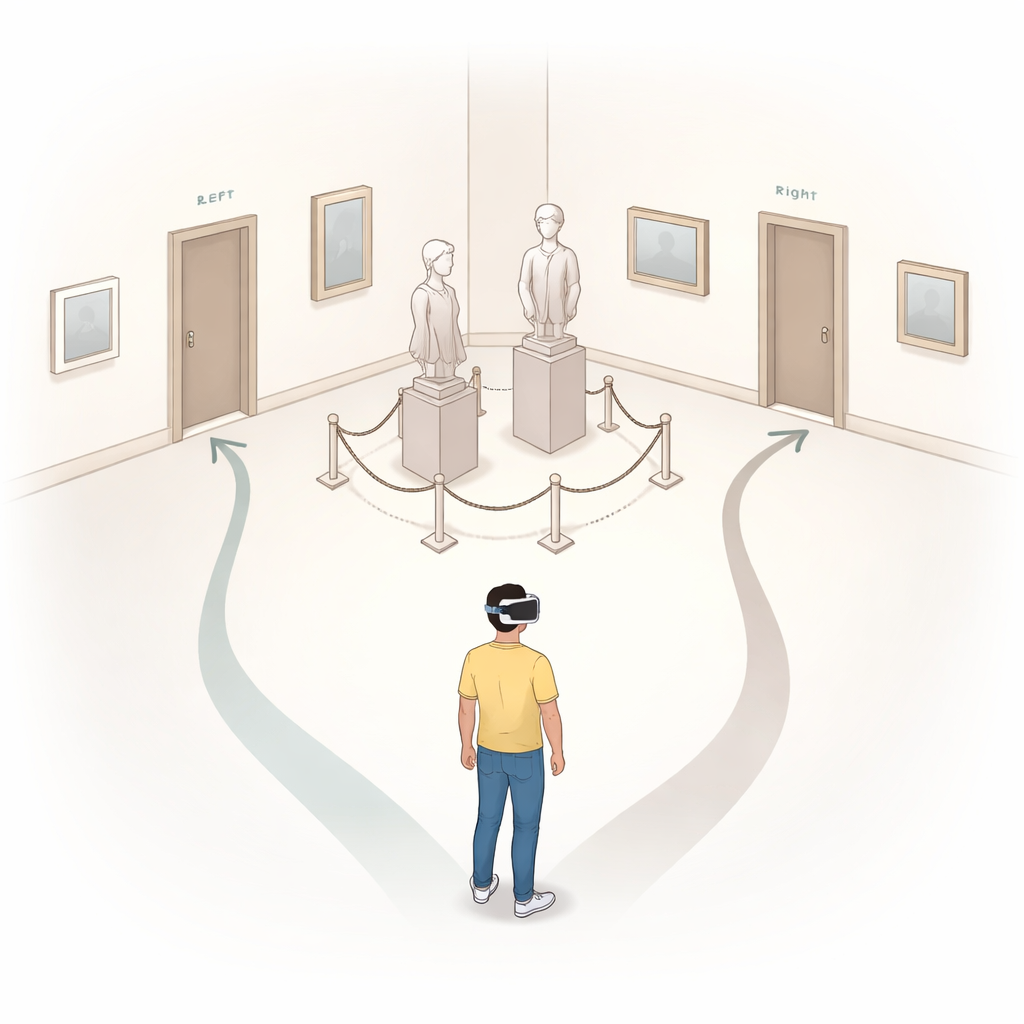
To explore this question, researchers built a small art museum inside virtual reality. Volunteers wore a VR headset and walked in a real room that matched the virtual space. On each trial, they started at one end of the museum and had to reach one of two doors at the far wall as quickly and directly as possible, while avoiding a central display and a moving security guard. The guard would suddenly appear from the left or right side and block one of the doors. Across groups of trials, the guard tended to block the same side much more often than the other, but participants were never told this; they had to discover it from experience alone.
When waiting feels safer than predicting
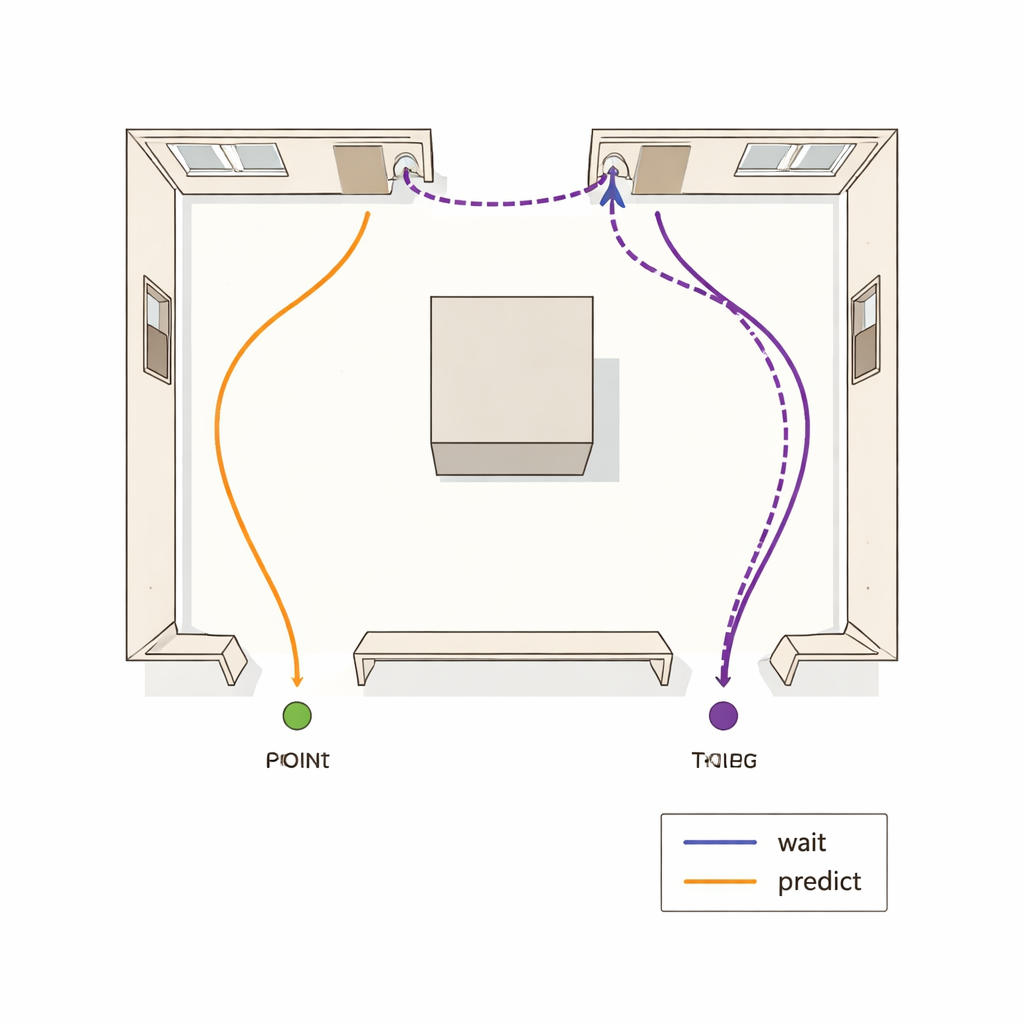
In the first experiment, the layout allowed people to walk straight down the middle and postpone their choice until the guard appeared. Many participants adopted exactly this “wait-and-see” strategy. They walked forward with little sideways movement, then made a sharp correction only after seeing which door was blocked. Careful analysis of their body positions showed only small average shifts toward the statistically safer side over time, and most of that effect came from a small minority of “super learners.” Cluster analyses revealed distinct styles: most were Waiters who delayed their decision, a few were Moderate Learners who made modest anticipatory shifts, one person showed strong predictive behavior, and some behaved more randomly. Eye-tracking suggested that people’s gaze did become somewhat more focused as they grew familiar with the room, but changes were modest and varied a lot between individuals.
Making early choices pays off
The second experiment changed a key feature of the environment. A larger central obstacle forced the two paths to split earlier, so participants now had to commit to the left or right well before the guard appeared. Choosing the blocked path was costly: they had to turn around and walk back before trying the other side. Under these new conditions, nearly everyone rapidly learned which side was usually open in each block of trials and started choosing that side in advance. Their pattern of choices closely matched the behavior of an ideal mathematical learner that updates its expectations from trial to trial. In other words, when the task made early decisions both necessary and worthwhile, people quickly picked up on the hidden regularities and used them to guide their movements.
Eyes on the path, but minds on the task
Across both experiments, eye-movement data told a subtler story. Participants gradually reduced how much they scanned the scene and focused their gaze more narrowly as they gained experience with the virtual museum. However, these changes were not strongly tied to whether the guard’s position was predictable or not. Instead, they seemed to reflect growing familiarity with the setting and personal differences in viewing style, rather than a clear signature of learning specific probabilities.
What this means for real-world navigation
Together, the two experiments show that people do not always use what they can learn about their surroundings to plan ahead. Even when a pattern is available, many will wait for clear sensory evidence if reacting late is cheap and safe. Predictive planning becomes prominent when early commitment is required and mistakes are costly. In daily life, this means that how we move through the world reflects not just what we know, but how the environment rewards or punishes early decisions. Predictive use of environmental regularities is therefore not automatic; it is an adaptive choice shaped by task demands, effort, and personal strategy.
Citation: Kretzmeyer, B., Rothkopf, C.A. & Fiehler, K. Predictive use of environmental regularities requires action relevance. Sci Rep 16, 1596 (2026). https://doi.org/10.1038/s41598-026-35500-x
Keywords: motor planning, virtual reality navigation, predictive behavior, embodied decision making, statistical learning