Clear Sky Science · en
Effect of rotational field on thermo-acoustic and optical wave propagation in hydrodynamic semiconductors
Spinning chips and hidden waves
Modern sensors, communication hardware and aerospace instruments increasingly rely on semiconductor parts that are not only illuminated by lasers and heated, but also spinning or vibrating at high speed. This study asks a deceptively simple question with big engineering consequences: how do heat, sound-like vibrations and electric charges move inside a porous semiconductor when the whole device is rotating?
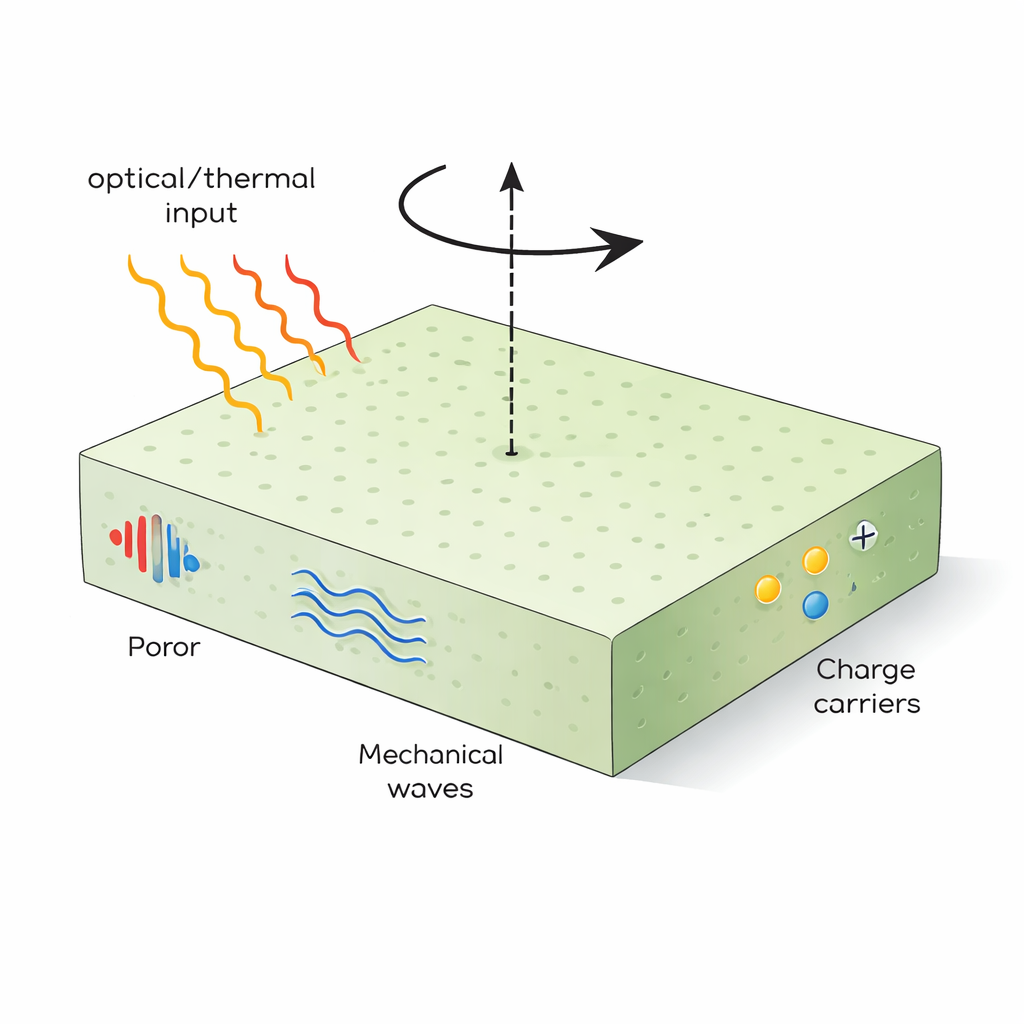
A sponge-like semiconductor
The work focuses on “poro-semiconductors” such as porous silicon – materials that look solid from the outside but contain a maze of tiny fluid-filled pores. Because both the solid skeleton and the trapped fluid can move and deform, heating these materials does more than just raise their temperature. Light or other energy absorbed at the surface can generate heat, build up fluid pressure in the pores, deform the solid framework and shift the distribution of electric charge carriers. The authors build on earlier theories of thermoelasticity (how heat and mechanical stress interact) and photothermal effects (how light turns into heat) and extend them to this porous, fluid-filled setting.
Adding rotation to the mix
Rotation introduces two familiar but often overlooked effects: Coriolis and centrifugal forces, the same influences that shape weather systems on Earth. In a spinning semiconductor, these forces act on every tiny element of material, subtly steering how mechanical waves travel, how heat spreads and how charges move. The authors construct a detailed mathematical model that couples five key quantities: temperature, mechanical displacement, electric carrier density, pore-fluid pressure and stress. They treat the material as a semi-infinite slab and apply a time-varying heat input at the surface, similar to a controlled laser or thermal pulse, together with specified mechanical loading and fluid pressure conditions.
Unraveling coupled waves with math
To understand the resulting maze of interactions, the researchers convert the governing equations into a simplified, dimensionless form and analyze wave-like “normal modes” that vary in time and space with well-defined frequency and wavelength. This procedure reduces the full problem to an eighth‑order equation whose solutions describe how each field dies away or oscillates with depth inside the material. From these solutions they reconstruct temperature, carrier density, fluid pressure, stress and mechanical motion and compare two situations: a rotating medium and a non-rotating one, as well as models with and without porosity and pore water.
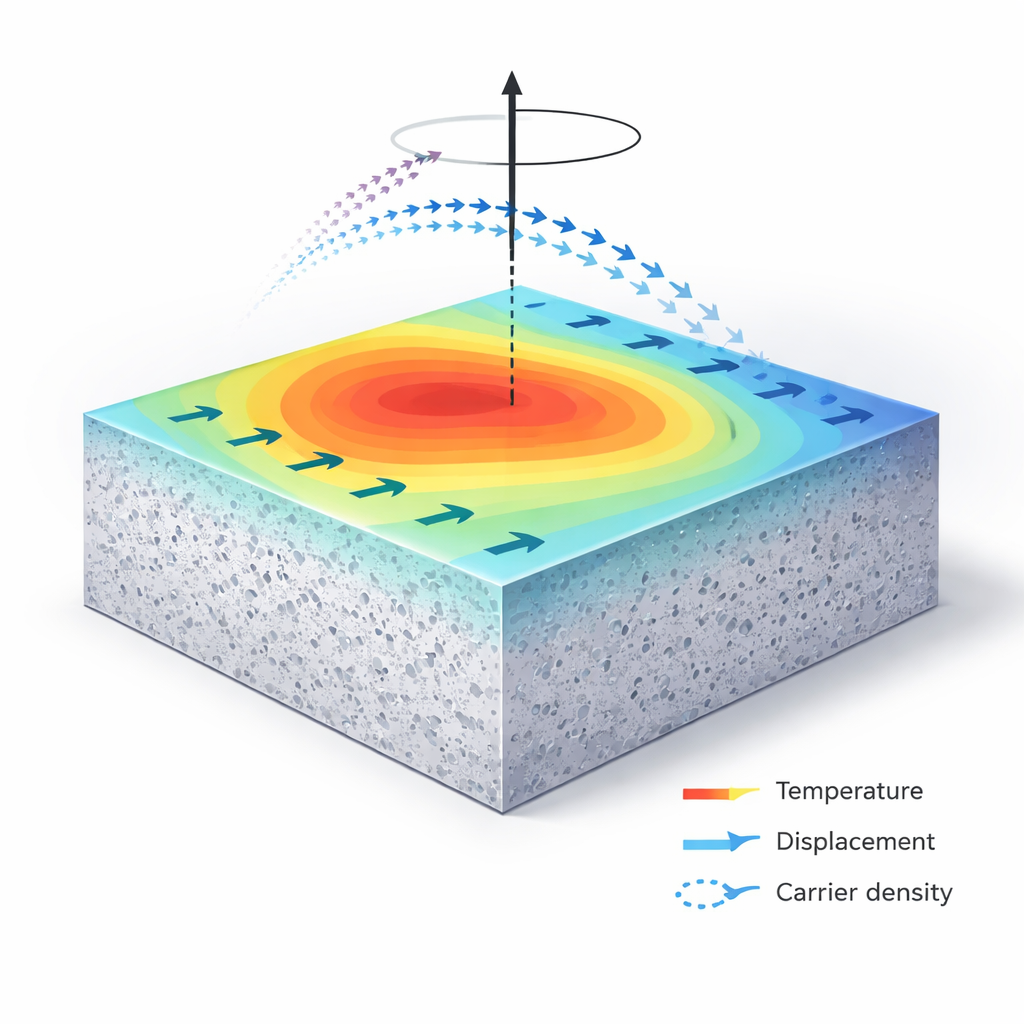
What rotation and porosity really do
Numerical results for porous silicon reveal that rotation does not simply speed things up or slow them down; it reshapes the entire pattern of waves. Temperature near the heated surface drops slightly but develops stronger oscillations deeper inside, as rotational forces redirect some of the energy into mechanical motion and then feed it back into the thermal field. Electric carriers show higher concentrations near the surface and more pronounced ripples, indicating that rotation alters strain and temperature gradients in ways that favor local charge build-up. Horizontal and vertical displacements become larger and more oscillatory under rotation, and the associated stresses and pore-water pressures show amplified peaks and shifted phases, signaling richer and more tightly coupled wave behavior than in the non-rotating case.
Why the pores matter
Porosity itself plays a central role. When the model ignores pore space and fluid, the semiconductor behaves more stiffly and heat and carriers relax relatively quickly. When pores and water are included, the fluid can move and store energy, adding new pathways for heat and mechanical waves. The study finds that porosity tends to dampen temperature peaks yet maintains higher carrier densities farther from the surface, while also allowing pore pressure waves to travel and interact with the solid skeleton. Under rotation, this porous framework permits larger mechanical oscillations and stronger stress fluctuations than a solid, non-porous counterpart, emphasizing that fluid–solid coupling cannot be treated as a minor detail.
Takeaway for future devices
In plain terms, the paper shows that both rotation and internal porosity can dramatically reshape how heat, vibrations and charges move through semiconductor components. For spinning or vibrating devices built from porous silicon and related materials – from gyroscopic sensors and turbine-mounted detectors to compact photonic and bio-sensing platforms – these effects will influence signal strength, stability and long-term reliability. Designers who ignore rotation or the role of trapped fluids risk misjudging temperature hotspots, stress levels or charge transport. By providing a unified framework that blends optical heating, mechanical motion, fluid flow and rotation, this work offers a more realistic foundation for engineering robust, high-performance semiconductor technologies in demanding environments.
Citation: Alshehri, H.M., Lotfy, K. Effect of rotational field on thermo-acoustic and optical wave propagation in hydrodynamic semiconductors. Sci Rep 16, 1598 (2026). https://doi.org/10.1038/s41598-026-35494-6
Keywords: porous semiconductors, rotating devices, thermoelastic waves, photothermal effects, carrier transport