Clear Sky Science · en
Premature pollen development hinders autonomous self-pollination and promotes insect pollination in soybean (Glycine max L.)
Why soybean flowers hold a hidden surprise
Soybean is often treated as a nearly “set‑and‑forget” crop: farmers plant it, it largely pollinates itself, and out come the beans that underpin oils, animal feed, and many everyday foods. This study shows that the story is more complicated. A little‑known quirk inside soybean flowers—pollen that starts growing too early—can quietly reduce self‑fertilization and make the crop more dependent on insects, especially wild pollinators, for good yields.
A timing glitch inside the flower
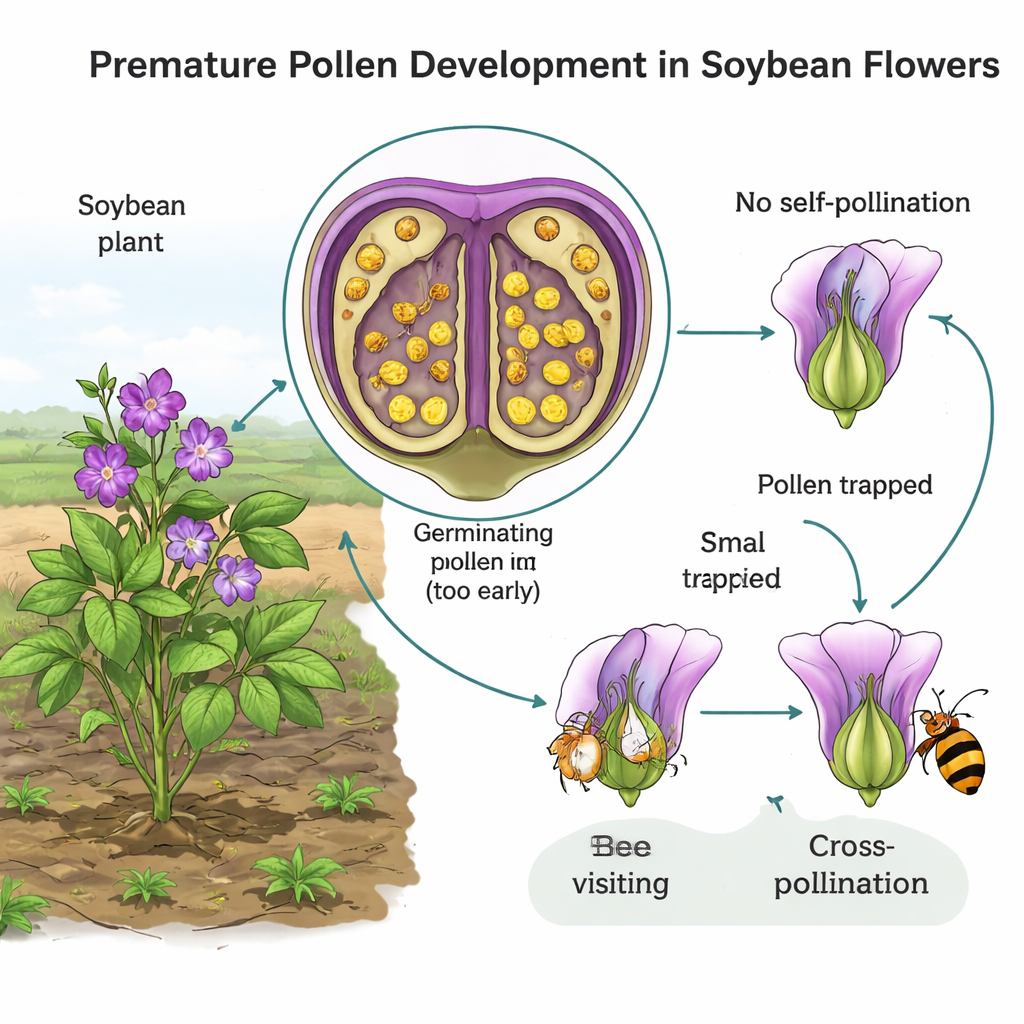
In most flowering plants, pollen grains leave the anther, land on the sticky stigma, and only then germinate and send out tubes that carry the male genetic material toward the ovules. In premature pollen development (PPD), some pollen grains jump the gun: they germinate and start tube growth while still trapped inside the anther. This can shorten their useful life and tangle up the anther’s contents. Although PPD has been seen in several wild plants and crops, including soybean, almost no one has tested what it actually does to pollination and yield in real farm fields.
A real‑world test in Argentine fields
The researchers worked in a 24‑hectare soybean field in central Argentina planted with a single commercial variety. Over four weeks, they monitored insect visits to flowers in 15 plots arranged along a gradient—from areas near honeybee hives to spots close to natural grassland. They collected nearly 500 flowers to examine pollen tubes growing in the flower’s style, a direct sign of successful pollination, and took a closer look at undehisced anthers from 186 flowers to measure how many pollen grains had developed prematurely. Later, they counted seeds in 2,000 pods to see how pollination translated into yield.
Wild insects step in where self‑pollination fails
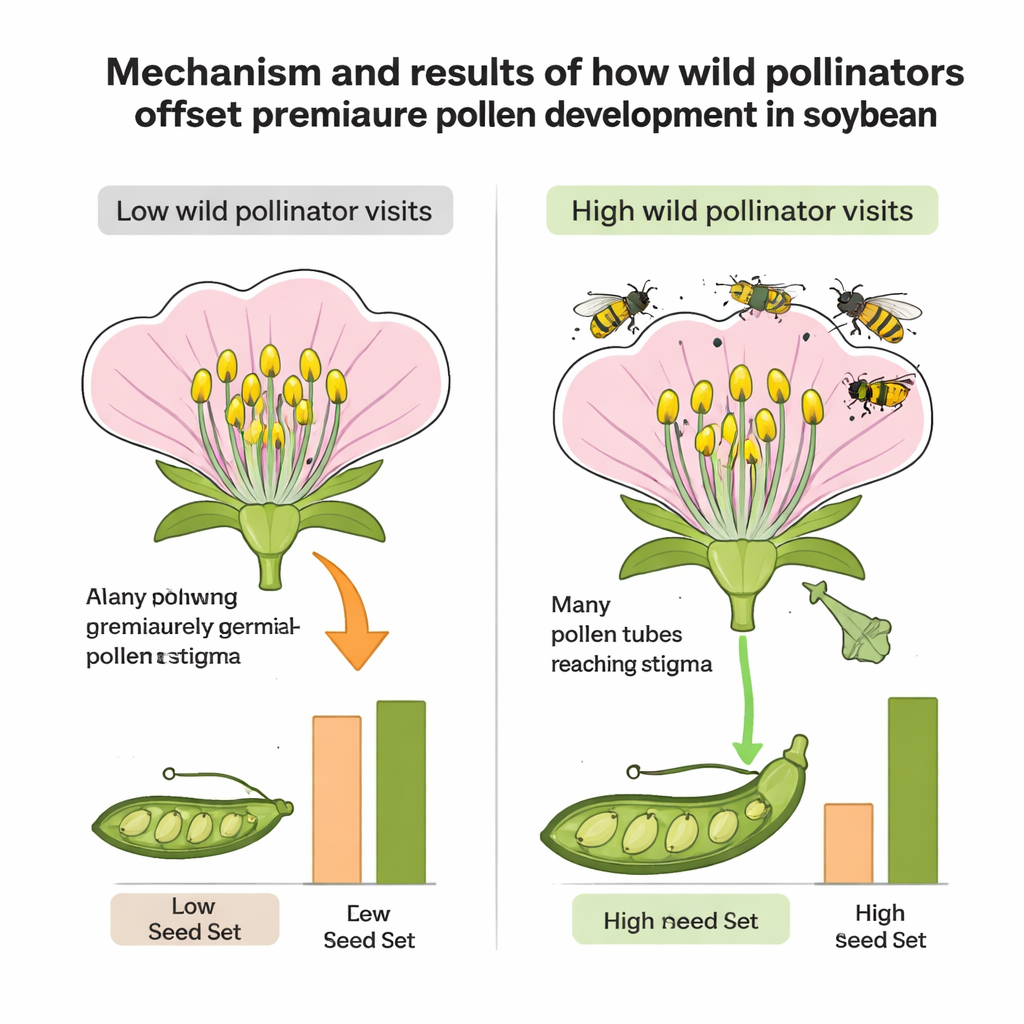
PPD turned out to be common: in some flowers, every counted pollen grain was prematurely germinated. When insect visits by small wild pollinators were rare, flowers with more PPD had far fewer pollen tubes reaching the style. This suggests that early‑germinating pollen can clog the anther and block normal grains from escaping and landing on the stigma, reducing a flower’s ability to fertilize itself. However, as visits by wild insects increased, this pattern flipped. In plots with many wild visitors—small native bees and hoverflies that matched the flower’s size especially well—pollen tube numbers rose even in flowers with heavy PPD. In contrast, managed honeybees, which made most of the recorded visits, did not show a clear relationship with pollen tube numbers.
Seed set, limits, and the pollination safety net
Despite decent average seed set, the study found signs that soybean plants in this field were somewhat short of pollen: plots with more pollen tubes in the style tended to produce a slightly higher fraction of full pods. When the researchers covered plants with mesh to exclude insects, seed set dropped by just over eight percent compared with open‑pollinated plants, proving that insects do boost production—even in a variety considered self‑pollinating. Together, these findings show that PPD can weaken built‑in self‑fertilization, and that wild insects can partially compensate by moving viable pollen between flowers and plants.
What this means for farms and future breeding
The work suggests that PPD, likely rooted in soybean’s evolutionary tendency toward closed, self‑fertilizing flowers and possibly intensified by modern breeding for early flowering, now has an unexpected side effect: it makes the crop more reliant on pollinators than many planners assume. In practice, that means that conserving habitat for wild insects around fields, limiting harmful pesticides, and considering pollinators in soybean breeding and management could help keep yields stable. Even in crops long labeled “autogamous” or self‑sufficient, the fine details of flower biology—and the presence of diverse wild pollinators—can quietly shape how much food we harvest.
Citation: Strelin, M.M., Aizen, M.A. & Cavigliasso, P. Premature pollen development hinders autonomous self-pollination and promotes insect pollination in soybean (Glycine max L.). Sci Rep 16, 5052 (2026). https://doi.org/10.1038/s41598-026-35487-5
Keywords: soybean pollination, premature pollen development, wild pollinators, crop yield, flower biology