Clear Sky Science · en
Drivers and mitigation of nocturnal heat Island propagation in Changsha music cultural districts
Hot Nights in the City
Why do some nightlife streets feel like they never cool down, even long after sunset? This study looks at exactly that question in Changsha, a major city in south-central China that has branded itself a “24-hour vibrant city.” The authors focus on five popular music and entertainment districts—places packed with bars, live houses, and open-air shows—to understand how these hotspots warm the city at night, how that heat spreads, and how smarter design could make evenings more comfortable and safer for residents and visitors.
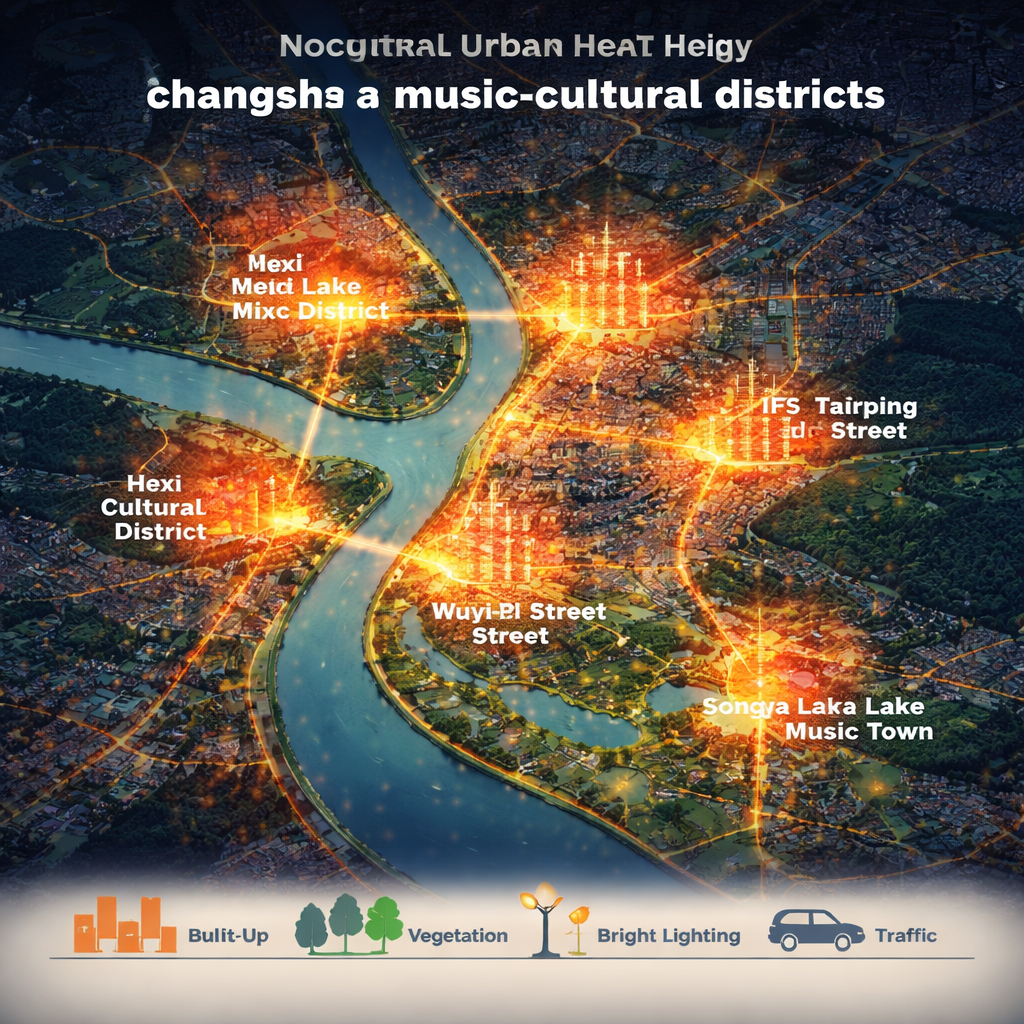
Where Nightlife and Hot Nights Overlap
The researchers treat music-cultural districts as a special kind of nighttime neighborhood. These are not just shopping streets; they are dense clusters of stages, clubs, restaurants, and tourist spots that stay busy from early evening until after midnight. In Changsha, such districts line historic corridors, busy downtown squares, and scenic riverfronts and lakefronts. Because buildings, roads, lights, and crowds all release heat, these areas are ideal for examining how the “urban heat island” effect behaves after dark—when people expect relief from daytime heat, but the city often stays warmest exactly where nightlife is strongest.
Measuring the City’s Nighttime Fever
To track how hot these districts get, the team stitched together multiple kinds of satellite data collected between 2013 and 2024. They fused coarse but frequent night-time temperature readings with sharper, less frequent images, and combined this with information on vegetation, water, building density, and night lights. Using advanced statistical and machine-learning tools, they built detailed nightly temperature maps and teased apart which features most strongly control how heat builds up and spreads. On average, Changsha’s nights warmed by more than 4.5 °C over the study period, with 2022 standing out as the hottest year and clear contrasts emerging between boiling-hot corridors and cooler green and blue (water) areas.
Hot Streets, Cool Islands
The five music-cultural districts showed sharply different “thermal personalities.” Jiefang West Road—an ultra-dense bar and club street—was consistently 1–2 °C hotter than the city average, with strong heat contrasts within just a few blocks. Downtown Wuyi Square–IFS was also warm, but its plazas and scattered greenery took a bit of the edge off. In contrast, river and lake districts such as Orange Island & Fisherman’s Wharf and Meixihu Art Center behaved as “cold islands,” averaging up to about 2–3 °C cooler than surrounding built-up areas thanks to trees and water. Historic Taiping–Pozi sat in the middle: packed and lively, yet moderated by traditional courtyards and preserved greenery. The analysis shows that three ingredients shape night heat most strongly: hard surfaces and dense buildings as the base problem, vegetation and water as natural coolers, and bright lights and heavy traffic as extra heat sources.
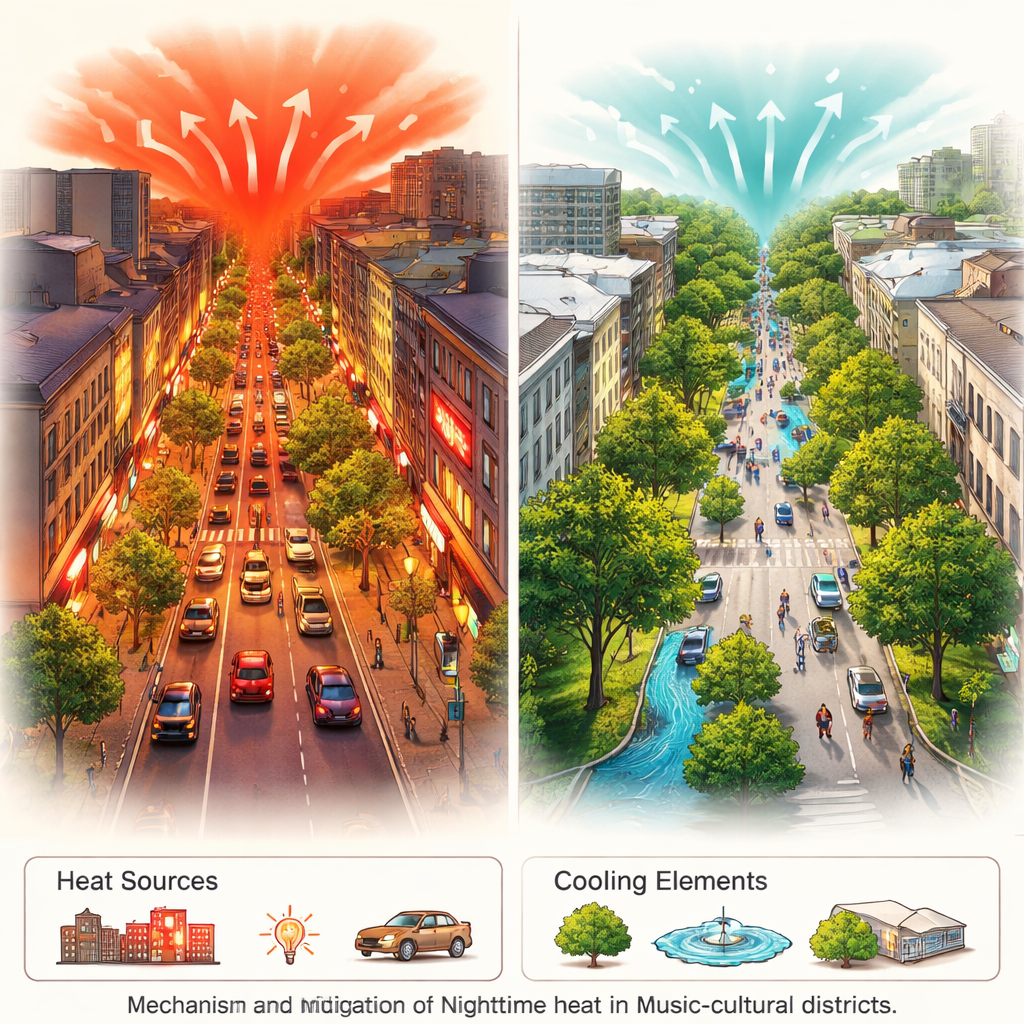
How Heat Spreads from Party Streets
Beyond simple hot and cool spots, the team examined how heat “leaks” outward from nightlife cores. By modeling temperature gradients around each district, they found corridor-like patterns: in places like Jiefang West Road and Wuyi Square–IFS, heat travels along major streets, with temperature dropping by roughly 1.5–4.2 °C per kilometer. The effective influence of a busy nightlife corridor can extend 2–3 km, meaning people living in nearby residential blocks may feel the heat of entertainment zones even if they never go out at night. Large parks and waterfronts, on the other hand, act as buffers. They not only stay cooler themselves but also weaken these heat gradients, slowing the spread of warmth into neighboring areas.
Cooling the Night Without Killing the Vibe
Finally, the researchers tested different “what if” scenarios using their model. Adding more trees and park space in and around nightlife streets delivered the biggest single cooling effect, lowering nighttime temperatures by about 0.7–1.0 °C. Brightening roofs and pavements so they reflect more sunlight, and cutting back late-night traffic, each produced smaller but still meaningful drops. The most effective approach combined all three measures, shrinking heat-diffusion intensity by roughly one-third and cooling some areas by up to 1.8 °C. For a general reader, the takeaway is clear: lively nightlife and comfortable summer evenings do not have to be at odds. With thoughtful planning—more shade and water, reflective surfaces, and gentler traffic and lighting—cities like Changsha can keep their music districts buzzing while reducing nighttime heat stress for everyone who lives, works, or plays nearby.
Citation: Xie, S., Long, T. & Huang, M. Drivers and mitigation of nocturnal heat Island propagation in Changsha music cultural districts. Sci Rep 16, 4967 (2026). https://doi.org/10.1038/s41598-026-35486-6
Keywords: urban heat island, nighttime economy, music districts, green-blue infrastructure, heat mitigation