Clear Sky Science · en
Early neurophysiological signatures of multi-digit number length encoding
Why the length of numbers matters to your brain
When you glance at numbers like 30 and 300, you instantly know which is larger—not just because of the digits, but also because 300 looks longer. This study asks a deceptively simple question: does your brain pick up on the length of multi-digit numbers almost immediately, even before it fully works out their value? By recording brain activity while people compared numbers, the researchers show that our minds use the visual length of numbers as a fast shortcut to meaning.
How our number system ties length to size
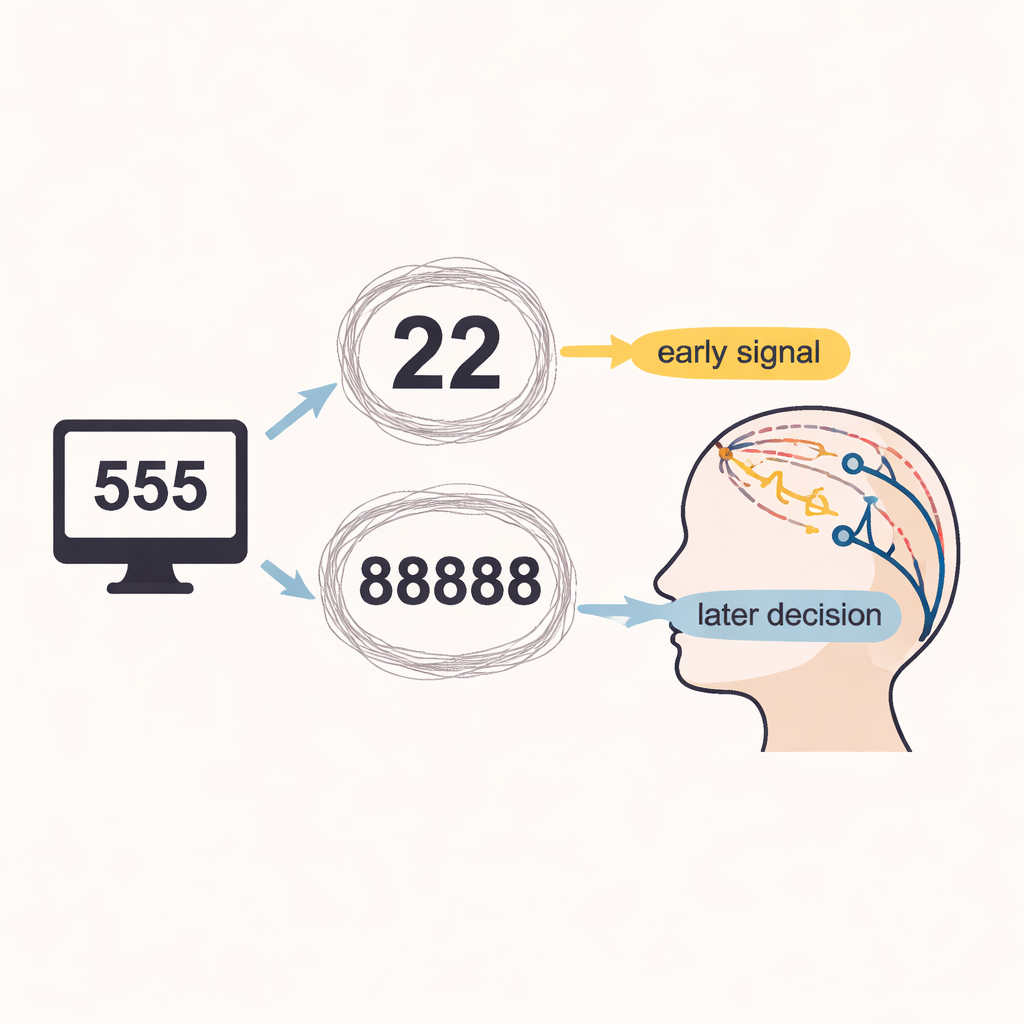
In the familiar Hindu–Arabic number system, the position of each digit matters: adding a digit usually means jumping to a much larger quantity (30 vs. 300, 555 vs. 88888). That means the physical length of a number string reliably hints at its magnitude. Earlier theories of how we read multi-digit numbers disagree on whether we treat each number as a whole ("555" as one unit) or break it into separate digits. Newer, hybrid ideas suggest we do both at once: the brain evaluates overall size and individual digits in parallel. This study builds on that view and asks when, in time, the brain first registers number length, and how that early information shapes later decisions.
Two tasks that pull number length and value apart
To separate visual appearance from meaning, the researchers ran two experiments while recording electrical signals from the scalp (EEG). In both, people compared a changing target number to a remembered standard, "555." The targets were "tie" numbers made of a single repeated digit, such as 22, 4444, or 88888, and could be shorter or longer than 555. Crucially, each number was surrounded by random scribbled lines so that short and long numbers took up the same overall space on the screen. In Experiment 1, volunteers judged whether the repeated digit in the target (for example, 2 in 2222) was smaller or larger than 5, and were told to ignore how long the number looked. In Experiment 2, they did the opposite: they judged whether the target number was physically shorter or longer than 555, ignoring which digit it contained.
Fast brain signals for number length and distance
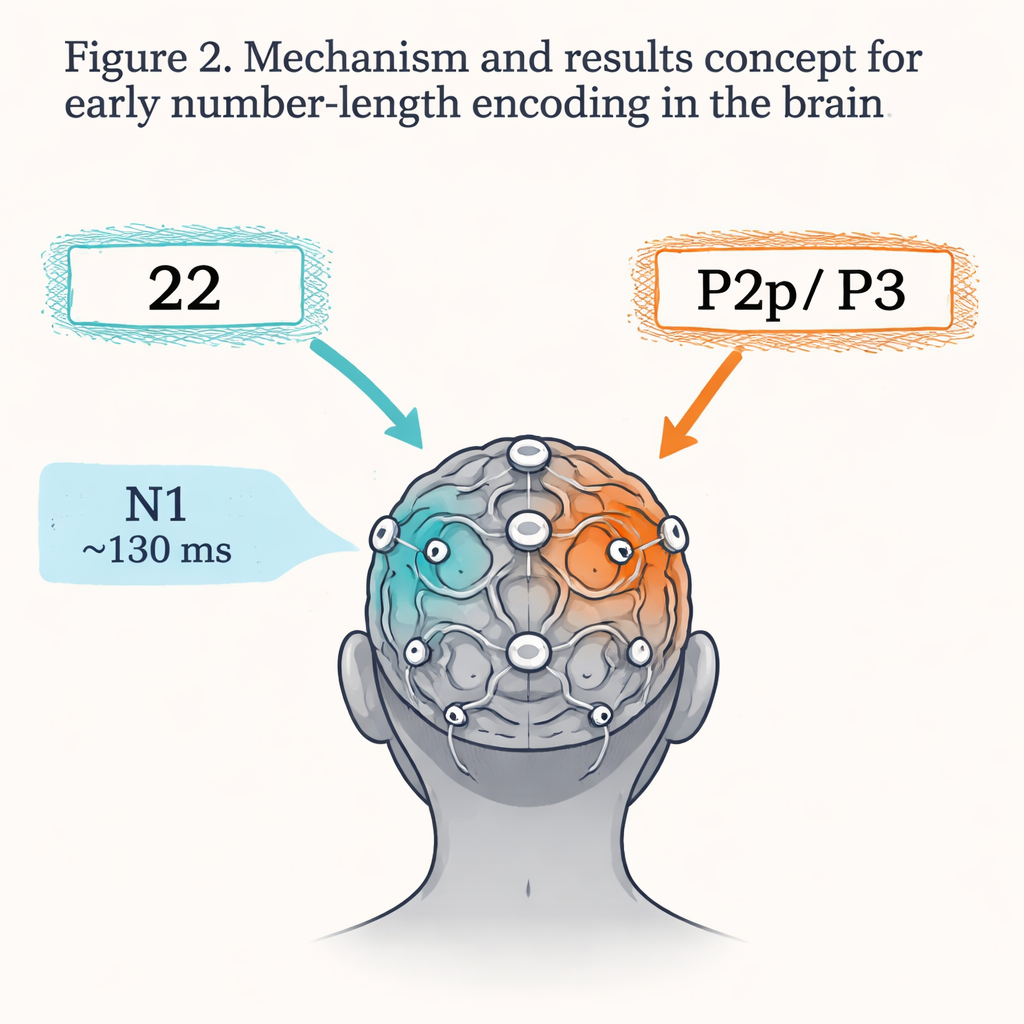
The EEG recordings revealed three distinct stages of processing. Within about 120–150 thousandths of a second after a number appeared, a component called N1, strongest over the back of the head, became more negative for longer numbers than for shorter ones—even though the scribbled frames kept their overall size identical. This shows that the brain is encoding number length itself, not just raw visual area, at a very early perceptual stage. A little later, around 150–190 milliseconds, a positive component called P2p reflected how far the target number was from 555 in numerical terms: numbers closer in value produced different responses from those further away, indicating a more refined "how much bigger or smaller?" comparison.
When conflict between length and value shows up
A third brain signal, the P3 component around 300–360 milliseconds, reflected how the brain resolves conflicts between what the digits say and what the length suggests. When people focused on digit value (Experiment 1), they responded more slowly and showed reduced P3 activity when the longer number actually contained the smaller digit (for example, 4444 vs. 555). This indicates extra effort to overcome misleading length cues. But when people focused on physical length (Experiment 2), this conflict signal largely disappeared, implying that obvious length differences can dominate so strongly that digit meaning barely interferes. Together, these patterns support the idea that a quick, rough "which is bigger?" process based on length runs alongside a slower, more precise analysis of exact numerical distance.
What this means for everyday number sense
For a lay reader, the key message is that your brain does not wait to carefully read every digit before forming a sense of numerical size. Instead, it very quickly picks up simple visual cues—like how many digits there are—and uses them as a shortcut to magnitude, refining this estimate later and resolving conflicts only when necessary. This early sensitivity to number length shows how deeply our writing system for numbers shapes the way we think about quantity, with implications for how we teach multi-digit numbers and how we understand difficulties in learning math.
Citation: Neumann, N., Pinhas, M. Early neurophysiological signatures of multi-digit number length encoding. Sci Rep 16, 5869 (2026). https://doi.org/10.1038/s41598-026-35478-6
Keywords: numerical cognition, multi-digit numbers, brain signals, EEG, magnitude comparison