Clear Sky Science · en
Preparation and characterization of typical potassium salt dry water and its fire extinguishing performance
Safer Ways to Put Out Everyday Fires
Household and warehouse fires often start in ordinary things such as furniture, pallets and construction wood, yet putting them out quickly and cleanly is still a challenge. Many highly effective fire extinguishers used in the past can damage the environment, while others leave behind choking dust or fail to stop slow, hidden burning deep inside the fuel. This study explores a new kind of "dry water" made with potassium salts that aims to combine the cooling power of water, the reach of a powder, and a cleaner environmental footprint.
A Strange Material That Is Mostly Water
"Dry water" sounds like a contradiction, but it is really tiny droplets of water wrapped in a fine shell of water-repelling silica powder. To the eye and to the touch, the material behaves like a free-flowing, soft powder, even though more than 90 percent of it is actually liquid. The researchers first worked out how to make these particles reliably: by vigorously mixing deionized water with hydrophobic (water-hating) silica at a specific speed and time so that the liquid is torn into many small droplets and immediately coated. They then dissolved different potassium salts in the water before coating it, and in some cases added a plant-based cold-setting gel that helps the particles hold their shape under pressure. 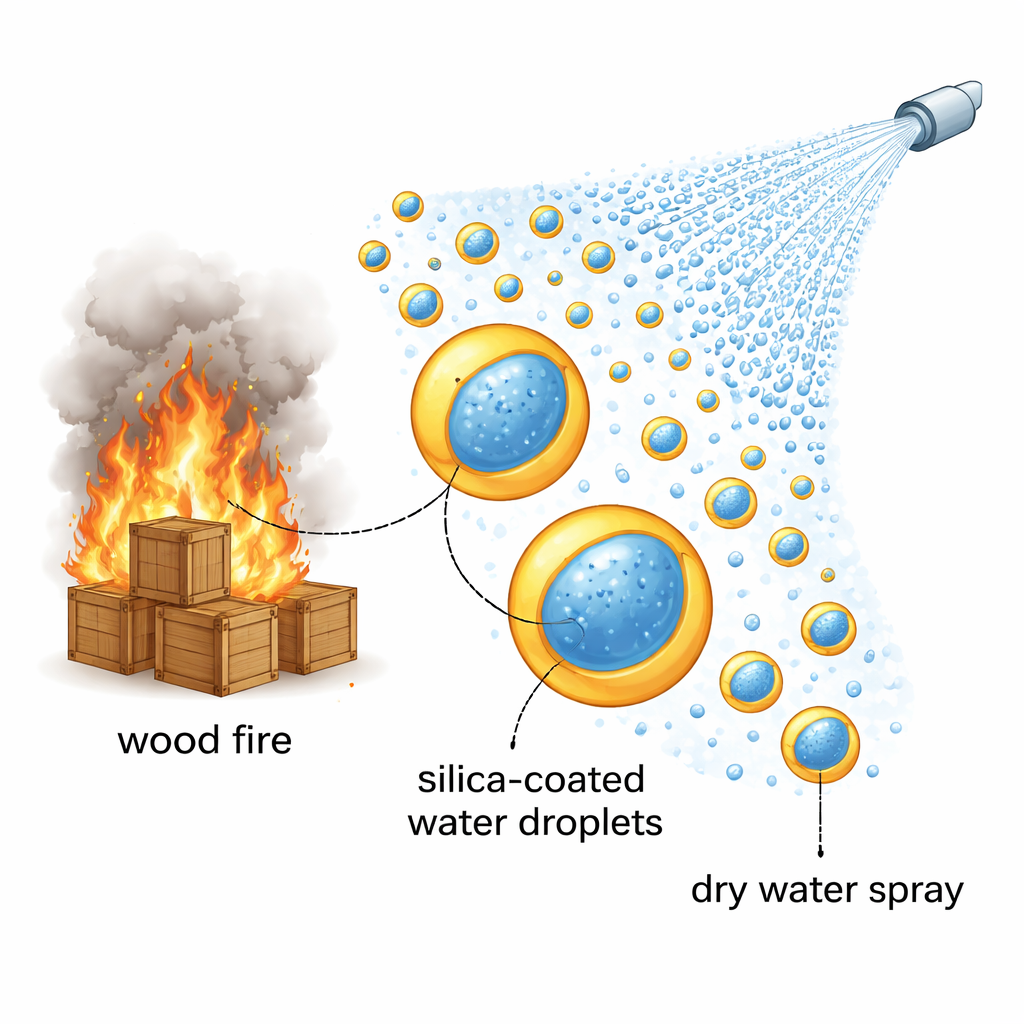
Building Stronger, Easier-Flowing Particles
Using powerful microscopes, the team observed that the dry water particles are roughly spherical with a rough, bumpy outer shell formed by the silica. When the cold-setting gel was included, the particles tended to be a bit larger, but they also survived high pressure much better: instead of being squeezed back into liquid, they compressed slightly and kept their structure. Measurements of particle size and how easily the powder flows showed that well-made dry water has a narrow, uniform size range and slides much like fine sand. This balance is important because the material must both travel smoothly through pipes and nozzles and also stay intact long enough to reach the heart of a fire.
Putting Dry Water to the Test on Wood Fires
To see how these powders behave in real flames, the scientists built a test rig with stacked pine strips, a fuel pan to ignite them, and several thermocouples and an infrared camera to monitor temperatures. They compared four versions: plain dry water and dry waters made with three different potassium salts—potassium acetate, potassium chloride, and potassium dihydrogen phosphate—with the gel added for strength. Under a standard pressure of nitrogen gas, each agent was sprayed onto fully developed wood fires. In every case the flames were knocked down and temperatures in and above the wood dropped below 100 °C within two minutes, showing that all of the powders can put out this kind of fire.
Why Potassium Acetate Works Best
Although all four materials could extinguish the fires, the one based on potassium acetate (CH3COOK) stood out. It cooled the hottest part of the flames faster and required the least mass of agent to do the job. Detailed tests suggest several reasons. First, when the particles hit the fire, some burst and release fine droplets that quickly evaporate, soaking up large amounts of heat and helping to smother the flames with steam and nitrogen gas. Second, the intact particles blanket the wood in a porous silica layer that slows fresh air from reaching the fuel. Third, at flame temperatures above 700 °C, the potassium acetate breaks down to form potassium hydroxide gas, which reacts with the reactive fragments inside the flame and interrupts the chain reactions that keep it burning. 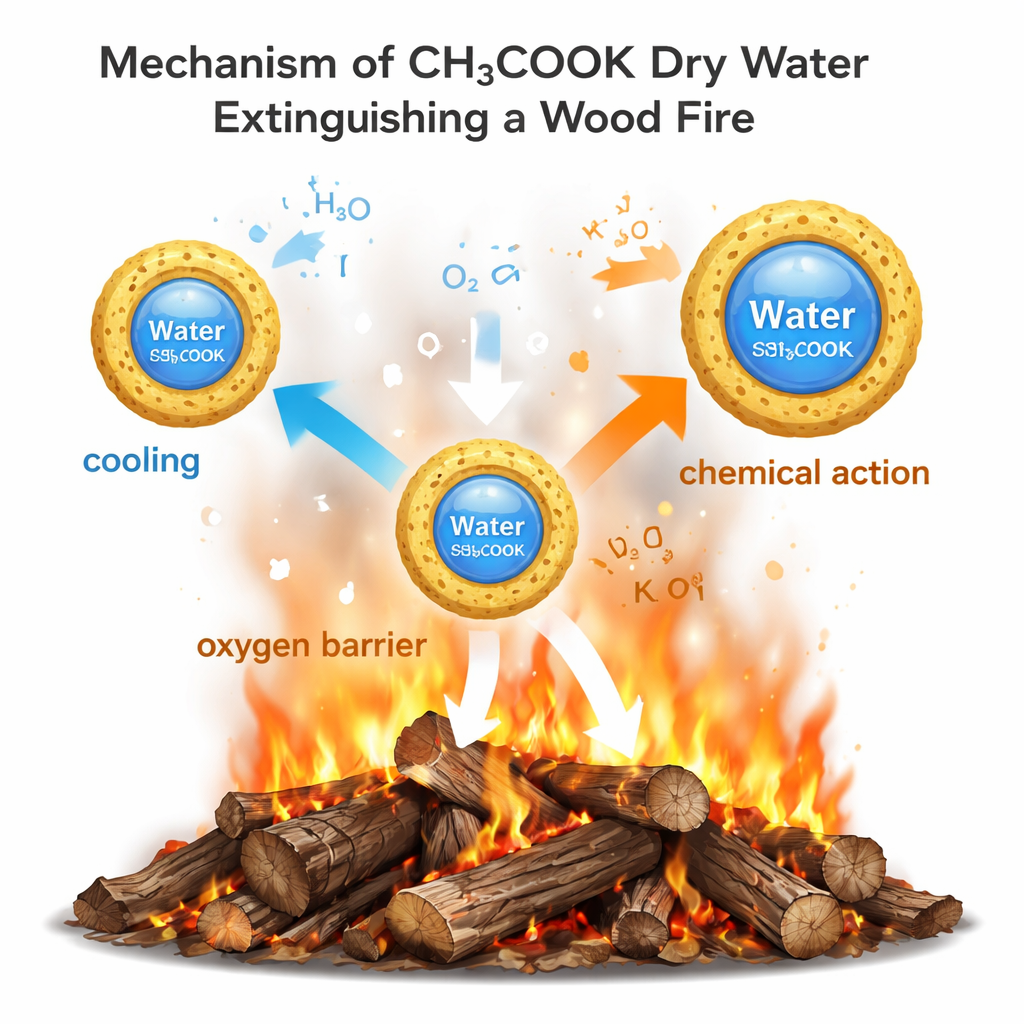
A Cleaner, More Versatile Fire Suppressant
For non-specialists, the key message is that this potassium acetate dry water behaves like a smart hybrid between water and dry powder. It flows and sprays like a powder, but it cools like water and also uses simple, well-known chemicals to interfere with the flame itself. Because it is mostly water and silica, with potassium compounds that are far less harmful to the atmosphere than traditional halon agents, it holds promise as a cleaner option for tackling fires in wood and other everyday solids, especially where both open flames and deep, slow-burning embers must be brought under control.
Citation: Yaoyong, Y., Quan, W., Yingkang, Y. et al. Preparation and characterization of typical potassium salt dry water and its fire extinguishing performance. Sci Rep 16, 6420 (2026). https://doi.org/10.1038/s41598-026-35477-7
Keywords: fire suppression, dry water, potassium salts, wood fires, green firefighting agent