Clear Sky Science · en
Integrative analysis of plasma small-molecule and gut-microbiome markers of sarcopenia in a pilot study within an Indian cohort
Why muscle loss in aging bodies matters
As people live longer, staying strong enough to walk, climb stairs, and live independently becomes just as important as avoiding disease. This study looks at sarcopenia—the age-related loss of muscle strength and mass—through a new lens. Instead of focusing only on exercise and diet, the researchers examined tiny molecules in the blood and the trillions of bacteria in the gut to see how they might signal, or even help drive, muscle decline in older adults in India.
Connecting muscle strength, blood tests, and daily function
The team followed 40 older adults in Bangalore, aged 60 to 87, and carefully grouped them into those with and without sarcopenia using widely accepted clinical rules. They measured how hard people could squeeze a hand grip device, how quickly they could rise from a chair, and how much muscle they had on abdominal scans. They also recorded basic blood counts and health history. A simple measure—dominant hand grip strength—turned out to be the single best clinical indicator of sarcopenia in this group, closely matching international standards. People with weaker grip strength also tended to show more signs of frailty, such as slower chair rise times, smaller muscle area on scans, and more health problems like fractures and high blood pressure. 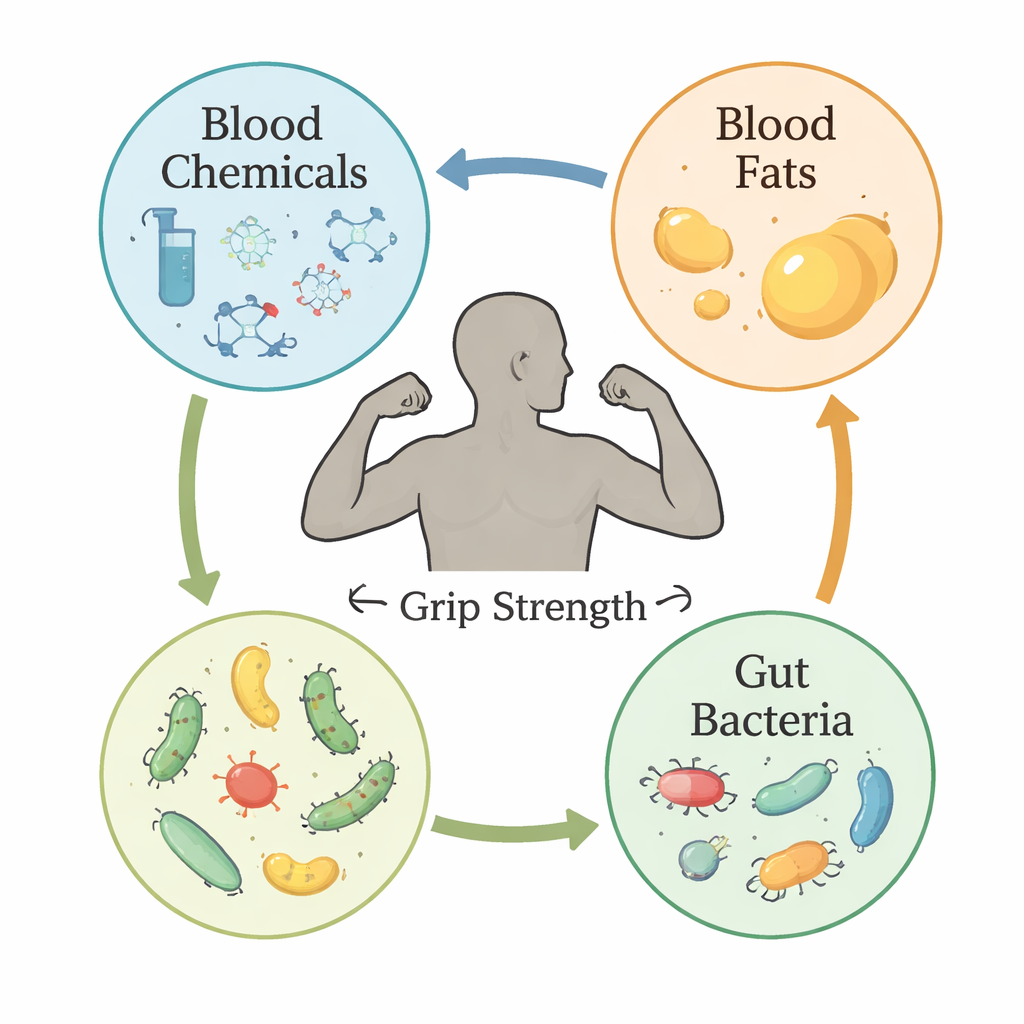
Hidden stories in blood chemicals and fats
Beyond these routine tests, the researchers used advanced mass spectrometry tools to profile more than 300 small molecules and nearly 300 types of fats circulating in the blood. They found 24 small molecules and 13 fat species that differed between people with and without sarcopenia. Several of these differences pointed toward ongoing, body-wide inflammation and stressed metabolism. For example, arachidonic acid—a fat that feeds the body’s production of inflammatory messengers—was higher in those with weaker muscles and tracked closely with an inflammatory blood marker called the neutrophil-to-lymphocyte ratio. Certain amino acids, vitamin-related molecules, and a compound called spermidine, which supports cellular clean-up processes, were also altered. Using machine learning, the team built a 16-molecule panel that could classify people as sarcopenic or not with about 89% accuracy, though they caution this result needs to be tested in larger groups.
The gut–muscle connection and microbial fingerprints
The investigators also analyzed the gut microbiome by sequencing bacterial DNA in stool samples. When they compared all sarcopenic participants as a single group to those without sarcopenia, the overall bacterial mix did not clearly separate the two. But a closer look revealed two distinct sarcopenia subgroups. One subgroup (G1) had a markedly disturbed microbiome, with fewer helpful, butyrate-producing bacteria and more species linked to inflammation and infection. These participants were typically older and showed higher inflammation and weaker muscles. The second subgroup (G2) had a gut community more similar to healthier controls, suggesting that not all muscle loss in aging is tied to severe microbiome disruption. 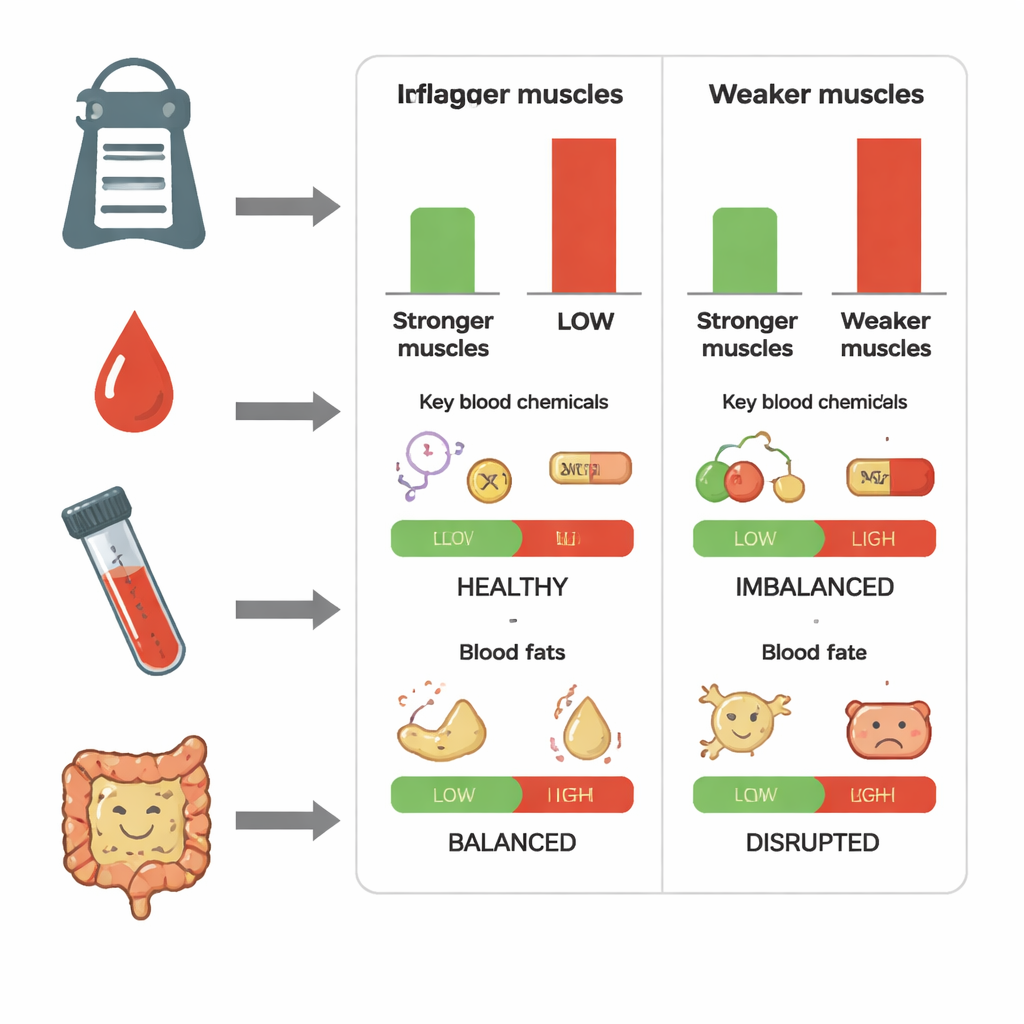
How microbes and molecules may talk to muscle
By layering the microbiome and blood data, the researchers identified 54 bacterial taxa that tracked with at least two of the sarcopenia-linked blood molecules. Some microbes were positively tied to spermidine, while others were inversely related to plant-derived molecules such as karanjin, which was more abundant in non-sarcopenic participants and likely reflects diet. This pattern hints at a gut–muscle axis in which intestinal bacteria shape the availability of protective or harmful compounds circulating in the body. Different microbial communities sometimes produced similar chemical fingerprints, a phenomenon known as functional redundancy, suggesting that what bacteria do may matter more than their exact names.
What this means for healthy aging
For a lay reader, the main message is that muscle health in later life is not just about how much you move; it is tightly intertwined with low-grade inflammation, the mix of chemicals and fats in your blood, and the health of your gut microbes. This small pilot study in an Indian cohort cannot yet deliver definitive diagnostic tests or prove cause and effect, but it outlines a roadmap. Simple tools like hand grip strength and a few routine blood markers could flag people at risk, while more detailed "multi-omics" profiles—linking blood chemistry and gut bacteria—may eventually help doctors pinpoint which older adults are most vulnerable and why. With validation in larger, diverse populations, such integrated markers could guide personalized strategies to preserve strength, independence, and quality of life as we age.
Citation: Hashmi, M.A., Verma, S., Math, R.G.H. et al. Integrative analysis of plasma small-molecule and gut-microbiome markers of sarcopenia in a pilot study within an Indian cohort. Sci Rep 16, 5602 (2026). https://doi.org/10.1038/s41598-026-35476-8
Keywords: sarcopenia, gut microbiome, metabolomics, healthy aging, inflammation