Clear Sky Science · en
Effect of nitrogen radio frequency plasma on the structure, dielectric anisotropy, and electrical performance of liquid crystal nanocomposite
Smart materials behind our screens
From flat‑panel TVs to phone displays and emerging flexible sensors, many modern gadgets rely on liquid crystals—fluids whose molecules prefer to line up like tiny compass needles. This study explores a new way to fine‑tune how such materials respond to electricity by gently “polishing” added nanoparticles with a glow of nitrogen plasma. The findings suggest a simple knob—plasma exposure time—that could help engineers build faster, more efficient displays and soft electronic devices.
Why tweak liquid crystals at all?
Liquid crystals are unusual because they flow like a liquid yet maintain a preferred molecular direction, which gives them direction‑dependent electrical behavior. How strongly they react along or across this direction controls how quickly and cleanly a pixel can switch on and off, or how sensitively a sensor responds. One common strategy to improve this behavior is to sprinkle in metal‑oxide nanoparticles. These tiny, solid inclusions can help the liquid crystal molecules line up more firmly and can change how electric charges move through the material—without destroying the delicate liquid‑crystal state.
Giving nanoparticles a gentle plasma makeover
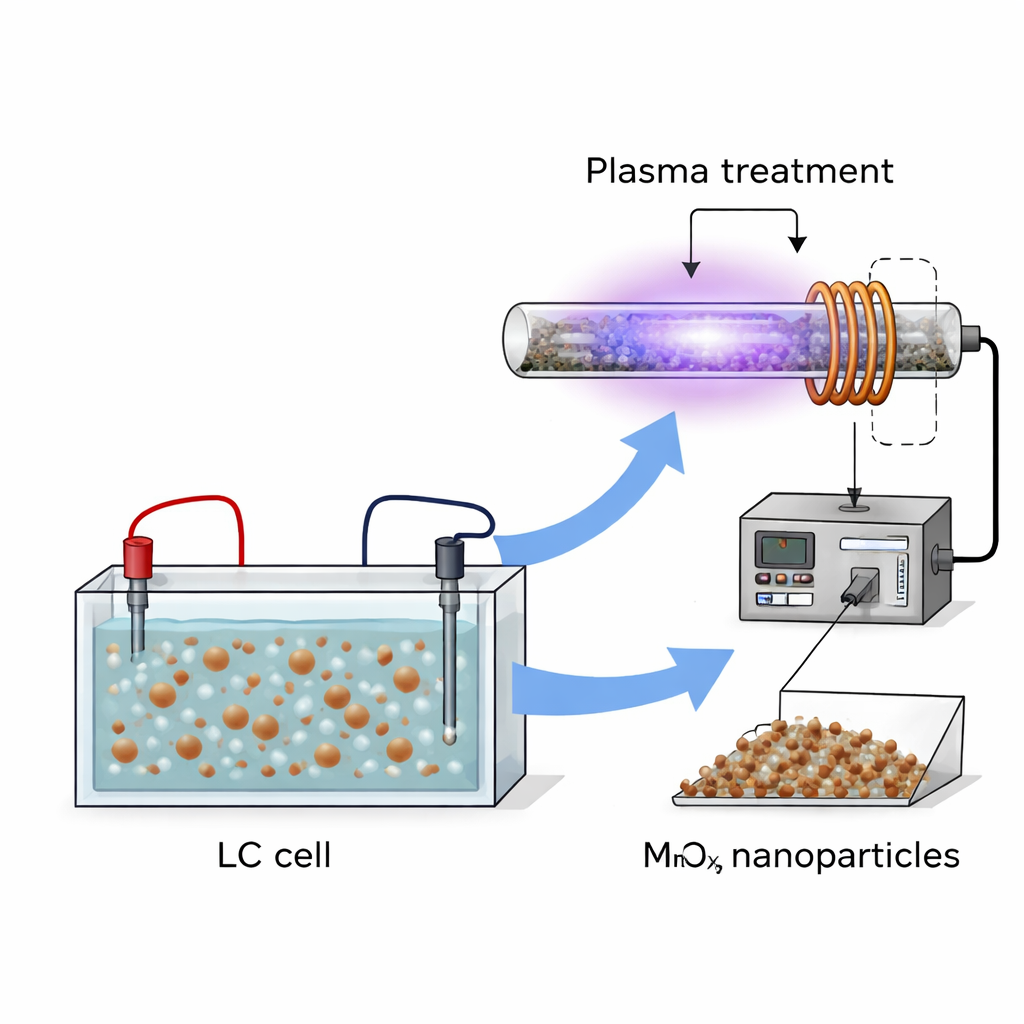
The researchers focused on manganese(III) oxide nanoparticles mixed into a commercial nematic liquid crystal at a low concentration. Before mixing, they exposed the nanoparticles to a low‑temperature nitrogen radio‑frequency plasma for carefully controlled times: 0 (untreated), 2, 7, or 14 minutes. Plasma is often called the “fourth state of matter”—a gas filled with energetic ions and electrons. Here it was used not to melt or etch the particles, but to subtly modify their surfaces, adding active sites while keeping their crystal structure intact. The treated particles were then dispersed into liquid‑crystal cells designed so that the team could measure how the material responded to electric fields in different directions, across a sweep of temperatures and frequencies.
Finding the sweet spot for alignment
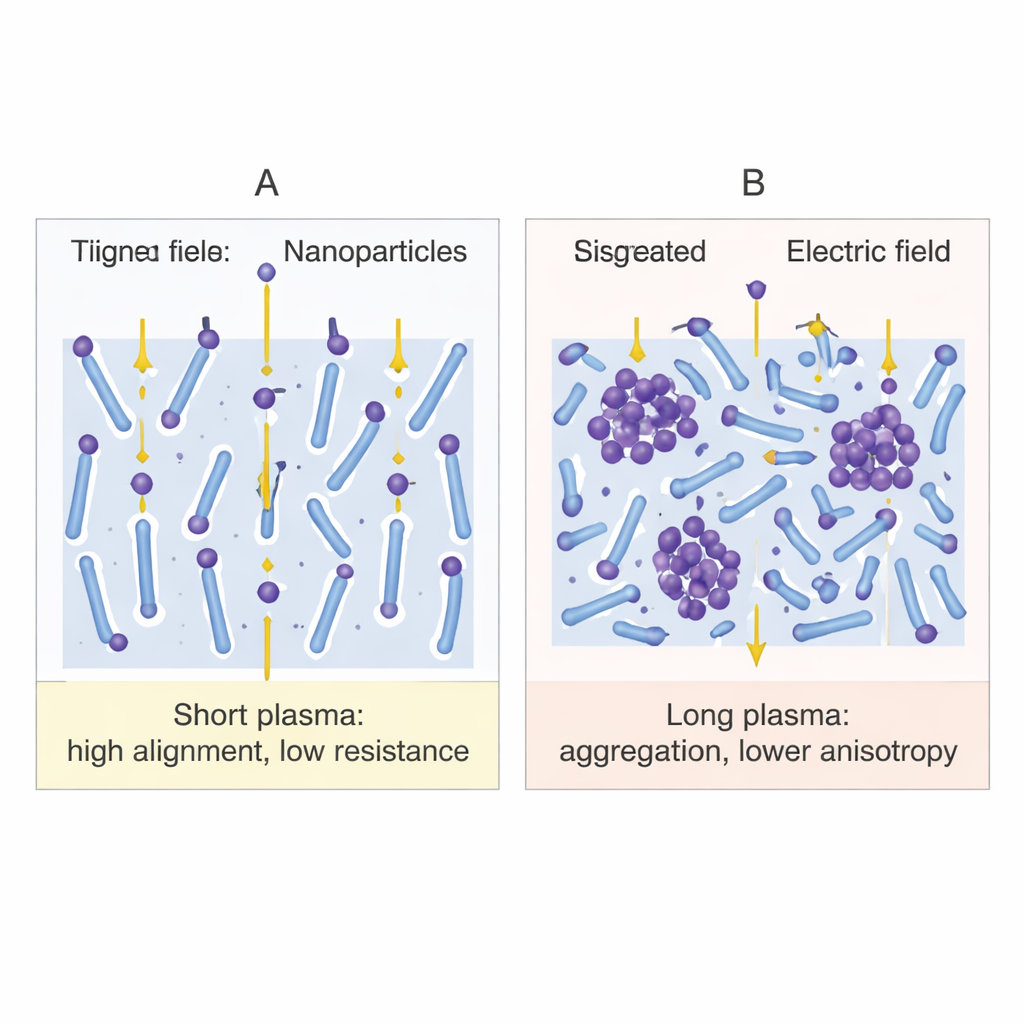
Measurements showed that the liquid crystal’s ability to respond differently along and across its preferred direction—its dielectric anisotropy—depended strongly on how long the nanoparticles had been exposed to plasma. A brief, 2‑minute treatment gave the best results: nanoparticles were better dispersed, their surfaces more compatible with the surrounding molecules, and the liquid crystal alignment became more orderly. As temperature changed, the difference between the “along” and “across” responses grew larger for this sample, which is good news for precise electro‑optical control. When the plasma exposure was pushed to 7 or 14 minutes, however, the particles began to clump together. These aggregates disturbed the orderly molecular arrangement, shrinking the useful directional contrast that devices rely on.
How electrical signals travel through the mixture
The team also examined how easily alternating electric currents passed through the different samples—both in terms of overall resistance and how charges piled up and relaxed at interfaces. Across a wide frequency range, they found that, as expected, the material’s ability to store electrical energy dropped at higher frequencies, and energy losses declined as well. Crucially, plasma‑treated nanoparticles changed these trends. Short plasma exposure lowered the effective resistance of the liquid‑crystal mixture and enhanced the subtle charge build‑up at boundaries, making the material more responsive without excessive loss. Longer treatment altered these benefits, again likely because of particle aggregation, leading to less favorable pathways for charge transport.
From lab insight to everyday devices
In plain terms, the study shows that a short, carefully controlled plasma “tune‑up” of nanoparticles can make a nanoparticle‑doped liquid crystal both more directional and more electrically efficient. Too little treatment leaves the particles less helpful; too much causes them to clump and spoil the order. By identifying this sweet spot, the work points to a practical route for designing next‑generation displays and soft electronic components that switch faster, waste less energy, and can be tailored simply by adjusting a few minutes of plasma exposure.
Citation: Khadem Sadigh, M., Daneshfar, A., Sayyar, Z. et al. Effect of nitrogen radio frequency plasma on the structure, dielectric anisotropy, and electrical performance of liquid crystal nanocomposite. Sci Rep 16, 4881 (2026). https://doi.org/10.1038/s41598-026-35474-w
Keywords: liquid crystals, nanoparticles, plasma treatment, electro-optical devices, dielectric anisotropy