Clear Sky Science · en
Investigation of 50 temperature-based models for estimating potential evapotranspiration (PET) in a semi-arid region
Why Water Loss to the Air Matters
In dry farming regions, every drop of water counts. Yet crops quietly lose enormous amounts of moisture back to the air through a combined process of evaporation from soil and transpiration from leaves. Knowing how fast this loss occurs—called potential evapotranspiration—is crucial for deciding when and how much to irrigate. The study summarized here asks a simple but pressing question for semi-arid parts of India: can farmers and planners reliably estimate this water loss using only basic temperature and humidity readings, instead of expensive, data-hungry weather instruments?
Measuring Thirst in a Dry Landscape
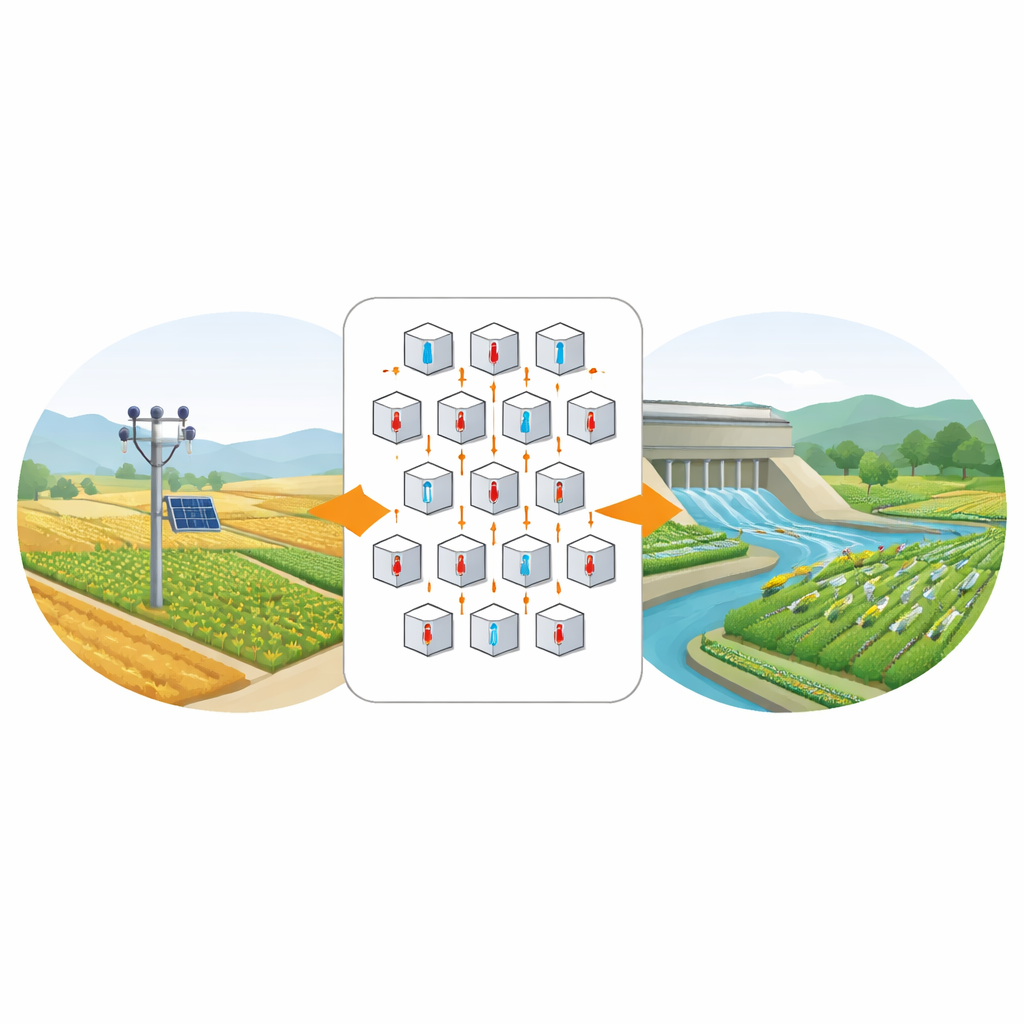
The researchers focused on Lalgudi Taluk in Tamil Nadu, a semi-arid region with hot summers, modest winds, and relatively low humidity. Over ten years, from 2005 to 2014, they collected routine weather data from an agricultural college observatory—maximum and minimum temperature, humidity, sunshine, wind speed, and rainfall. Using these records, they first calculated a reference measure of crop water demand with a detailed formula recommended by the UN’s Food and Agriculture Organization, known as FAO56 Penman–Monteith. This method is widely considered the gold standard but needs many different weather inputs, which are often missing in rural stations.
Putting 50 Shortcuts to the Test
To find simpler alternatives, the team assembled 50 published shortcuts, or empirical models, that estimate potential evapotranspiration using mostly temperature and, in some cases, humidity. Thirty-seven models relied only on temperature, while thirteen also included humidity-related terms. All of them were re-created in a consistent computer environment and fed with the same daily weather data. The scientists then compared each model’s output to the gold standard, checking not only how closely values lined up day by day, but also whether the models captured the overall seasonal pattern and long-term average water demand.
Scoring the Winners and Losers
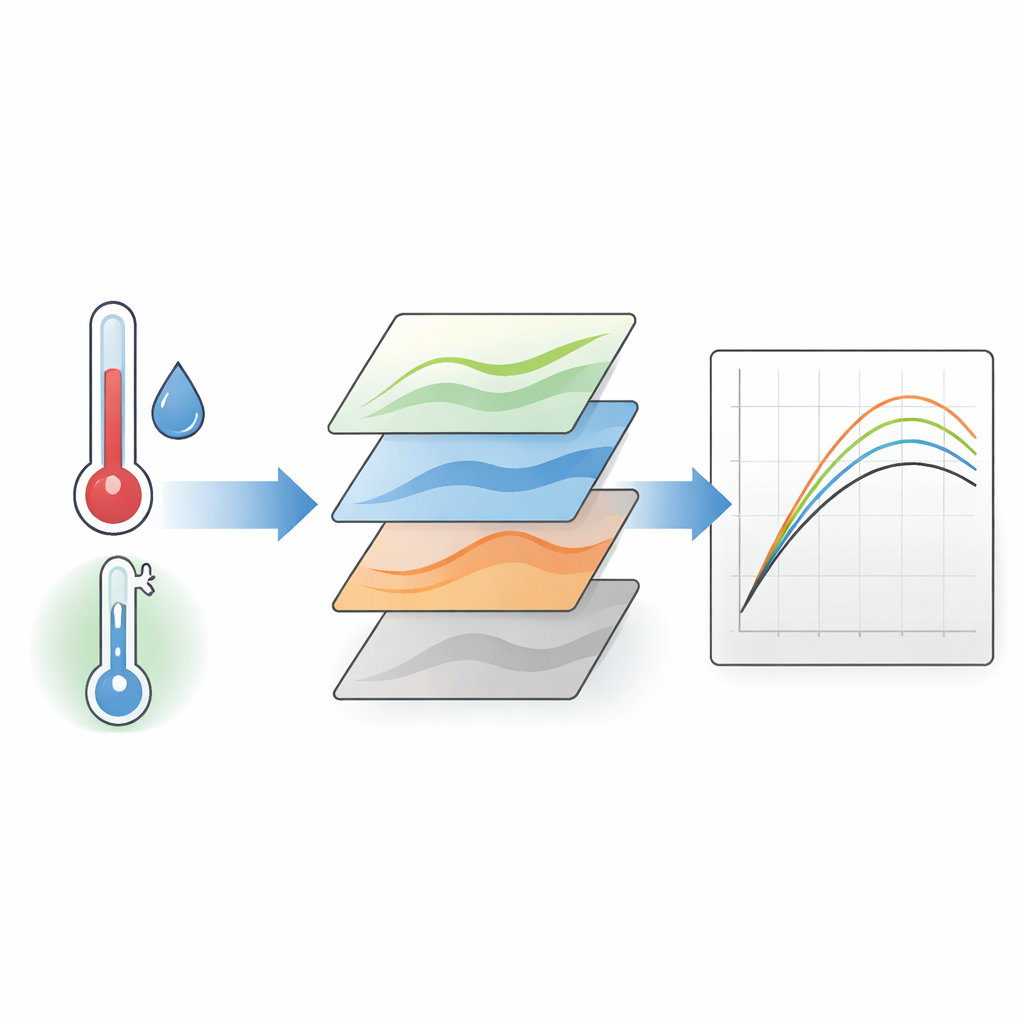
Rather than judging by a single score, the study used several complementary yardsticks. These included how tightly each model tracked the benchmark, how large its typical error was, whether it tended to consistently over- or underestimate water demand, and how its long-term average compared with the reference. To combine these measures fairly, the authors created a standardized ranking index that scales performance between 0 and 1. A few models stood out: one proposed by Althoff and colleagues, along with versions from Pereira and Pruitt and from Samani, provided the best balance of accuracy and simplicity. They followed the rise and fall of seasonal water demand in the semi-arid climate while keeping errors small and long-term totals close to the benchmark.
Limits of Humidity and Older Rules of Thumb
Not all shortcuts worked well. Some traditional formulas, long used in irrigation planning, either overstated water needs—risking wasted water and energy—or understated them, which could leave crops stressed. Surprisingly, models that added humidity did not automatically outperform temperature-only approaches. In this particular dry region, air moisture changes less than temperature and sunlight, so humidity-focused equations sometimes misread the true drivers of water loss. The study also showed that several methods developed for other climates, such as cool or very humid areas, struggled when applied directly to the hot, semi-arid conditions of southern India without local adjustment.
What This Means for Farmers and Planners
For those managing water in data-scarce, semi-arid regions, the message is practical and hopeful. The work shows that carefully chosen, temperature-based formulas can stand in for more complex methods when only simple weather records are available. In particular, the Althoff, Pereira and Pruitt, and Samani models emerged as strong candidates for guiding irrigation schedules and long-term water budgeting in this part of India. At the same time, the study warns against blindly applying any one "rule of thumb" everywhere. Local testing and, where possible, fine-tuning remain essential. Looking ahead, the authors argue that blending temperature with other influences such as sunlight, wind, and even machine-learning tools could further sharpen estimates, helping dryland agriculture make the most of limited water supplies.
Citation: Ramachandran, J., Rashwin, A.A., Arunadevi, K. et al. Investigation of 50 temperature-based models for estimating potential evapotranspiration (PET) in a semi-arid region. Sci Rep 16, 7879 (2026). https://doi.org/10.1038/s41598-026-35472-y
Keywords: evapotranspiration, irrigation, semi-arid agriculture, climate data, water management