Clear Sky Science · en
Chemical activation of kaolin-based clay bricks as a sustainable route to enhanced mechanical and thermophysical properties
Why better bricks matter
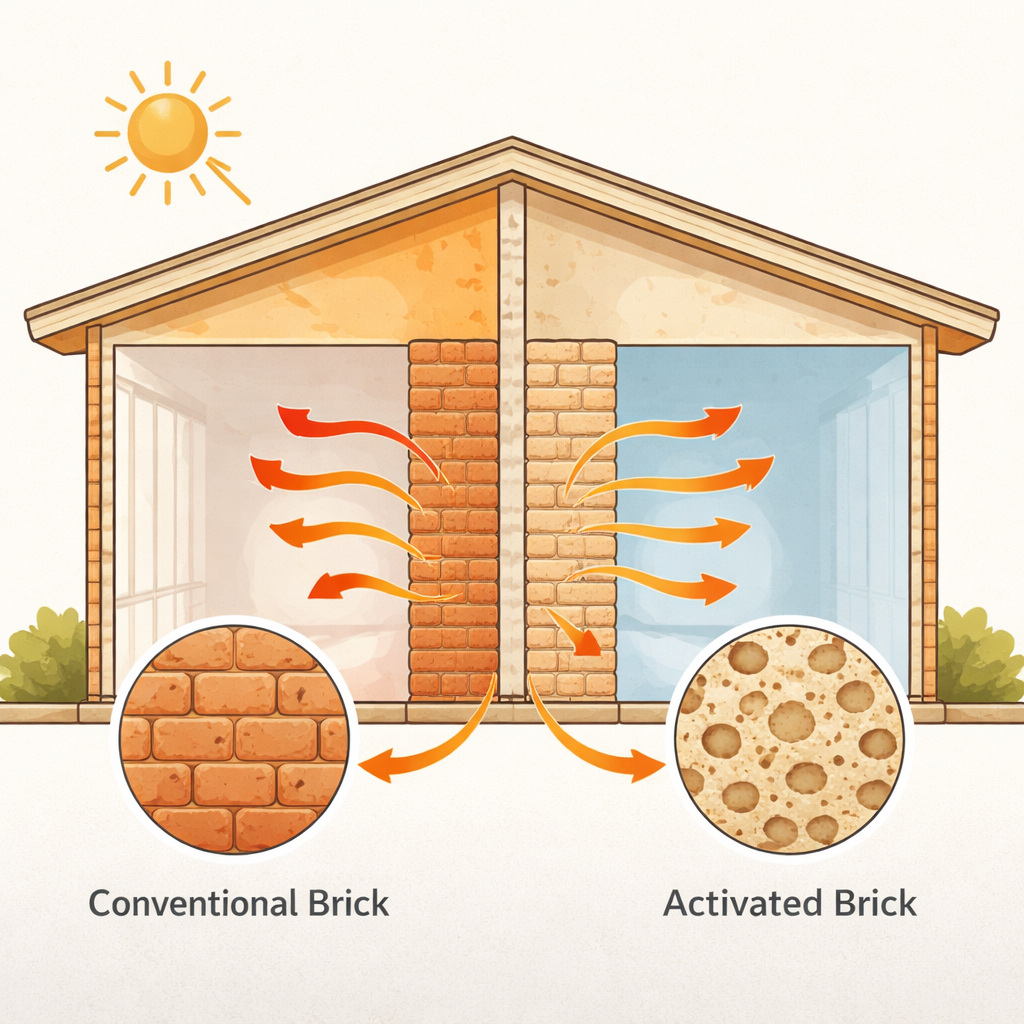
In hot regions, especially places like Upper Egypt, keeping buildings cool often means running air conditioners for many hours a day. That uses a lot of electricity and produces carbon emissions. This study explores a different approach: redesigning the humble clay brick itself so that walls naturally block more heat. By tweaking the clay with a common white mineral called kaolin and carefully using everyday acids, the researchers created bricks that insulate better while still being strong enough for construction.
Turning common clays into smarter materials
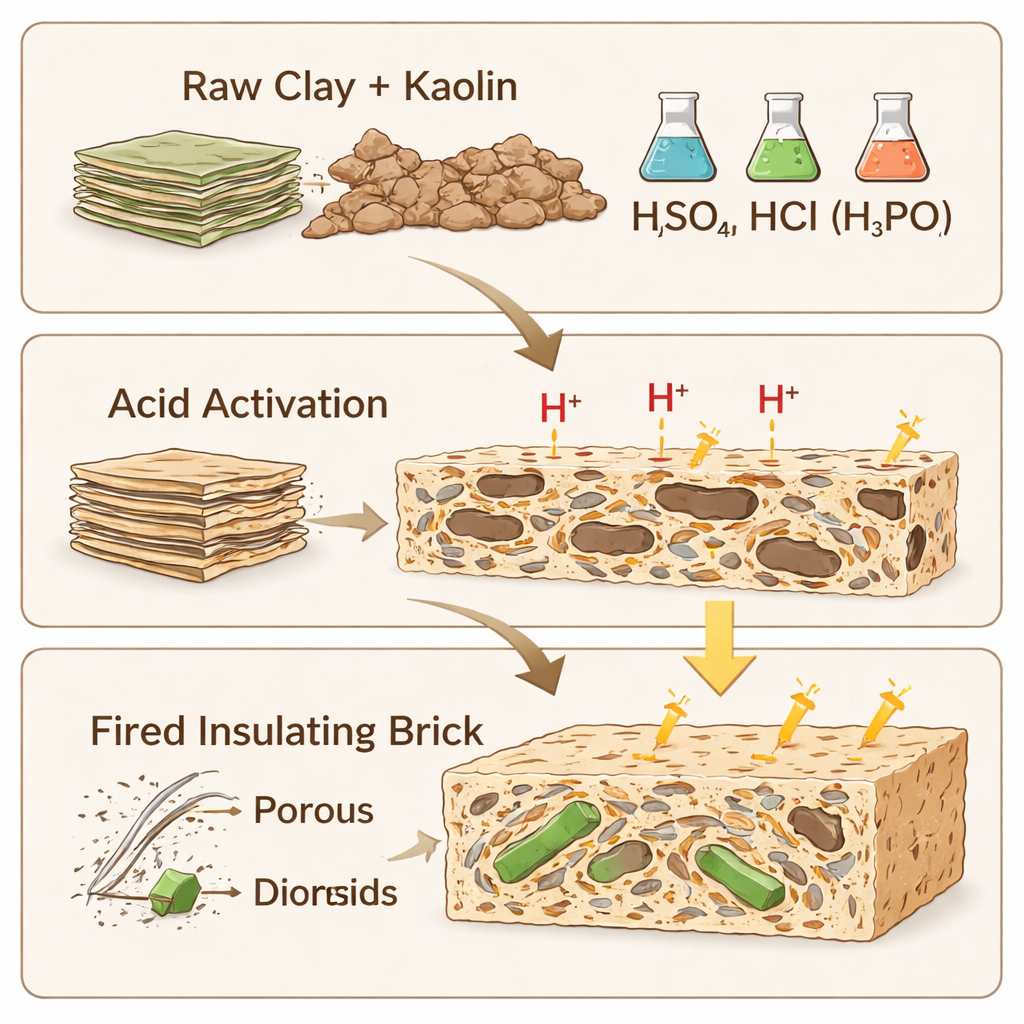
Traditional fired clay bricks are made from natural clays shaped with water and baked at high temperatures. Here, the team started with local Egyptian clays and kaolin, a widely used industrial clay also found in paper and ceramics. Before mixing it into the bricks, they “activated” the kaolin by soaking it in small amounts of three different acids—hydrochloric, sulfuric, and phosphoric—or in a mixture of all three. This treatment subtly rearranges the mineral structure of the kaolin, dissolving some components and increasing its surface area and internal pore space. The activated kaolin was then blended in small doses with the base clay, molded into bricks, air‑dried, and fired in an electric furnace at 1100 °C, similar to industrial brickmaking.
Peering inside the new bricks
To see what changed, the researchers used several laboratory techniques that reveal the internal makeup of the bricks. X‑ray diffraction showed that firing transformed the clays into a mix of minerals dominated by quartz along with two key phases: mullite and diopside. Mullite, well known in high‑temperature ceramics, acts like a reinforcing skeleton that resists heat and mechanical stress. Diopside, a calcium‑magnesium silicate, is prized in insulating ceramics for its thermal stability and resistance to chemical attack. Electron microscope images revealed that acid treatment reshaped the brick microstructure, creating finer, more evenly distributed pores and rougher surfaces where particles lock together. Energy‑dispersive X‑ray mapping confirmed that elements from the acids—such as phosphorus, sulfur, and chlorine—were not just on the surface but integrated throughout the brick matrix, helping to control how new minerals formed during firing.
Balancing pores, strength, and heat flow
Bricks must do two things at once: carry the weight of a building and resist the flow of heat. Porosity—the amount of tiny voids inside a brick—is central to this balance. Air trapped in those pores is a very poor conductor of heat, so more well‑distributed pores generally mean better insulation. In the acid‑activated bricks, overall porosity increased slightly to about 29–30%, and the average pore size became smaller and more uniform. Despite this added porosity, compressive strength stayed in a practical range around 11.5–12.3 kg/cm², comparable to conventional fired bricks. The best performance came from the brick made with a mixture of all three acids, where the chemical reactions fostered a network of micro‑ and mesopores interwoven with mullite and diopside crystals. This structure yielded a brick that is relatively light, structurally sound, and better at resisting heat transfer.
Cooler walls with less energy
When the team measured thermal properties directly, the benefits became clear. Compared with untreated bricks, the acid‑modified versions showed lower thermal conductivity (how easily heat passes through) and lower thermal diffusivity (how quickly temperature changes spread through the material). The phosphoric‑acid brick reached the lowest thermal conductivity, about 0.44 W/m·K, while the mixed‑acid brick showed the slowest heat diffusion. At the same time, specific heat capacity—the ability to store heat—was highest for the mixed‑acid brick. That means walls built from these bricks would heat up and cool down more slowly, smoothing indoor temperature swings and reducing the need for constant active cooling.
What this means for future buildings
To a non‑specialist, the takeaway is straightforward: by making small chemical adjustments to widely available clays and kaolin, it is possible to produce bricks that naturally keep buildings cooler while still meeting structural demands. The improved bricks owe their performance to carefully controlled porosity and the formation of tough, heat‑resistant minerals inside the fired body. In hot, sunny climates, such materials could cut energy use for air conditioning and lower emissions over a building’s lifetime. The study suggests that acid‑activated kaolin‑clay bricks are a promising, scalable route toward more comfortable and sustainable housing built from familiar, earth‑based materials.
Citation: Soliman, W., Shahat, M.A. Chemical activation of kaolin-based clay bricks as a sustainable route to enhanced mechanical and thermophysical properties. Sci Rep 16, 4720 (2026). https://doi.org/10.1038/s41598-026-35471-z
Keywords: thermal insulation, clay bricks, kaolin, sustainable construction, acid activation