Clear Sky Science · en
CO2-responsive terpolymer hydrogels with adjustable dynamic networks for fractured plugging in the reservoir
Smart gels that help lock away carbon and boost oil recovery
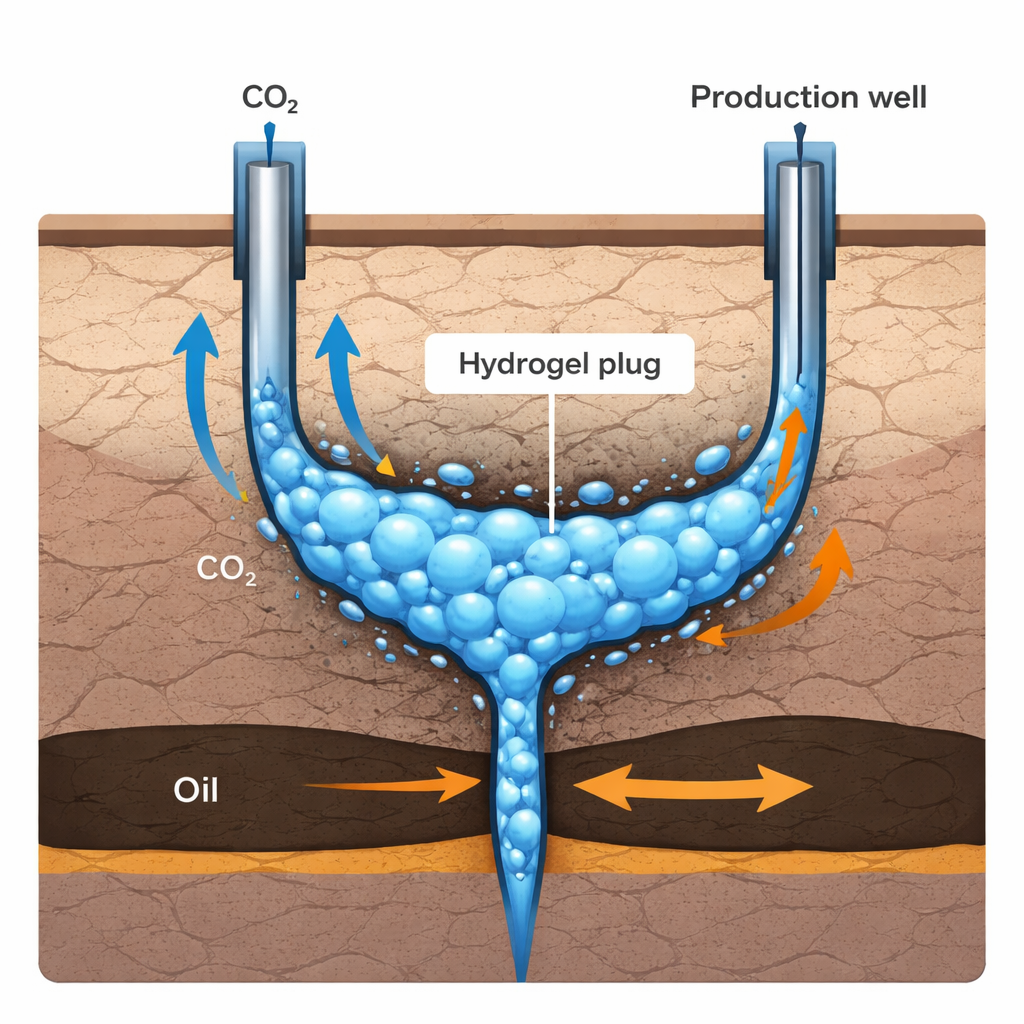
Burning fossil fuels releases vast amounts of carbon dioxide (CO2), and one way to limit the damage is to inject this gas deep underground, where it can both push out more oil and be stored for decades. But there’s a catch: many rock layers are crisscrossed by cracks that let CO2 race through too quickly, wasting energy and risking leaks. This study introduces a new “smart” hydrogel—a water-rich, jelly-like material—that thickens and hardens when it meets CO2, plugging those cracks and helping keep the gas, and the remaining oil, in the right place.
A jelly that changes when it meets CO2
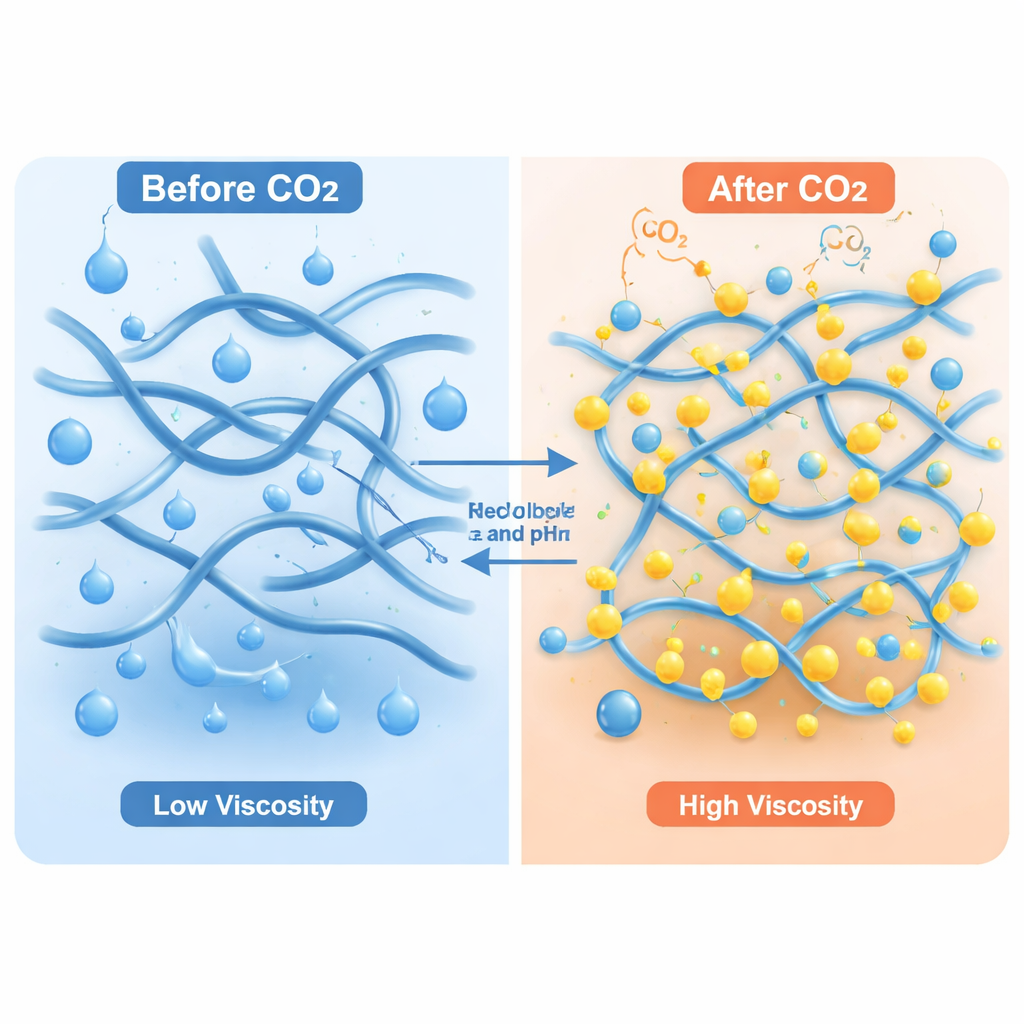
The researchers designed a special hydrogel built from three building blocks that are already familiar to the oilfield and polymer industries. Two of them form a water-loving backbone that lets the material flow easily into narrow rock fractures. The third is a small connecting molecule that both ties the chains together and reacts strongly with CO2. In ordinary conditions, the hydrogel behaves like a soft, injectable fluid. Once it encounters dissolved CO2 underground, chemical groups along the chains grab the gas and turn into charged sites. These new charges attract each other and cluster, forming extra “hidden” junctions inside the gel. In practical terms, the material suddenly becomes thicker, tougher, and better able to hold its shape, turning from a flowing liquid into a semi-rigid plug right where it is needed.
Tuning the internal scaffold for strength and speed
A key innovation of this work is that the team can finely adjust the length of the connecting molecule inside the gel. If the connectors are too short, the network becomes crowded and brittle; if they are too long, the chains become floppy and slow to respond. By systematically varying this length, and carefully measuring viscosity, swelling in water, and how the material deforms under stress, the authors identified a “just right” version with a medium connector. This optimized hydrogel swells moderately (so it fills fractures but does not fall apart), responds to CO2 in under ten minutes, and recovers its structure quickly after being sheared, meaning it can be pumped through pipes and then regain stiffness once in place. Laboratory tests showed that its basic skeleton remains stable even at temperatures much higher than those found in typical oil reservoirs, and simulations suggest it loses very little mass over a decade.
How CO2 locks the gel into place
To understand why the material stiffens so effectively, the team used a mix of chemical analysis, imaging, and computer modeling. Infrared spectroscopy tracked the appearance of new signals as the gel absorbed CO2, confirming that parts of the polymer reacted and formed charged ammonium and carbonate groups. High-resolution electron microscopy then revealed tiny dark spots—ionic clusters—scattered throughout the gel after exposure to CO2. These clusters act like reversible anchors that tie multiple chains together. Calculations at the molecular level showed that the attractions within these clusters are strong enough to hold the network tight, yet flexible enough to rearrange when the gel is squeezed or relaxed. Together, the permanent chemical links and the CO2-made clusters create a hybrid network that is both sturdy and adaptable, with markedly higher stiffness and excellent self-recovery after deformation.
From lab jars to cracked rock deep underground
Beyond the lab bench, the hydrogel was tested in core flooding experiments that mimic fluid flow through fractured rock. When particles of the optimized gel were injected into rock samples and then exposed to CO2, they formed a strong barrier that dramatically increased the resistance to flow, especially in narrow cracks. In numerical reservoir simulations based on a real oilfield, sealing fractures with this gel slowed the loss of stored oil and significantly improved how much oil could be recovered over ten years. Scenarios with full fracture sealing kept more than three-quarters of the original oil in place and raised recovery compared with unsealed cases, where unchecked CO2 channels stripped oil rapidly from the easiest paths and then bypassed much of the remaining reserves.
What this means for cleaner and more efficient energy
For a non-specialist, the takeaway is straightforward: this CO2-responsive hydrogel acts like a smart, self-strengthening grout for underground cracks. It can be pumped in as a liquid, sense the presence of CO2, and then firm up into a durable plug that lasts for years. That behavior helps steer CO2 and injected fluids away from leaky fractures and into the rock pores that still hold oil, boosting production while also improving the security of long-term CO2 storage. Although field trials are still needed, the study shows that carefully engineered “jellies” could become powerful tools for making today’s hydrocarbon production cleaner and tomorrow’s carbon storage safer.
Citation: Yan, Y., Tao, Y., Zhou, S. et al. CO2-responsive terpolymer hydrogels with adjustable dynamic networks for fractured plugging in the reservoir. Sci Rep 16, 5242 (2026). https://doi.org/10.1038/s41598-026-35469-7
Keywords: CO2-responsive hydrogel, fractured reservoirs, enhanced oil recovery, carbon storage, smart materials