Clear Sky Science · en
Design and dynamic analysis of the profiling mechanism for suspended mowing and flattening machines in hilly and mountainous areas
Why mowing steep fields is harder than it looks
For farmers raising cattle and sheep in hilly regions, alfalfa is a lifeline: this rugged plant feeds animals through long, dry seasons. Yet cutting and flattening alfalfa cleanly on steep, uneven ground is surprisingly difficult. Conventional mowing machines were designed for flatter fields. On rough slopes they can gouge into the soil, leave ragged stalks at irregular heights, and even damage the pricey equipment itself. This study describes a new mowing-and-flattening machine that automatically follows the ups and downs of mountain fields, keeping its blades at a steady height while protecting both the crop and the land.
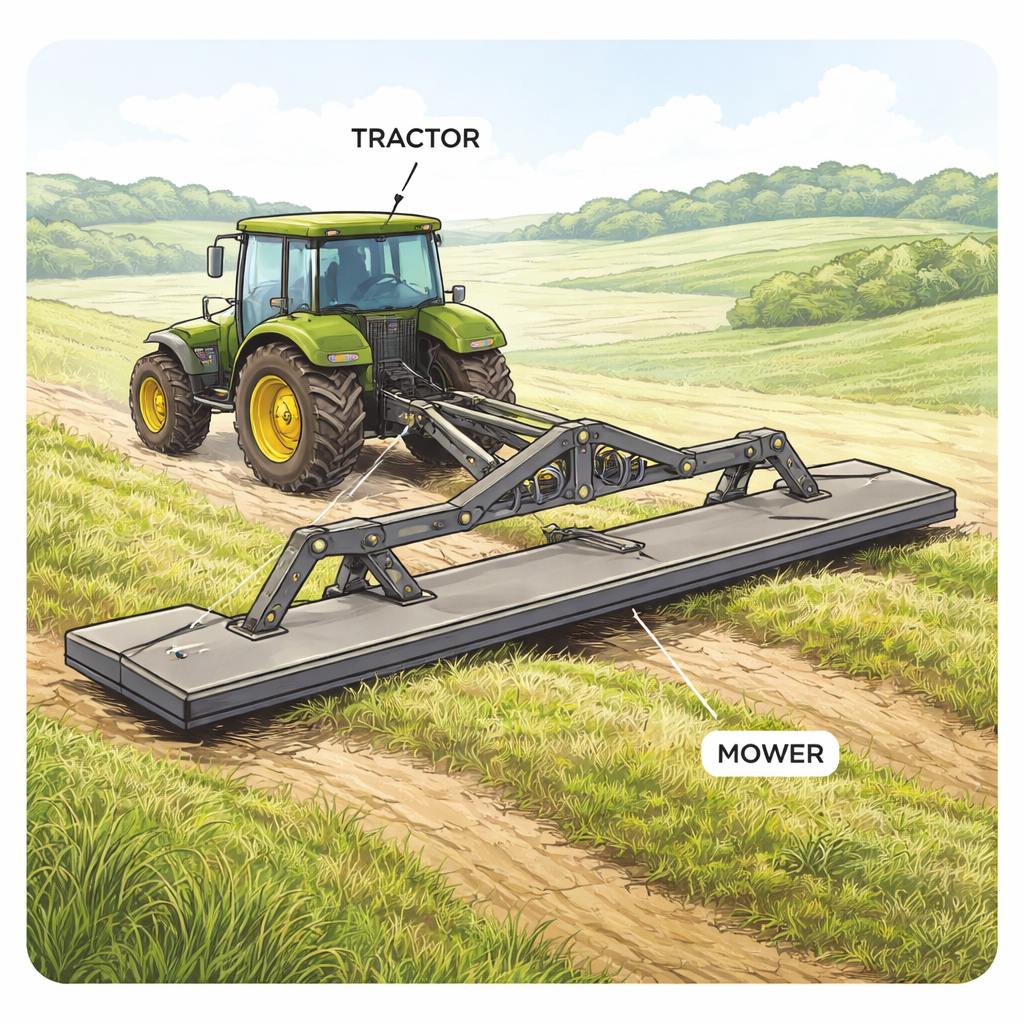
Farming on slopes and broken ground
Hilly and mountainous areas in China are central to the country’s grassland and livestock industries, but their fields rarely resemble the neat rectangles of valley farms. Slopes can reach 20 to 35 degrees, the soil surface rises and falls by 20 to 30 centimeters over short distances, and potholes or small ridges of about 5 centimeters are common. Existing mowing and flattening machines, built mainly for flat plains, struggle in this environment: they ride too stiffly over bumps, press their blades into the soil, or float so high that they leave tall, uneven stubble. That wastes valuable forage and can weaken alfalfa regrowth. Farmers therefore need equipment that is smaller, more agile, and able to "profile" the ground—automatically following its shape while maintaining a safe, consistent cutting height.
A new spring-based balancing act
The researchers designed a suspended mowing and flattening machine whose cutting table hangs behind a tractor and is held in place by a carefully arranged system of springs and linkages. Two main components share the job. A profiling device lets the cutting table rotate slightly so it can tilt with the slope, while a suspension spring mechanism moves mostly up and down to absorb vertical bumps. Both use strong tension springs sized and positioned so that part of the table’s weight is carried by the springs and only a controlled portion presses on the ground. Instead of relying on hydraulics, which earlier designs used, this purely mechanical approach aims to hold the downward force on the ground—the "ground pressure"—below about 2,000 newtons, while still keeping the blades close enough to cut effectively.
Putting the design through virtual hills and holes
Before building and testing the machine in the field, the team constructed a detailed 3D model and ran it through a multi-body dynamics program called RecurDyn. They drove the virtual machine across computer-made test tracks that mimicked real-world terrain: sinusoidal, wave-like surfaces with 25-centimeter peaks; long 30-degree slopes; and tracks peppered with 5-centimeter-deep potholes and 5-centimeter-high bumps. The simulations tracked how far the cutting table moved up and down, how much each spring stretched or compressed, and how strongly the table pressed on the ground at different points. Across these conditions, the cutting table’s height adjusted within about 21 to 48 centimeters, and the contact forces at key points stayed mostly within 0 to 1,500 newtons—comfortably inside the design limit. The profiling springs consistently deformed more than the supporting springs, confirming that they were doing most of the fine ground-following work.
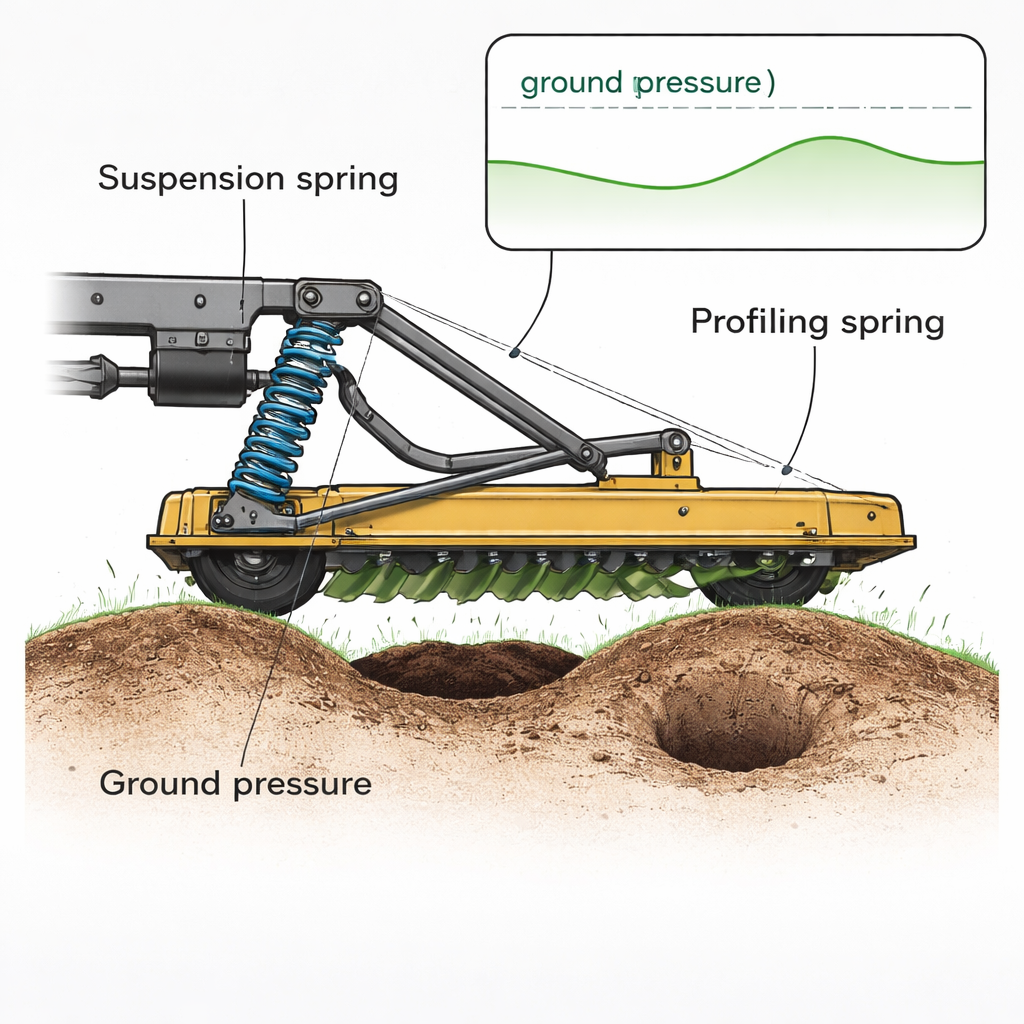
From computer model to real alfalfa fields
To see whether the virtual performance held up in practice, the researchers tested a prototype in an alfalfa field in Gansu Province. The mower was hitched to a standard 90‑horsepower tractor and run over real hilly plots. According to Chinese standards for mowing and flattening machines, two simple measures summarize performance: how high the remaining stubble stands, and what fraction of the cut stems are properly flattened to dry evenly. After multiple passes and measurements, the machine left an average stubble height of 63.2 millimeters—below the 70‑millimeter limit—and flattened about 95.1 percent of the alfalfa, surpassing the required 90 percent. Importantly, the mower maintained good ground-following behavior and did not show signs of digging into the soil or missing large patches, even as speed increased within normal operating ranges.
What this means for farmers on rugged land
For a lay reader, the takeaway is straightforward: by using an intelligently tuned system of springs rather than complex hydraulics, this new mower can "float" over rough, sloping land while keeping its blades at a safe, steady distance from the soil. That leads to cleaner cuts, more uniform drying of the crop, and less risk of equipment damage. While the study notes that future work should refine the design for long-term fatigue and more extreme terrain, the prototype already shows that careful mechanical design can unlock higher yields and better forage quality for farmers working the steep, uneven fields that are often left behind by conventional machinery.
Citation: Wang, J., Geng, B., Li, P. et al. Design and dynamic analysis of the profiling mechanism for suspended mowing and flattening machines in hilly and mountainous areas. Sci Rep 16, 5663 (2026). https://doi.org/10.1038/s41598-026-35468-8
Keywords: alfalfa harvesting, hilly farmland, mowing machinery, spring profiling mechanism, terrain adaptation