Clear Sky Science · en
Prospective pilot randomized controlled study of mini-scleral lenses versus rigid gas permeable lenses in irregular cornea with dry eye
When Dry Eyes Make Vision Wavy
For many people with eye conditions such as keratoconus or scars on the front of the eye, seeing clearly is only half the struggle—keeping their eyes comfortable is the other. This study asks a practical question that matters to patients and clinicians alike: when the cornea is misshapen and the eyes are dry, which is the better tool—traditional rigid gas-permeable lenses or newer mini-scleral lenses that rest on the white of the eye?
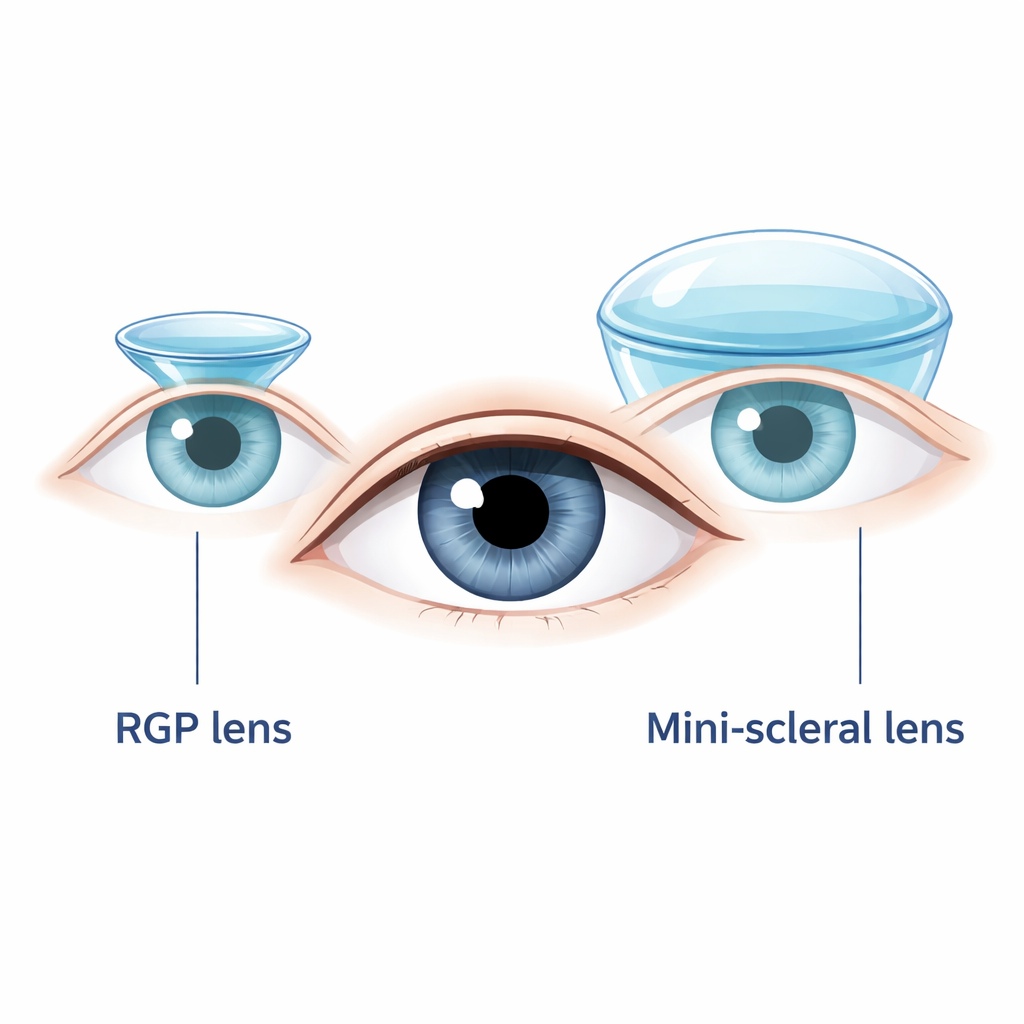
Two Different Ways to Place a Lens
The research focused on adults whose corneas were irregular in shape and who also had clear signs of dry eye disease. These irregularities can bend light in unpredictable ways, blurring vision and making ordinary glasses less effective. At the same time, a poor, unstable tear film can leave the eyes feeling gritty, sore, and easily tired. Rigid gas-permeable (RGP) lenses, which sit directly on the cornea, have long been used to sharpen vision by providing a smooth front surface. Mini-scleral lenses, by contrast, are larger and rest on the white part of the eye, vaulting over the cornea with a pool of fluid underneath that can protect and cushion the surface.
Putting the Lenses to the Test
In this single-center trial, 40 patients (78 eyes) were randomly assigned to wear either mini-scleral lenses or RGP lenses. Everyone had moderate to severe corneal irregularity and measurable dry eye. Eye doctors checked vision with and without lenses, measured how long the tear film stayed stable before breaking up, and examined the front of the eye with microscopes and imaging tools. Participants also filled out detailed questionnaires about eye dryness, comfort, and how often their vision seemed to fluctuate during the day. These assessments were repeated over six months—at one week, one month, three months, and six months—while the examiner remained unaware of which type of lens each patient wore.
Clarity of Sight and Day-to-Day Comfort
Both lens types did what they are designed to do: they clearly improved vision compared with ordinary glasses. In fact, contact-lens-corrected vision was better than best spectacle-corrected vision in both groups throughout the study. On average, the traditional RGP lenses produced a slightly larger jump from uncorrected vision to corrected vision, suggesting a marginal edge in raw sharpness. However, this difference may reflect individual factors and the small sample more than a true superiority. Where the two designs diverged more clearly was in how they felt. Over time, scores on dry eye questionnaires dropped in both groups—meaning symptoms improved—but mini-scleral wearers reported greater relief. They consistently scored lower on a lens-specific dry eye survey and had fewer episodes of vision that came and went over the day, indicating steadier, more comfortable eyesight.
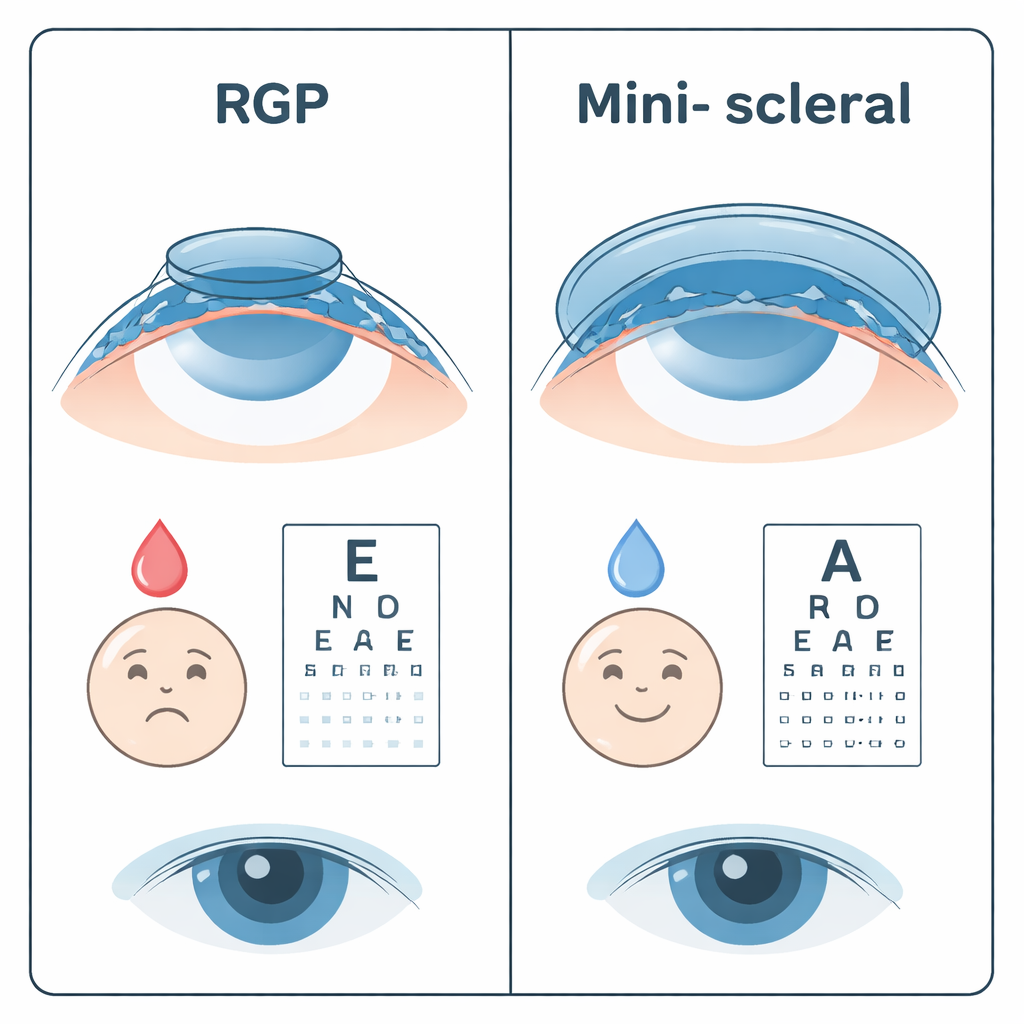
What Was Happening on the Eye Surface
Objective measures of the tear film told a more nuanced story. The time before the tears broke up—a standard test of tear stability—increased somewhat in both groups, and for several early visits it was higher in the mini-scleral group. Still, changes were modest and not always statistically strong, underscoring that a single test may not capture all the benefits that patients feel. Imaging showed that the fluid layer under mini-scleral lenses remained within a safe thickness range over six months, suggesting that oxygen delivery to the cornea was likely adequate. Mild side effects, such as small blood-vessel growth at the edge of the cornea or minor surface irritation, occurred in both groups but were infrequent, treatable with drops, and did not force anyone to leave the study.
What This Means for People With Sensitive Eyes
For patients with both irregular corneas and dry eye, this pilot study supports mini-scleral lenses as a strong option. While RGP lenses may offer slightly more improvement in pure sharpness of vision in some cases, mini-sclerals appear to better soothe dryness and reduce bothersome visual ups and downs, likely because they bathe the cornea in a protective layer of fluid and avoid direct rubbing on the most sensitive regions. The authors emphasize that their findings come from a relatively small, single-hospital study and that larger, longer-term trials are needed. Still, the message for patients is encouraging: for those who struggle with both distorted vision and dry, uncomfortable eyes, mini-scleral lenses may offer a more comfortable path to clearer sight.
Citation: Yang, X., Tian, L., Liu, Y. et al. Prospective pilot randomized controlled study of mini-scleral lenses versus rigid gas permeable lenses in irregular cornea with dry eye. Sci Rep 16, 6252 (2026). https://doi.org/10.1038/s41598-026-35459-9
Keywords: dry eye disease, contact lenses, scleral lenses, rigid gas permeable lenses, keratoconus