Clear Sky Science · en
Early hominin arrival in Southeast Asia triggered the evolution of major human malaria vectors
Why ancient mosquitoes matter today
Malaria still sickens hundreds of millions of people every year, and a few mosquito species are especially good at passing the parasite to humans. This study asks a surprising question with big implications for both human evolution and disease: when and why did some Southeast Asian mosquitoes switch from biting monkeys high in the forest canopy to biting humans on the ground? By tracing mosquito DNA back in time, the authors argue that this shift began more than a million years ago, long before our own species arrived in the region, and was likely triggered by earlier human relatives.
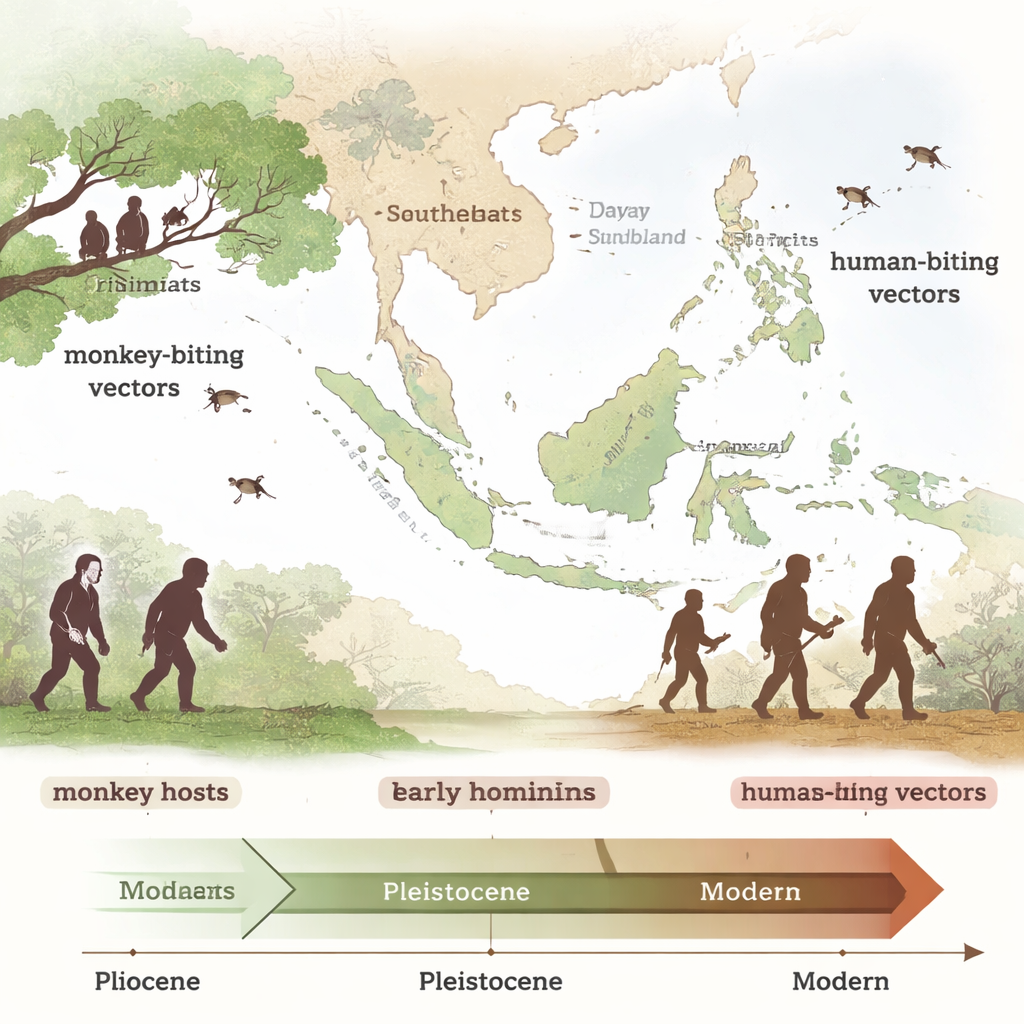
Monkey-biters in a drowned subcontinent
The researchers focused on the Leucosphyrus Group, a cluster of Anopheles mosquitoes found across Southeast Asia. Some members of this group are notorious malaria vectors that strongly prefer human blood, while close relatives feed almost entirely on non-human primates such as monkeys and gibbons. Using genomes from 40 mosquitoes representing 11 species, the team reconstructed a detailed family tree and overlaid it on maps of ancient landscapes. Their analyses indicate that the earliest members of this group lived several million years ago on Sundaland, a now partly submerged landmass that once connected present-day Borneo, Sumatra, Java and the Malay Peninsula, and that these ancestral mosquitoes fed mainly on monkeys in dense, permanently wet rainforest.
Climate shifts and a taste for new hosts
As global climates cooled and dried during the late Pliocene and early Pleistocene, Sundaland’s unbroken rainforests began to fragment into a patchwork of seasonal forests and more open habitats. Fossils show that these changing environments supported a mix of forest and ground-dwelling mammals. The mosquito family tree suggests that this was also when a key behavioral shift occurred. A species called Anopheles latens, which still feeds on both monkeys in the canopy and mammals on the ground, appears near the base of a large subgroup. The authors propose that increasing opportunities to find blood meals at ground level favored mosquitoes that were willing to leave the treetops, setting the stage for later evolution of a stronger attraction to humans.
Genomes reveal a single leap toward humans
To pin down when true human preference arose, the team combined nuclear and mitochondrial DNA, selected particularly “clock-like” genes, and used established mutation rates to estimate divergence times. They then reconstructed ancestral feeding behaviors along the tree. The results point to a single origin of strong human-biting behavior between about 2.9 and 1.6 million years ago, within Sundaland, followed by the spread and diversification of several anthropophilic species. Instead of evolving multiple times independently, the authors argue that human preference likely emerged once through “adaptive introgression”: genetic mixing between closely related mosquito lineages that passed along combinations of smell- and host-detection genes favoring human odor. Subsequent branches inherited this genetic package, producing today’s efficient human malaria vectors in the Dirus and Balabacensis lineages.
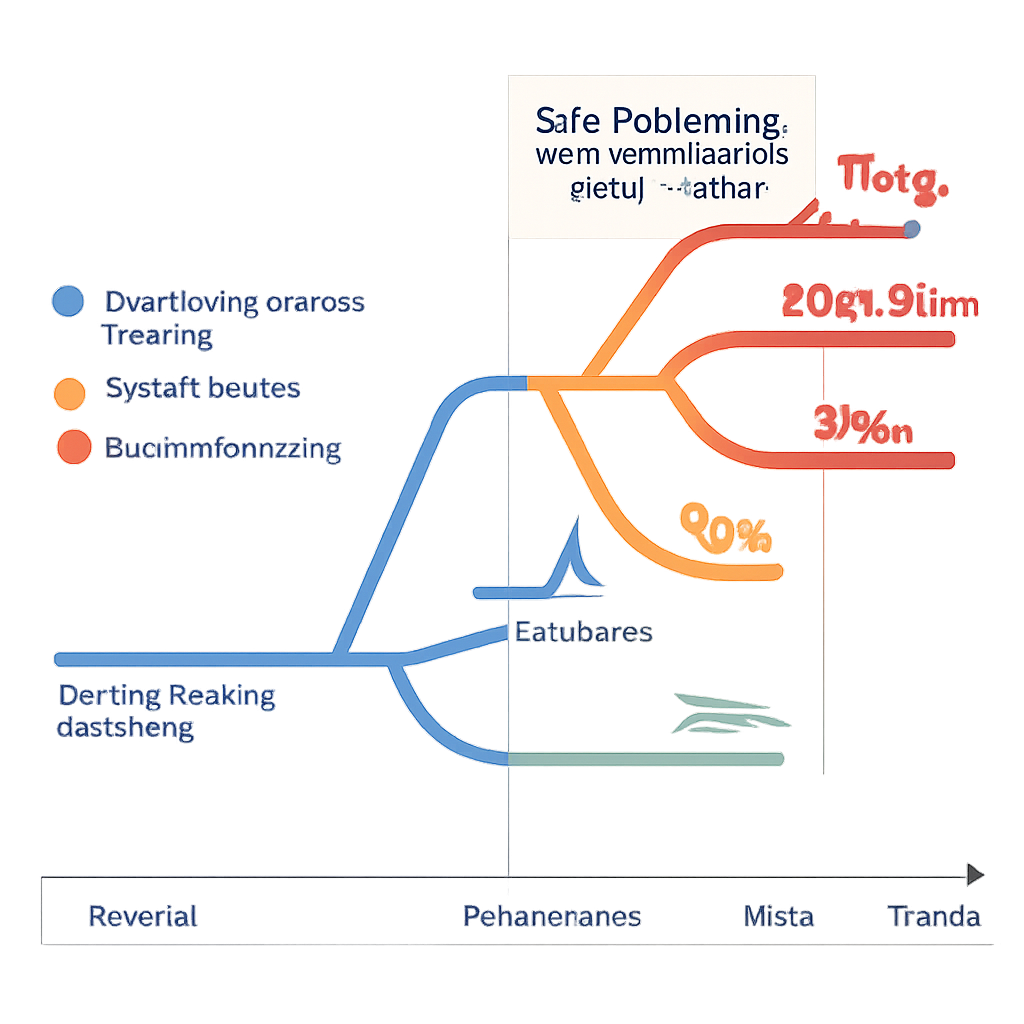
Early human relatives as unwitting partners
The timing of this evolutionary leap is crucial. The estimated window for the origin of human-preferring mosquitoes is far older than the earliest evidence for modern Homo sapiens in Southeast Asia, which appears only in the last hundred thousand years. Instead, it overlaps with geological and fossil evidence for the spread of earlier hominins, especially Homo erectus, into the region around 1.8 million years ago. For mosquitoes to adapt so strongly to a new host, that host must have been both abundant and long-lasting on the landscape. The authors therefore suggest that large populations of early hominins were present in Sundaland by this time, providing enough steady blood meals to drive the evolution of dedicated human-biting vectors.
What this means for malaria and human history
In everyday terms, this work suggests that our deep evolutionary cousins helped create the specialized mosquitoes that still transmit malaria today. Long before farming villages or cities existed, early human relatives in Southeast Asia were already shaping the behavior and genomes of local insects just by being common and tasty hosts. The study offers rare “biological” evidence, independent of fossils and tools, that early hominins colonized Sundaland early and in substantial numbers. At the same time, it highlights how shifts in climate, habitat and host availability can push mosquito species toward or away from humans—a lesson that remains highly relevant as modern environmental change continues to reshape the risks of mosquito-borne disease.
Citation: Singh, U.S., Harbach, R.E., Hii, J. et al. Early hominin arrival in Southeast Asia triggered the evolution of major human malaria vectors. Sci Rep 16, 6973 (2026). https://doi.org/10.1038/s41598-026-35456-y
Keywords: malaria vectors, Southeast Asia, hominin evolution, mosquito host preference, Sundaland