Clear Sky Science · en
Diversity and distribution of bacterial community vertically across ecological and trophic gradient within sediments of lake Bosten area
Why the Mud at the Bottom of a Lake Matters
At first glance, the dark mud at the bottom of a lake may look lifeless. In reality it is packed with microscopic bacteria that quietly recycle nutrients, break down pollution, and help keep the water healthy. This study explored those hidden communities in the sediments of Lake Bosten in arid northwestern China, asking how they change from place to place and with depth beneath the lake floor—and what those changes reveal about human impacts on the ecosystem.
A Lake Split into Three Worlds
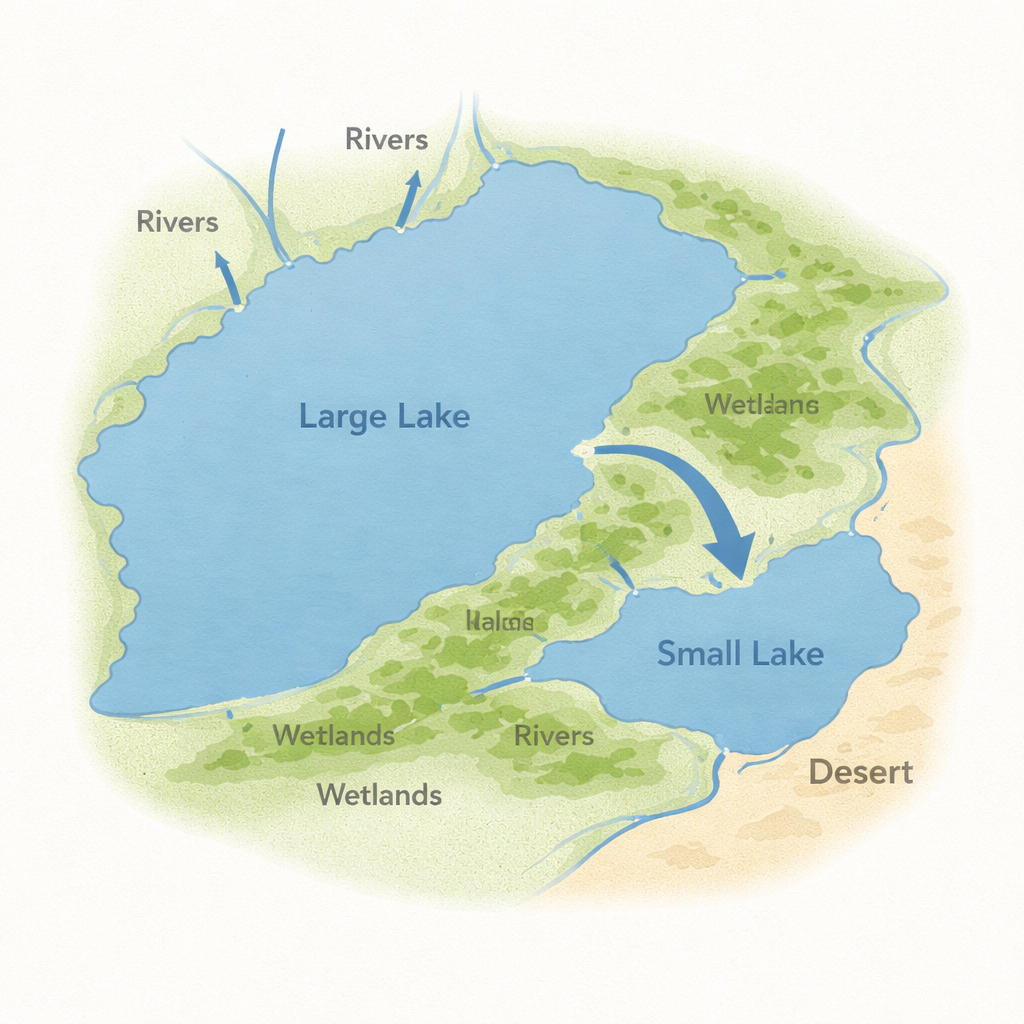
Lake Bosten is not a single uniform water body. It consists of a Large Lake that receives river inflow, farm runoff, and glacial meltwater; a Small Lake fed only by overflow from the Large Lake; and a belt of Wetlands around the shore. Together they form a natural gradient in salinity and nutrient levels, from more complex, human-influenced areas to quieter, plant-dominated zones. The researchers treated these three parts as distinct “ecological neighborhoods” and sampled sediments at 14 sites, taking cores down to 30 centimeters and dividing them into surface, middle, and deep layers. Using high-throughput DNA sequencing of the 16S rRNA gene, they identified which bacteria were present and how diverse the communities were.
Hidden Diversity in the Sediment
The sequencing effort revealed a remarkably rich bacterial world: more than 16,000 distinct genetic groups, or operational taxonomic units (OTUs), across 42 sediment samples. Many OTUs were shared among all three regions, but each part of the lake also hosted hundreds to thousands of unique lineages. In general, the top layer of sediment held more kinds of bacteria than deeper layers, reflecting stronger contact with the overlying water and fresh inputs of organic matter. However, some sites—especially in the Large Lake and in certain wetlands—broke this rule, showing complex local patterns linked to nearby fish farms, river mouths, or slow water circulation. Statistical measures confirmed that community diversity differed significantly among the Large Lake, Small Lake, and Wetlands.
Who Lives Where in the Lake Mud
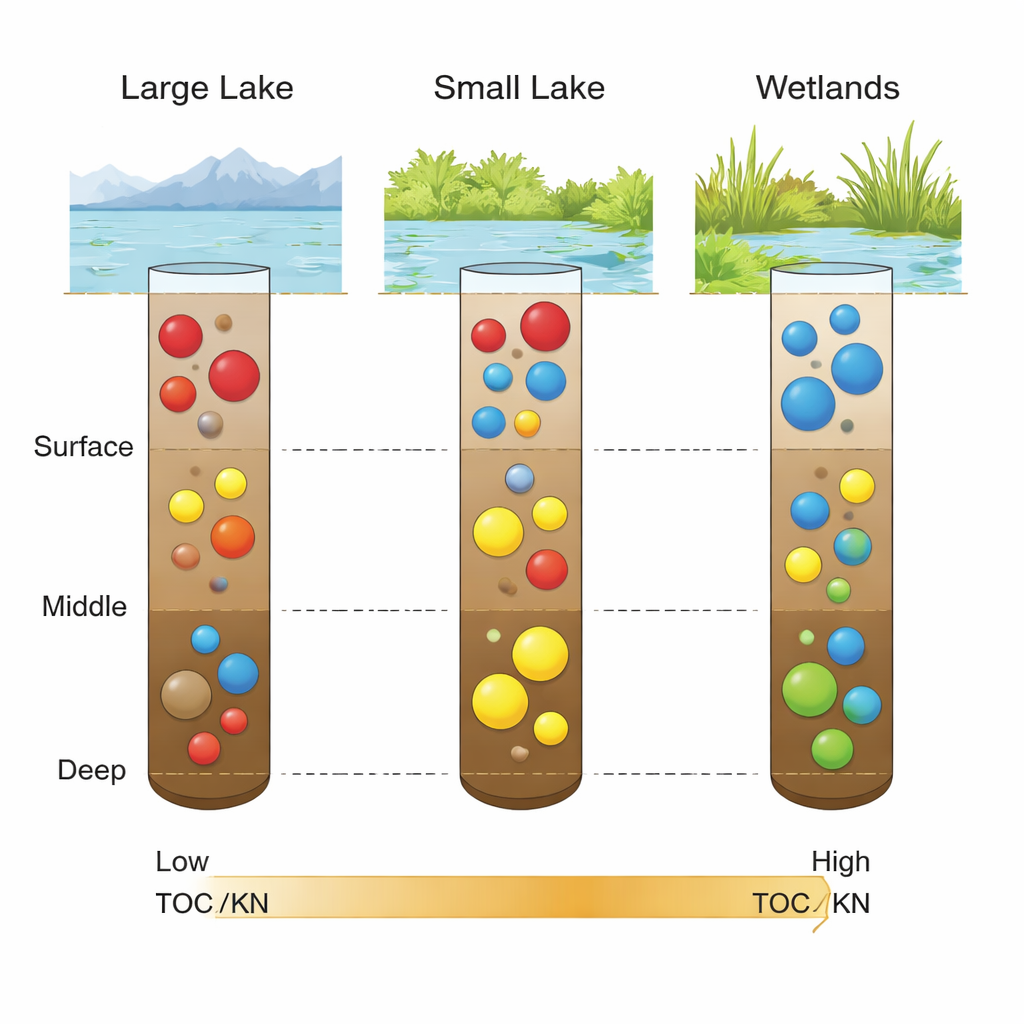
Across Lake Bosten, a handful of broad bacterial groups dominated, but their relative importance shifted from place to place and with depth. In the Large Lake, Firmicutes were especially abundant, often peaking in middle and deep layers, and included genera such as Paenisporosarcina and Trichococcus that can withstand harsh conditions, form spores, and help cycle nitrogen and carbon. Small Lake sediments were characterized by high levels of Bacteroidota, especially deeper down, and by the genus Flavobacterium, which is adept at breaking down organic material and is sometimes linked to fecal or domestic pollution. The Wetlands, by contrast, were richest in Proteobacteria, versatile bacteria that participate in many nutrient transformations. Other groups such as Chloroflexi, Actinobacteriota, and several lesser-known phyla contributed to organic matter degradation, denitrification, and even potential breakdown of herbicide residues.
How Nutrients and Salt Shape the Microbial Map
To understand what drives these patterns, the team measured key chemical properties of the sediments, including total organic carbon (TOC), kjeldahl nitrogen (KN, a form of total nitrogen), electrical conductivity, and salinity. They then linked these measurements to bacterial community data using multivariate statistics and network analysis. Two factors stood out: TOC and KN. Sites and layers richer in these nutrients tended to host more Bacteroidota and other bacteria specialized in consuming organic matter, while groups such as Actinobacteriota and some Firmicutes became less common. The Small Lake had the highest TOC and KN but surprisingly low overall bacterial diversity, suggesting that heavy nutrient loading and eutrophication may favor a narrower set of opportunistic microbes, including potential pathogens. In the Large Lake and Wetlands, where conditions varied more, communities were more diverse and more strongly structured by local geography and pollution sources.
What This Means for Lake Health
For non-specialists, the main message is that the bacteria buried in lake sediments act like a living archive and early-warning system. In Lake Bosten, their composition clearly mirrors differences in human activity: fish farming, river-borne pollutants, farm runoff, and tourism all leave distinct microbial fingerprints. The dominance of organic-matter-degrading bacteria such as Firmicutes, certain Proteobacteria, and Flavobacterium shows that the sediments are working hard to process substantial loads of waste and nutrients. At the same time, the buildup of Bacteroidota and predicted pathogenic traits in the nutrient-rich Small Lake flags a potential health concern. By mapping how these microscopic communities shift across space and depth, the study provides a scientific basis for monitoring organic pollution, managing aquaculture and agriculture around the lake, and protecting the long-term ecological balance of arid-region freshwater systems.
Citation: Ma, X., Ma, J., Paerhati, Y. et al. Diversity and distribution of bacterial community vertically across ecological and trophic gradient within sediments of lake Bosten area. Sci Rep 16, 5558 (2026). https://doi.org/10.1038/s41598-026-35454-0
Keywords: lake sediments, microbial diversity, organic pollution, eutrophication, freshwater wetlands