Clear Sky Science · en
Working face status detection in coal mine based on YOLOv8-EST
Smarter Eyes Underground
Modern coal mines are packed with powerful machines working in dark, dusty tunnels where human visibility is poor and safety margins are tight. This study introduces a new artificial intelligence (AI) system, called YOLOv8-EST, that helps mines continuously “watch” the working face—the area where coal is actively being cut—and automatically judge whether key machines are operating normally. By doing this quickly and accurately on limited on-site computers, the system aims to boost safety and efficiency without needing a room full of high-end servers.
Why Watching the Working Face Matters
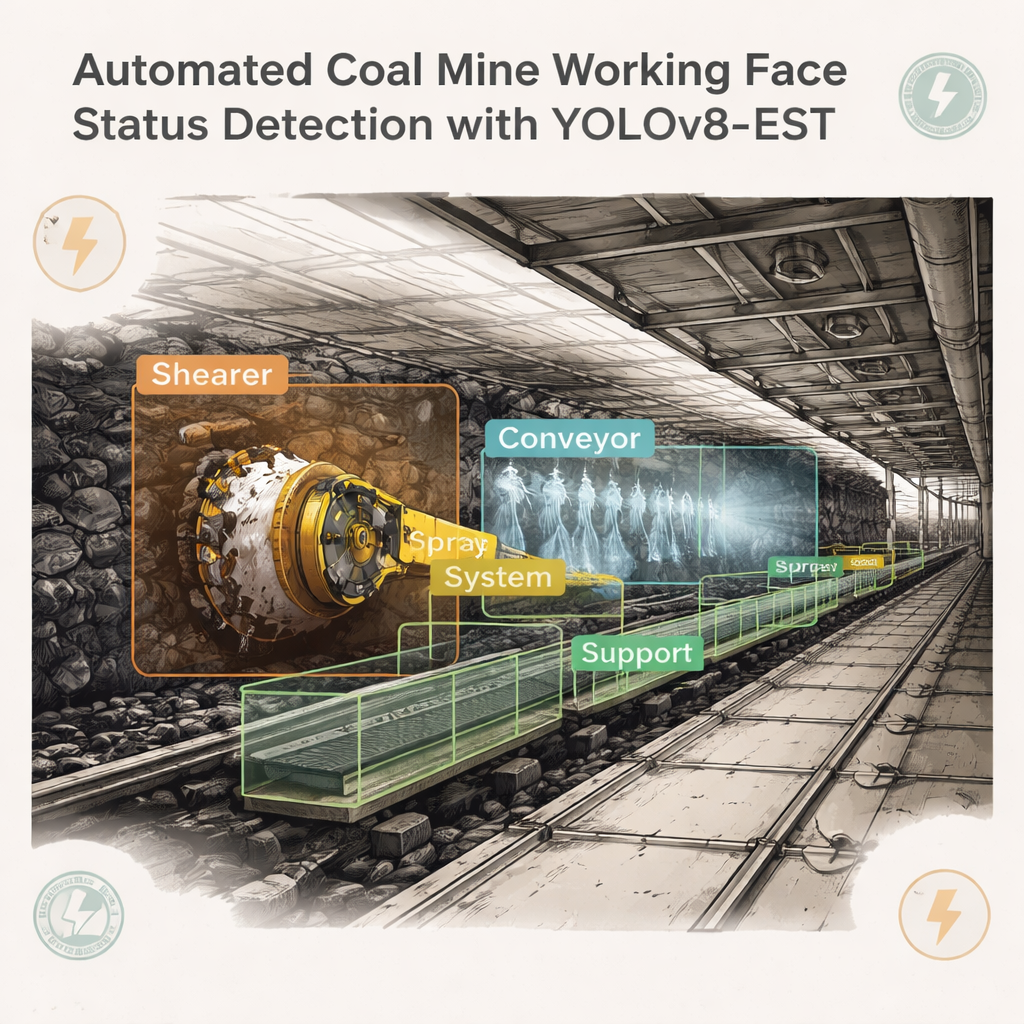
China is the world’s largest coal producer, and its mines are under pressure to be safer, cleaner, and more efficient. At a fully mechanized working face, a rotating cutting drum slices coal from the seam, while scraper and belt conveyors carry it away, and spray systems suppress dust. If any of these components fail or behave abnormally, production can slump and accidents can happen. Traditional monitoring relies heavily on workers’ experience and simple sensors, which struggle in conditions with low light, drifting dust, glare, and frequent occlusion by moving equipment. The authors define “working face status detection” as the real-time identification of normal and abnormal states of these key components, using only video images—an attractive path toward truly intelligent mines.
Limitations of Existing AI Vision in Mines
Recent years have seen a surge of success in AI-based object detection, particularly with fast systems such as the YOLO (You Only Look Once) family of algorithms. These models can spot and label many objects in an image in a fraction of a second. However, most improvements in accuracy have come from making networks deeper and heavier, which demands more computing power than is usually available at the coal face. Alternative detectors like Faster R-CNN, RetinaNet, EfficientDet, and Transformer-based systems can be very accurate, but they are often too slow or too resource-hungry for harsh and dynamic underground settings. In addition, standard models are not tailored for the special visual problems in mines—extreme contrast, swirling dust, partial views of machinery, and ever-changing backgrounds.
A Lean but Powerful Detection Engine
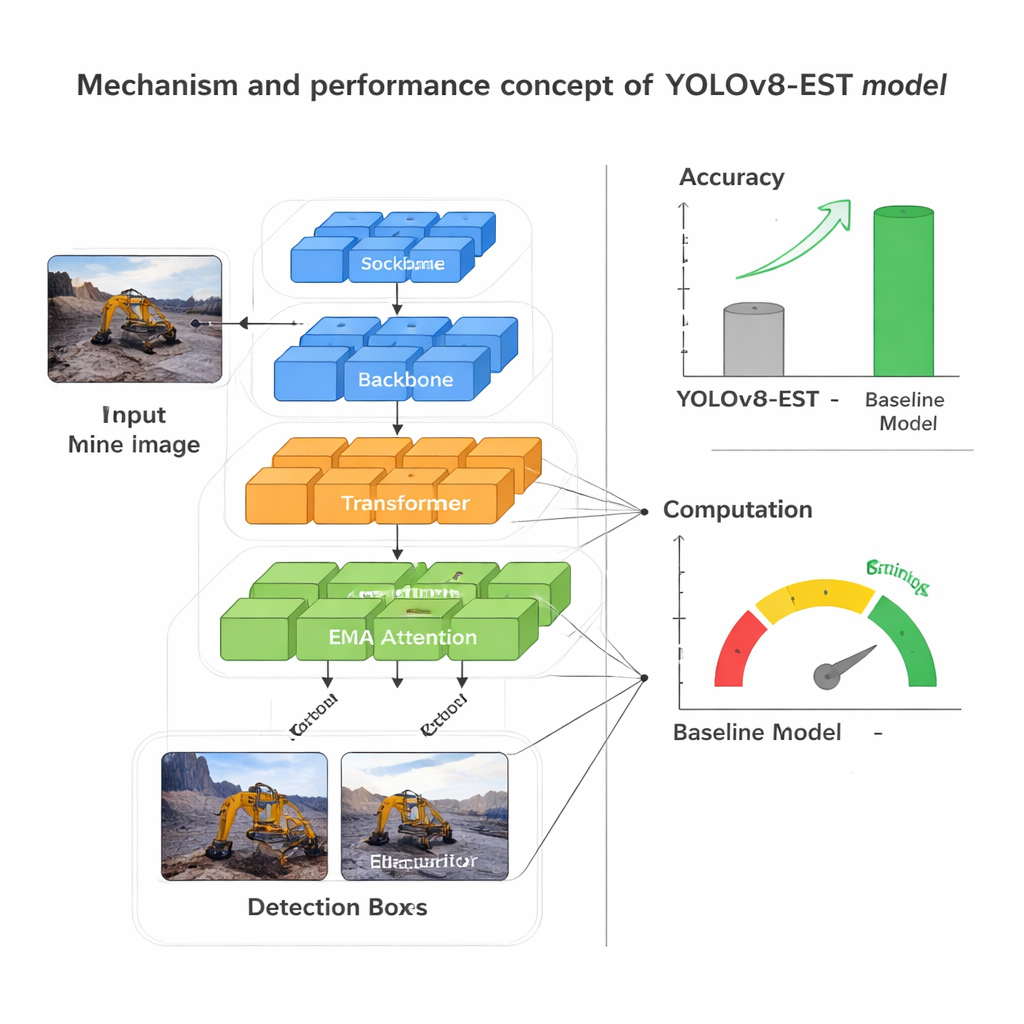
To tackle these constraints, the researchers build on YOLOv8, a recent real-time detector, and redesign it specifically for coal mining, creating YOLOv8-EST. The core idea is to add smarter feature-processing components without bloating the model. First, they insert Swin Transformer blocks—modules that use attention within small image windows and across shifted windows—to capture both local detail and longer-range patterns, such as the shape of a conveyor line or the outline of a shearer body. Second, they improve how the model understands spatial relationships by generating relative position encodings with a small deep network instead of simple linear formulas, helping it tell, for example, whether a spray plume is correctly aligned with a cutting drum. Third, they introduce a modified activation function called GELUS, which is mathematically tuned to respond smoothly yet efficiently to the kinds of noisy, low-contrast signals common in mine images, reducing computation while keeping learning stable. Finally, an EMA attention module uses an exponential moving average strategy to blend current and past feature information, helping the network focus on truly important regions and damp down noisy, flickering backgrounds.
Putting the System to the Test
The team assembled a dedicated image dataset from a fully mechanized coal face, called the CM dataset, with 10,862 images. These scenes include the machine body, cutting drum, scraper conveyor, belt conveyor, and spray system under a range of lighting and dust conditions. They divided the data into training, validation, and test subsets and also grouped images into low-light/high-dust, medium, and normal conditions to test robustness. Using standard quality measures—precision, recall, and mean average precision (mAP)—they compared YOLOv8-EST with lighter models like YOLOv3-tiny and SSD-Mobilenetv2, mainstream YOLOv5 and YOLOv8, heavier two-stage detectors such as Faster R-CNN and RetinaNet, and Transformer-based designs including DETR and RT-DETR. Across these tests, YOLOv8-EST delivered the best balance: around 98% precision and recall and a very high mAP, while keeping the model compact enough for real-time use on a single industrial-grade graphics card.
What This Means for Mine Safety
For non-specialists, the key outcome is that this research turns raw, murky video from underground into reliable, automatic status reports on critical mining equipment. Instead of asking workers to visually monitor dim screens filled with dust and motion blur, YOLOv8-EST can flag when a conveyor stops, a drum is not where it should be, or a spray system is inactive, and do so at nearly human-level accuracy but around the clock. By carefully tailoring modern AI techniques to run efficiently at the mine face—rather than only in distant data centers—the system offers a practical route to safer, more stable, and more intelligent coal production.
Citation: Wang, H., Wu, G., Yang, Q. et al. Working face status detection in coal mine based on YOLOv8-EST. Sci Rep 16, 7787 (2026). https://doi.org/10.1038/s41598-026-35452-2
Keywords: coal mine safety, object detection, computer vision, deep learning, industrial automation