Clear Sky Science · en
Impact of dual-tasking and balance confidence on turns and transitions: a cross-sectional study in Parkinson’s disease
Why everyday movements matter
For many people with Parkinson’s disease, the riskiest parts of daily life are not long walks but the short, ordinary moves we barely notice when we are healthy—standing up from a chair, turning in a hallway, or sitting down at the kitchen table. These actions often happen while the mind is busy with something else, like chatting or doing mental arithmetic. This study looks closely at how doing a thinking task at the same time as moving affects these everyday transitions and turns in people with Parkinson’s, and what role confidence in one’s balance plays.
A closer look at a simple mobility test
To explore this question, researchers used a standard clinic test called the Timed Up and Go, or TUG. In this test, a person starts seated in a chair, stands up, walks three meters, turns around, walks back, and sits down again while the total time is recorded. In a second version, called TUG-Cognitive, people repeat the same task but also count backward in threes, adding a mental challenge on top of the physical one. Rather than only measuring how long the test took, the team used small wearable sensors on the body to capture the fine details of how people stood up, turned, and sat down during each part of the test. 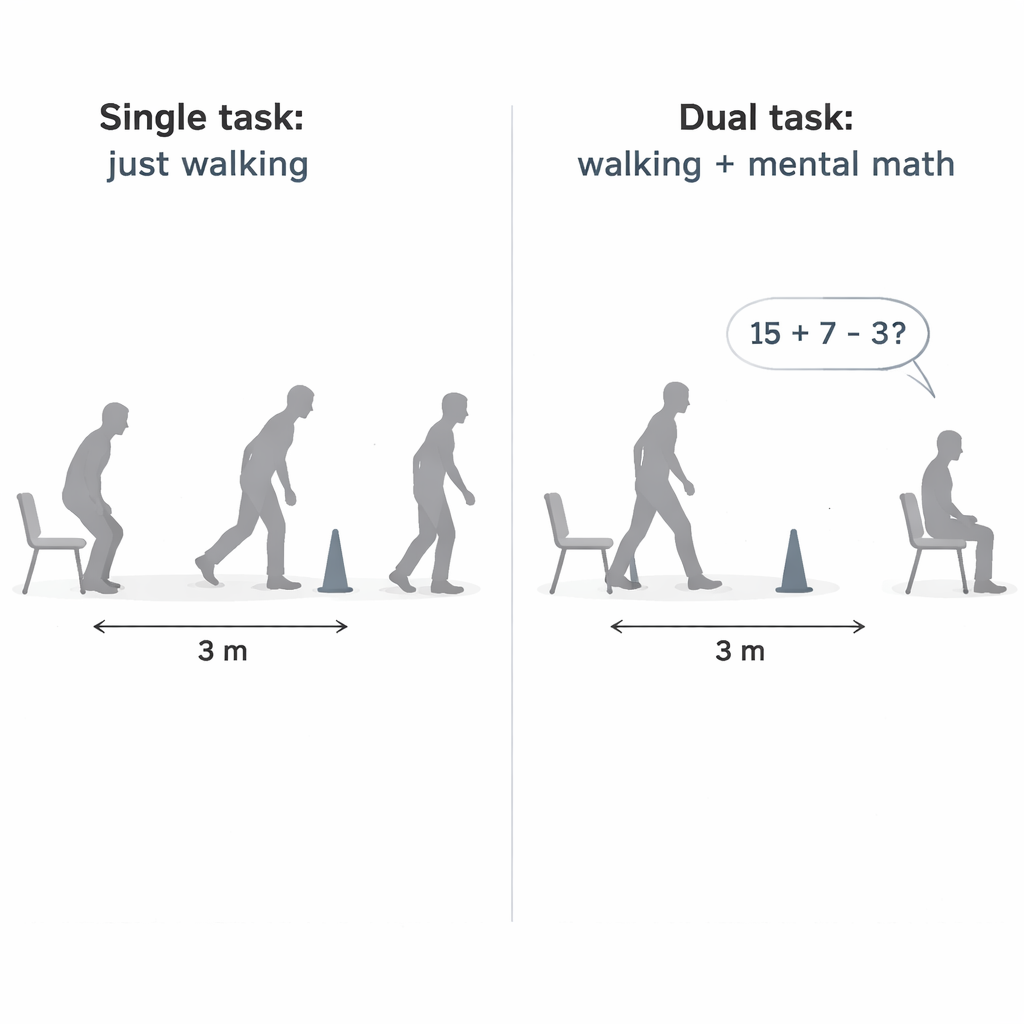
What happened when thinking and moving mixed
The study included 94 adults with mild to moderate Parkinson’s disease, with an average age of about 69 years. When participants added the mental subtraction task, they completed the test almost three seconds slower on average than when they just focused on moving. Their walking turns took longer, became wider, and were performed more slowly. Standing up from the chair also took slightly more time, and when they sat down again their trunk leaned forward less, suggesting a more cautious movement. In fact, nearly every part of the test was affected by the added mental load, showing that combining thinking and moving can strain the system in people with Parkinson’s.
Turns suffer more than simple up-and-down moves
By breaking the test into sub-phases, the researchers could see which parts of movement were most fragile. They found that turning—changing direction while walking—was hit hardest by the dual-task condition. Compared with standing up or sitting down, turns showed larger changes in how long they took, how wide they were, and how quickly the body rotated. This suggests that turns demand more attention and coordination and may be especially vulnerable when the brain has to share its resources between movement and mental work. Because many falls in Parkinson’s occur during turning at home, these findings point to turns as a critical focus for fall-prevention exercises and home safety advice.
How confidence in balance fits in
The researchers also asked participants how confident they felt about keeping their balance in everyday situations, using a standard questionnaire. They then examined whether people with lower balance confidence experienced greater “dual-task interference”—that is, a bigger drop in performance when the mental task was added. Overall, balance confidence was only weakly related to changes in most parts of the test. However, it did stand out for one important phase: standing up from the chair. People who felt less confident in their balance showed a greater slowdown in this sit-to-stand movement when they had to think and move at the same time, even after accounting for their usual walking speed and thinking skills. 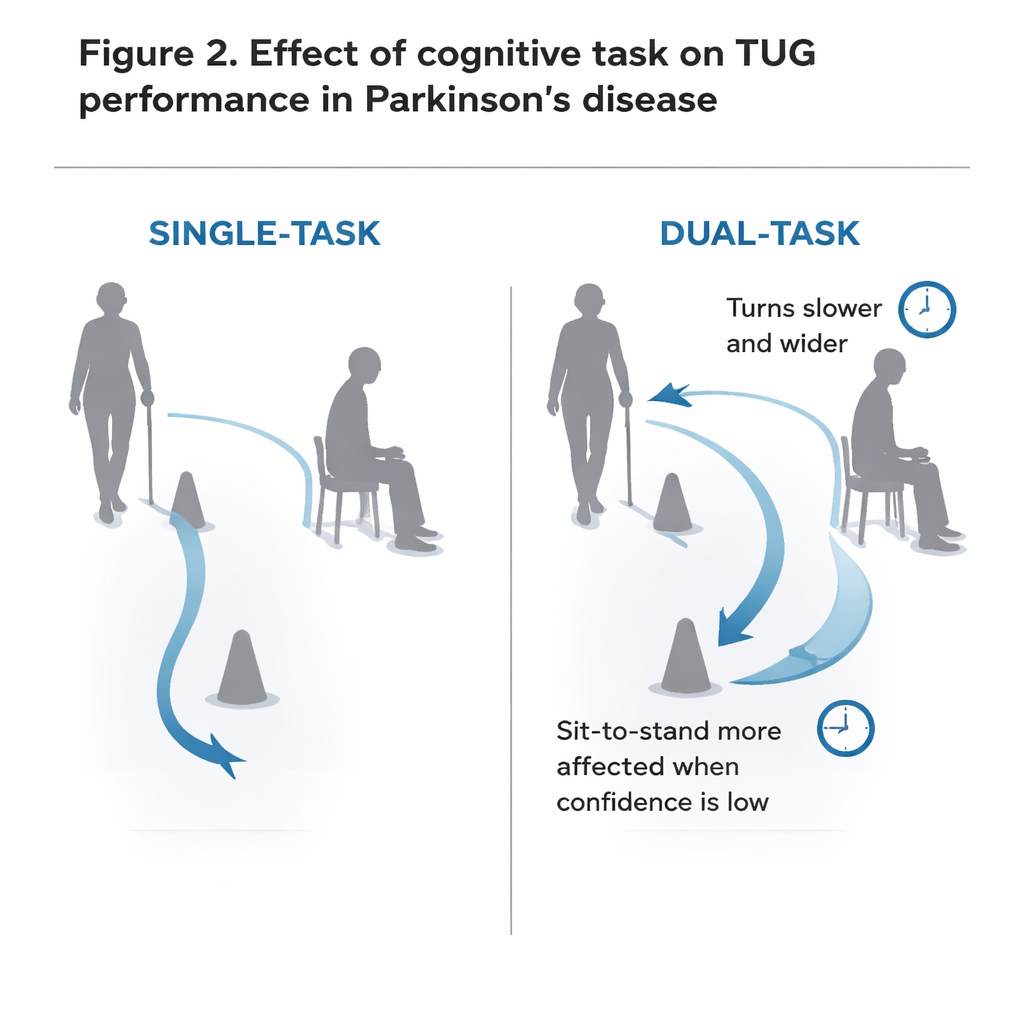
What this means for daily life and therapy
In simple terms, this study shows that for people with Parkinson’s, doing two things at once—moving and thinking—can noticeably disrupt how they perform very common actions. The overall test gets slower, turns become wider and slower, and standing up is particularly affected in those who lack confidence in their balance. For clinicians and therapists, this means that training should not only focus on straight walking but also practice turns and everyday transitions under realistic, “busy-brain” conditions. It also suggests that asking patients about their balance confidence can reveal hidden difficulties with getting out of a chair or moving safely at home. Together, these insights can help shape more targeted therapy and safer daily routines for people living with Parkinson’s disease.
Citation: Johansson, H., Löfgren, N., Porciuncula, F. et al. Impact of dual-tasking and balance confidence on turns and transitions: a cross-sectional study in Parkinson’s disease. Sci Rep 16, 1953 (2026). https://doi.org/10.1038/s41598-026-35450-4
Keywords: Parkinson’s disease, dual-task walking, falls and balance, Timed Up and Go, turning and transitions