Clear Sky Science · en
Gaze patterns during visual mental imagery reflect part-based generation
How Our Eyes Reveal the Pictures in Our Mind
When you picture your childhood bedroom or yesterday’s lunch, it feels like the scene just pops into your mind. But your eyes quietly trace out that inner picture. This study shows that when we imagine, our eyes move as if we’re rebuilding a scene piece by piece, rather than replaying how we originally looked at it. Understanding this helps scientists get closer to how mental images are formed and maintained in the brain.
Seeing Versus Imagining
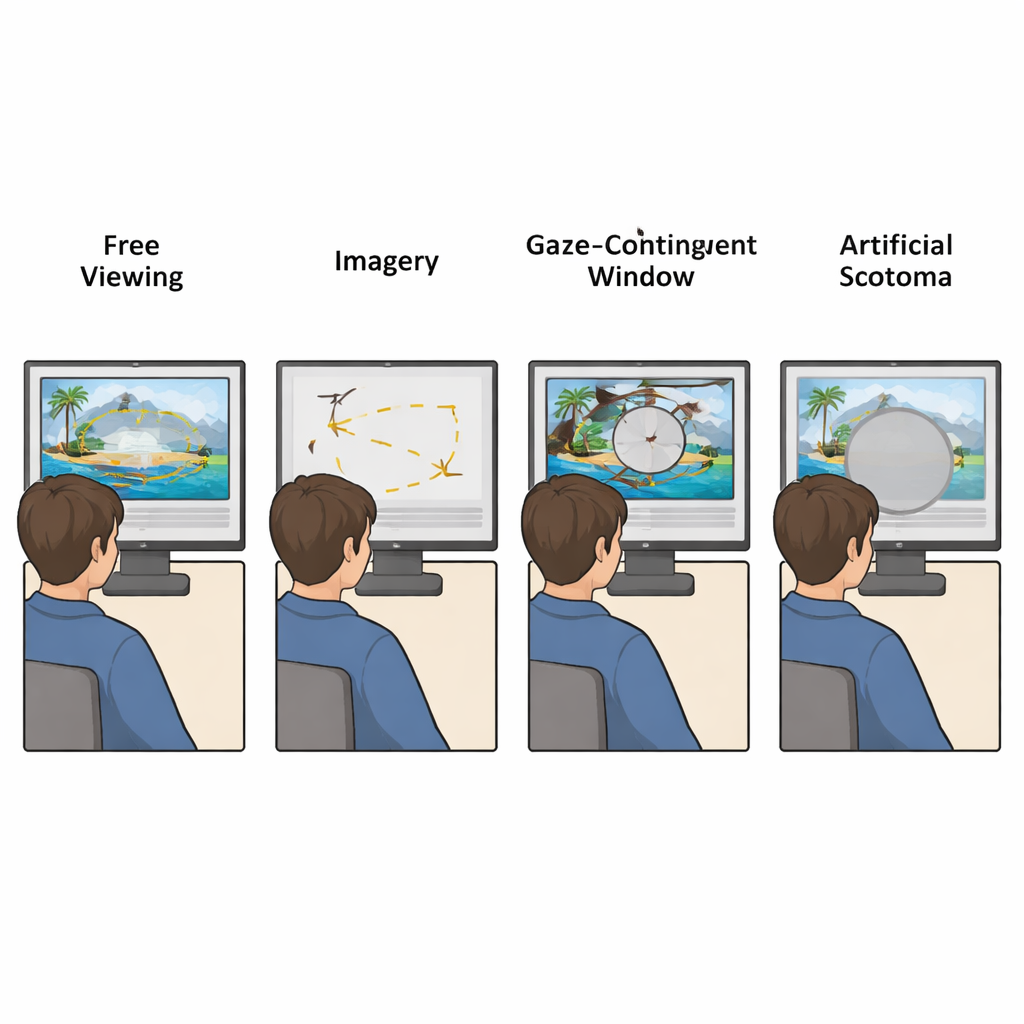
We know from earlier work that people often look back to the same places on a blank screen when recalling a picture they saw before. This “looking at nothing” effect suggests that eye movements are tied to memory and imagery. But it was unclear what exactly those eye movements were doing. Are they a simple replay of how we scanned the picture the first time, or are they part of an active process of building the image from its parts? The authors set out to separate these possibilities by forcing people to view pictures either in a fragmented, part-by-part way or in a more global, all-at-once way, and then comparing those patterns to the ones seen during mental imagery.
Forcing the Eyes to See in Pieces or as a Whole
The researchers used eye-tracking to record where people looked on a screen while they viewed and then imagined pictures of abstract art, indoor rooms, and outdoor scenes. They created two special viewing conditions. In the “tunnel vision” condition, only a small circular patch around the gaze was visible; everything else was covered, so people had to gather information in little chunks. In the “missing center” condition, the center of vision was blocked, but the outer part of the scene remained visible, encouraging people to rely on the broad overall layout instead of fine details. By comparing these controlled viewing patterns with eye movements during imagination, the team could ask whether mental imagery behaves more like part-based viewing, holistic viewing, or ordinary free looking.
Imagining Acts Like Piece-by-Piece Viewing
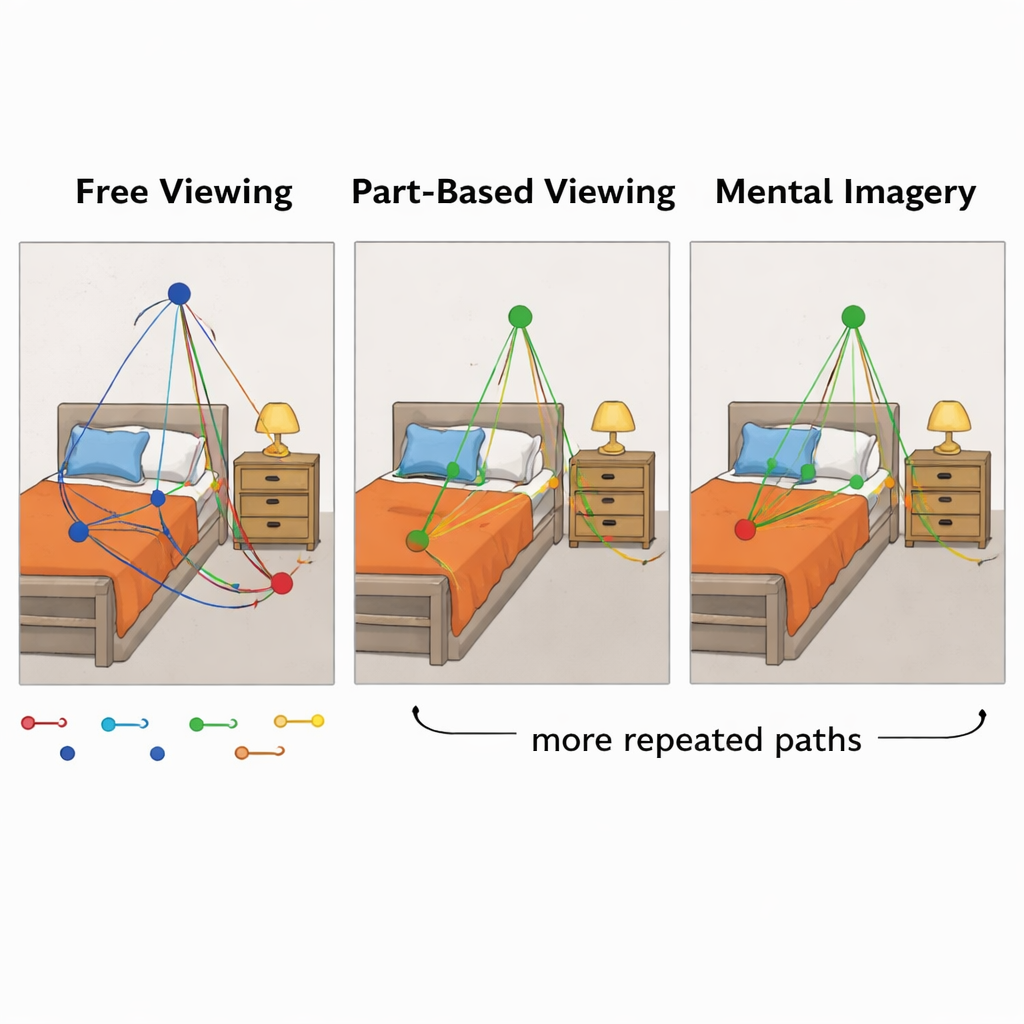
Across two experiments, the answer was surprisingly consistent. In the first experiment, participants freely studied each picture, imagined it, and then saw it again either through tunnel vision or with the missing center. Computer analyses of the eye-movement paths showed that the overall shapes, directions, and lengths of the gaze patterns during imagery were most similar to those during tunnel-vision viewing. People tended to revisit the same regions repeatedly and in similar sequences, especially when imagining or when forced to inspect the scene part-by-part. These repeated, ordered refixations suggest that the mind is stepping through specific parts of the picture to rebuild the scene.
Independent of How the Scene Was First Seen
The second experiment tested whether this piece-by-piece pattern depends on how the scene was originally learned. This time, participants first saw each image either freely, with tunnel vision, or with the missing center, and only then imagined it. Despite these very different starting conditions, their eye movements during imagination still resembled the part-based pattern, not the holistic one. Measures that captured how often people returned to the same spots, and whether they did so in a consistent order, all pointed in the same direction: imagining reliably produced clustered, sequential refixations. In other words, even when a scene was first viewed as a whole, the mind seemed to reconstruct it later by visiting its parts in a systematic way.
Why This Matters for Everyday Imagination
To a layperson, the key message is that mental images are not stored in the brain like complete photographs waiting to be pulled off a shelf. Instead, when we recall a visual scene, we appear to assemble it on the fly, stitching together remembered pieces at particular locations. Our eye movements during imagination trace out this construction process, hopping between important spots in a stable order to keep the fragile image from fading. This part-based rebuilding seems to be a basic feature of how we imagine, no matter how we first saw the scene.
Citation: Weber, E.J., Mast, F.W. Gaze patterns during visual mental imagery reflect part-based generation. Sci Rep 16, 5108 (2026). https://doi.org/10.1038/s41598-026-35447-z
Keywords: mental imagery, eye movements, visual memory, scene perception, visual attention