Clear Sky Science · en
A computationally efficient approach to quantum state reconstruction using robust classical shadows
Why peeking inside quantum states matters
Quantum computers promise unbreakable communication and ultra-fast simulations, but to trust them we need ways to "look inside" and verify what quantum states they actually create. Traditional methods for doing this, called quantum state tomography, demand an enormous number of measurements and quickly become impossible as devices grow. This article explores a far more efficient family of techniques, known as classical shadows and robust shallow shadows, that can reliably describe important features of quantum states with only a fraction of the effort — even when the hardware is noisy.
From full portraits to quick snapshots
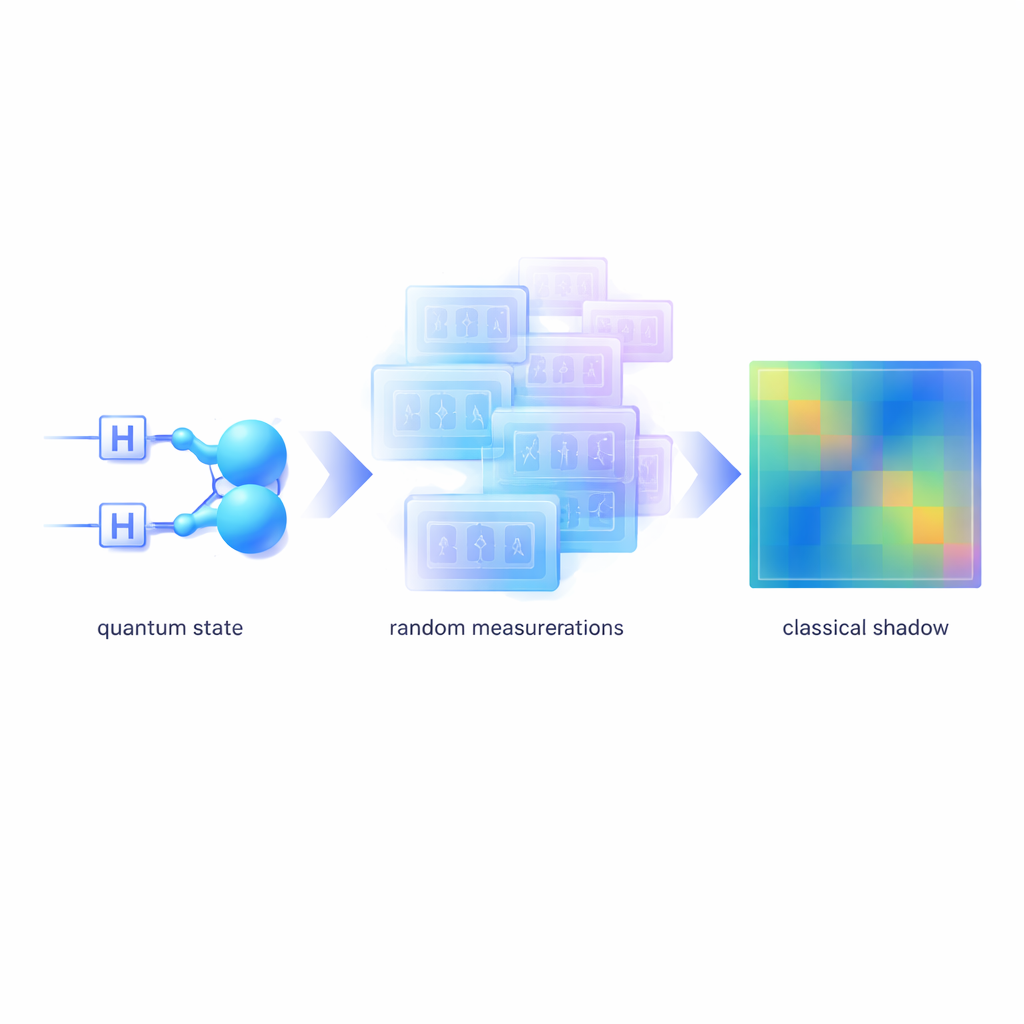
Conventional quantum state tomography aims to build a complete portrait of a quantum state, encoded in a mathematical object called a density matrix. For a device with many quantum bits (qubits), this portrait contains an astronomical number of details, and the number of required measurements grows exponentially. That means a method that works in the lab for two or three qubits becomes hopelessly expensive for the larger devices needed for real-world applications. The key idea behind classical shadows is to stop chasing the full portrait and instead collect many quick, cleverly chosen snapshots that are just rich enough to answer the questions we care about, such as how entangled a state is or how closely it matches a target.
How classical shadows work in practice
In the classical shadow approach, the quantum device is repeatedly prepared in the same state and then gently scrambled with randomly chosen circuits from a special family called Clifford circuits. After each scramble, the qubits are measured in the standard way, producing a simple string of zeros and ones. Each run — the random circuit plus the measurement outcome — forms a compact "shadow" that captures partial information about the original state. By averaging over many such shadows with efficient classical post-processing, one can reconstruct key properties of the state, or even an approximate density matrix, using far fewer measurements than full tomography would require.
Testing the method on a basic entangled state
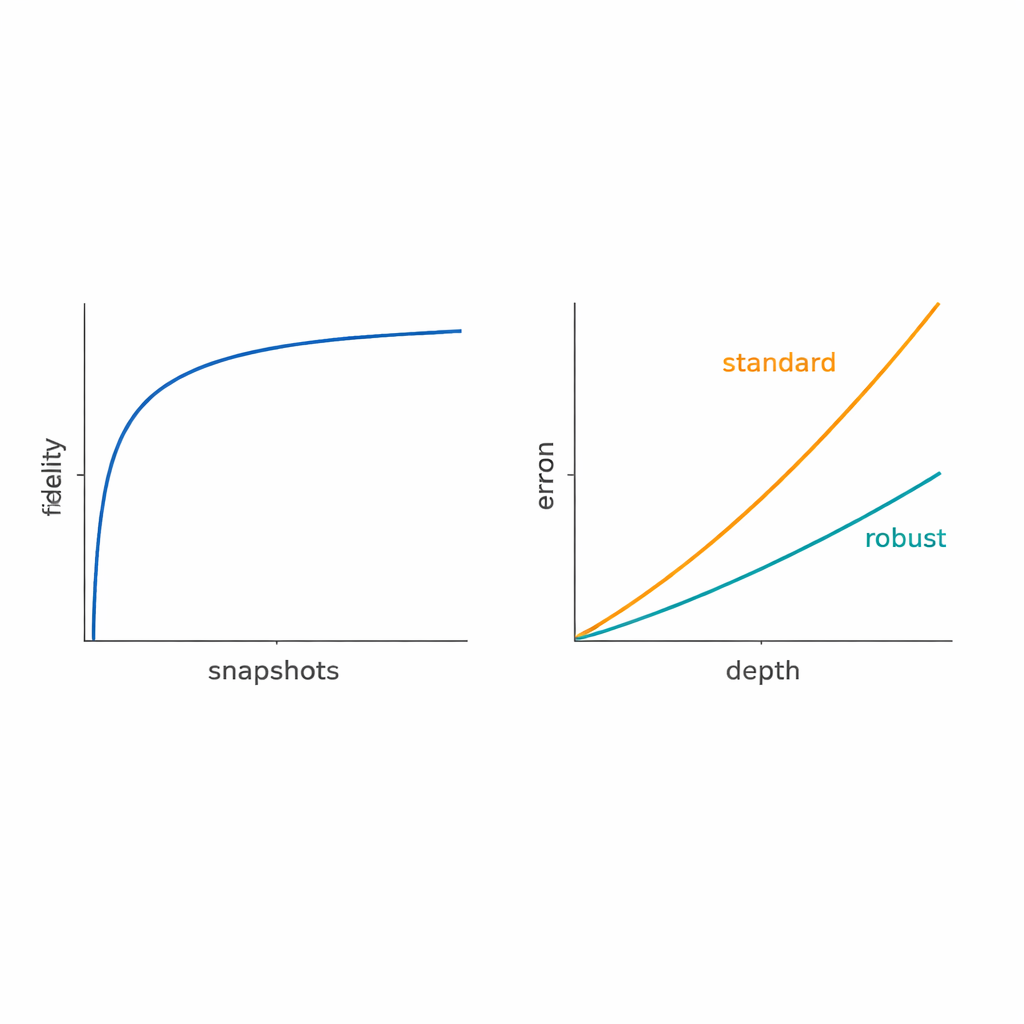
To demonstrate what these ideas can do, the authors focus on a textbook example of quantum entanglement: a two-qubit Bell state, in which the qubits behave as a single, perfectly correlated pair. They simulate a simple quantum circuit that generates this Bell state, then apply the classical shadow protocol with up to 1000 snapshots. Two yardsticks are used to judge success. The first is fidelity, which measures how close the reconstructed state is to the ideal Bell state (1 means perfect agreement). The second is a norm difference, which acts like a distance between the two states. As more snapshots are gathered, fidelity quickly climbs and then stabilizes around 0.98–1.0, while the distance shrinks to a tiny value of about 0.01–0.02. This shows that even for an entangled state, a modest number of randomized measurements is enough to reconstruct it with near-perfect accuracy.
Taming noise with shallow and robust shadows
Real quantum hardware is noisy: every gate and measurement slightly distorts the state. To cope with this, the authors examine a refined method called shallow shadow tomography, where only a few layers of entangling gates are used before measurement. These shallow circuits are short enough to run on today’s imperfect devices but still capture important global features of the state. However, noise in these circuits introduces a systematic bias: even if you take many measurements, your estimates stop improving beyond a certain point. To fix this, the paper introduces robust shallow shadows, which add a calibration step. The device is first run on a simple, known state, and the results are used, via Bayesian statistics, to learn how strongly noise damps the signals. This learned damping factor is then used to correct all later estimates.
Why this matters for future quantum devices
Simulations show that robust shallow shadows keep improving as more data are collected, while standard methods hit a noise-imposed floor. When circuit depth increases, the usual approach quickly becomes unreliable, but the robust version stays accurate over a much wider range of depths, at the cost of only slightly larger random fluctuations. For non-experts, the takeaway is that instead of demanding perfect quantum hardware or exhaustive measurements, we can lean on smart statistics and carefully designed random circuits to read out what quantum devices are doing. These techniques make it practical to check and characterize quantum states on the imperfect, medium-scale machines we have now, helping to turn ambitious quantum protocols into trustworthy tools.
Citation: Sharma, S., Akashe, S., Upadhyay, G.M. et al. A computationally efficient approach to quantum state reconstruction using robust classical shadows. Sci Rep 16, 6927 (2026). https://doi.org/10.1038/s41598-026-35442-4
Keywords: quantum state tomography, classical shadows, Bell state, noise mitigation, quantum computing