Clear Sky Science · en
Single-pulse TMS functional mapping of sensorimotor cortex during decision-making task
How the Brain Turns Sights into Actions
Every time you catch a ball, choose a traffic lane, or pick a key on your keyboard, your brain races through a chain of steps: seeing, deciding, and moving. We usually measure this process with a simple stopwatch—how fast did you respond?—but that single number hides a lot of inner workings. This study used brief, focused magnetic pulses on the brain to tease apart these hidden steps and show how different movement-related areas quietly shape our decisions in real time.
Peeking into Decisions with Gentle Brain Pulses
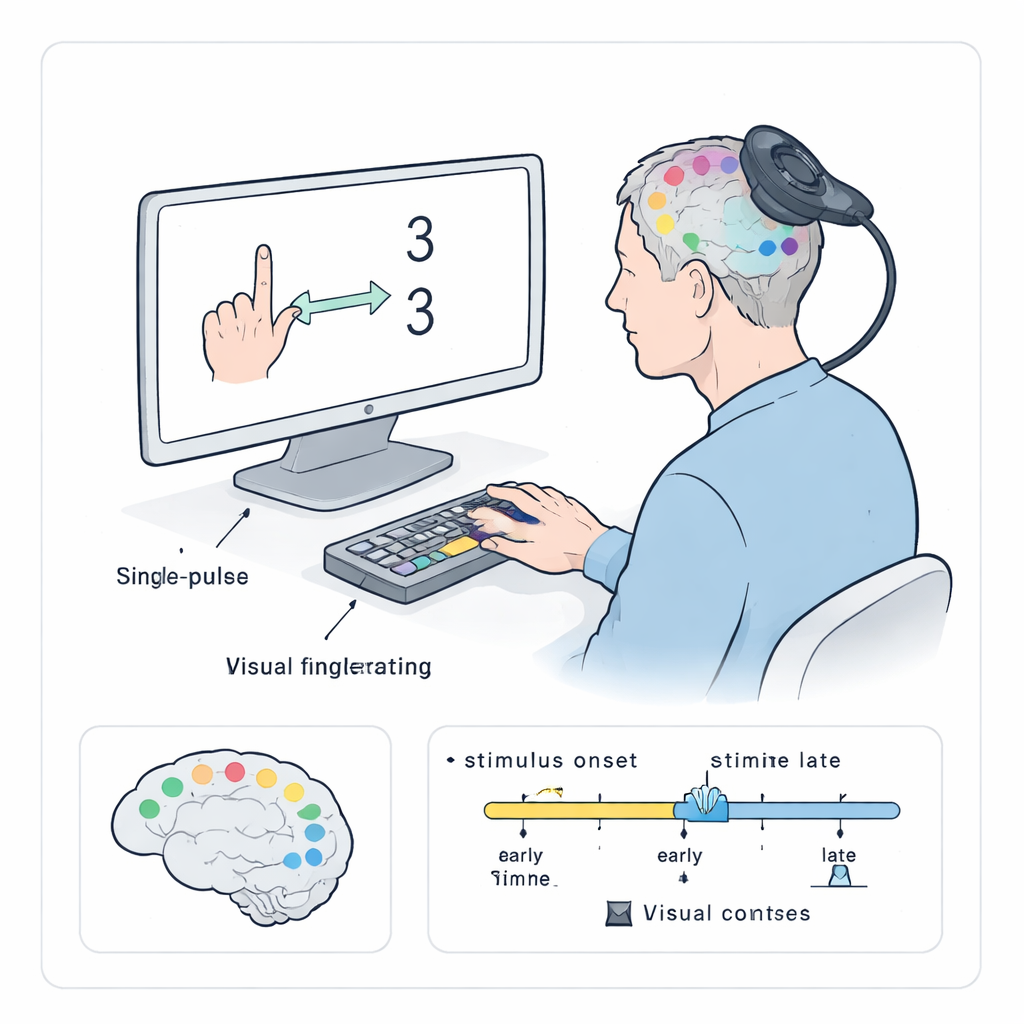
To probe these hidden steps, researchers used single-pulse transcranial magnetic stimulation (spTMS), a noninvasive method that briefly stimulates small patches of the brain from outside the skull. Thirty healthy volunteers took part in a finger-based decision task while receiving these brief pulses. The scientists targeted three key regions on both sides of the brain: a planning area in front of the motor strip (the dorsal premotor cortex), the primary motor cortex that directly controls movement, and the primary somatosensory cortex that processes touch and body position. By triggering single pulses at carefully chosen moments during the task, the team could test which parts of the decision chain each area influenced.
A Finger-Counting Puzzle for the Brain
Instead of a simple button press, the volunteers faced a compact puzzle on the screen. Each image showed the back of a right hand with one finger highlighted in red, an arrow pointing left or right, and a number that told them how many fingers to count along. After mentally stepping through the fingers, they had to press a key with the finger that matched their answer on a custom-built five-key keyboard. This design forced the brain to combine several pieces of visual information, perform an internal count, and then plan and execute a very specific finger movement. During each trial, a single magnetic pulse hit one of the six targeted brain locations either early (shortly after the image appeared) or later (closer to when the response was formed), while “sham” pulses mimicked the sound and feel without real stimulation for comparison.
Breaking Reaction Time into Hidden Parts
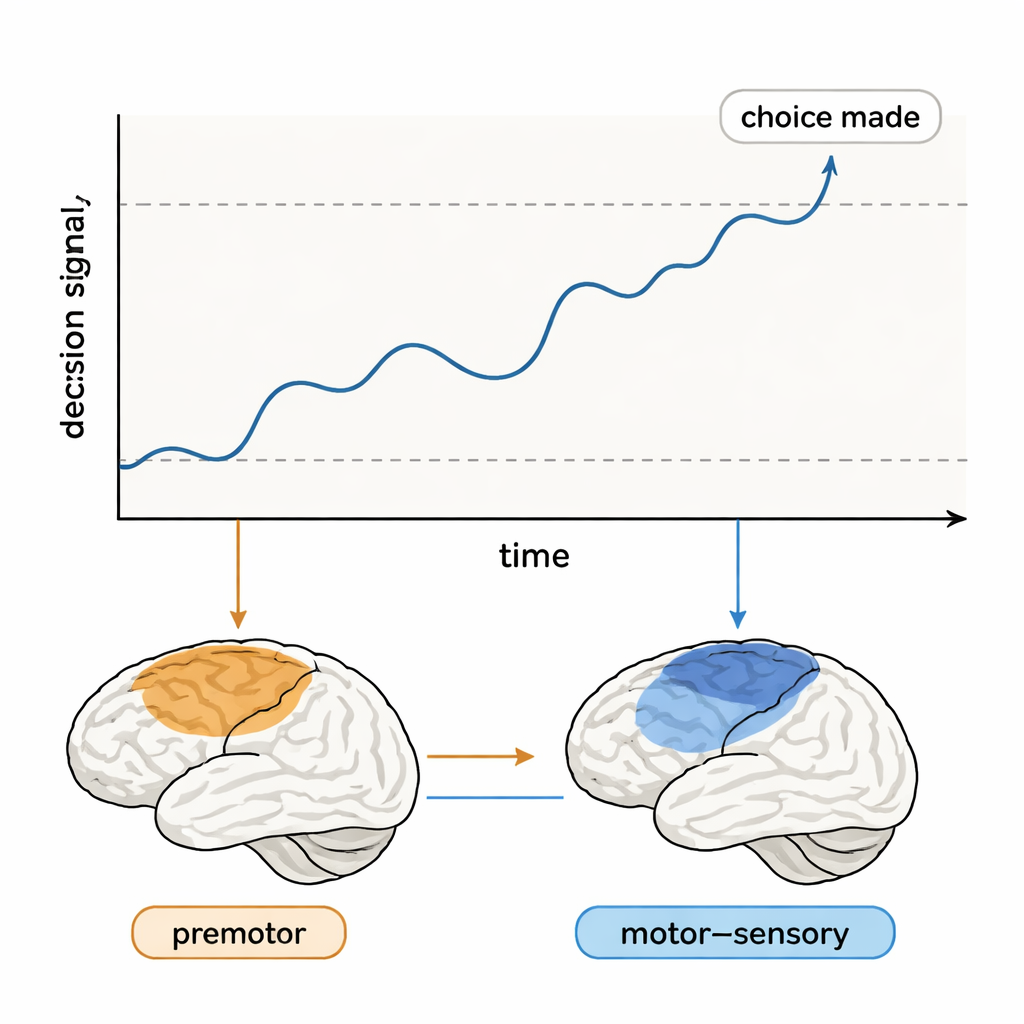
Reaction time might seem like a single block of time, but researchers can split it into at least two invisible pieces: non-decision time, which covers early sensing and final movement execution, and evidence accumulation time, when the brain weighs information until it commits to a choice. The team used a mathematical framework called the drift diffusion model to estimate these pieces from each person’s pattern of speed and accuracy. Rather than just asking “Did the pulse make people faster or slower?”, this approach asks “Which hidden stage changed—how quickly they gathered evidence or how long they spent on sensing and acting?”
Different Brain Areas, Different Hidden Roles
The results revealed a surprisingly subtle picture. Stimulating the premotor area consistently made people respond a bit faster, without making them more error-prone. The model showed that this speed-up came almost entirely from shortening the non-decision portion of the response, suggesting that premotor cortex helps prepare actions more efficiently once the visual information is in place, without altering how carefully evidence is weighed. In contrast, pulses over the primary motor and somatosensory regions changed both hidden components in opposite directions. In those areas, non-decision time shrank, but the evidence accumulation part grew longer. These two shifts effectively canceled each other, leaving total reaction time almost unchanged even though the internal balance of processes had clearly been disturbed.
What This Means for Understanding and Treating the Brain
For non-specialists, the key message is that not all “movement” areas in the brain do the same job during a decision. The premotor region seems to streamline the handoff from perception to action, while the primary motor and sensory strips jointly shape how evidence is built and checked before movement. Because standard reaction-time measures would have missed many of these effects, combining brief magnetic stimulation with modeling provided a much more detailed map of who does what in the decision circuit. In the long run, this kind of fine-grained mapping could inform smarter brain-based therapies, helping clinicians target specific stages of decision-making that go awry in conditions ranging from stroke to cognitive disorders.
Citation: Udoratina, A., Grigorev, N., Savosenkov, A. et al. Single-pulse TMS functional mapping of sensorimotor cortex during decision-making task. Sci Rep 16, 7748 (2026). https://doi.org/10.1038/s41598-026-35439-z
Keywords: decision making, brain stimulation, reaction time, sensorimotor cortex, drift diffusion model