Clear Sky Science · en
Structural relaxation and domain formation in anisotropically strained La0.7Sr0.3MnO3/LaFeO3 superlattices on DyScO3(101)
Shaping Magnetism with Gentle Crystal Stretches
Electronics of the future may not rely on electric charge alone, but also on the tiny compass needles of electron spin. To build such "spintronic" devices, engineers are turning to antiferromagnets—materials whose internal magnets cancel out so there is no stray field. This paper explores how very slight, directional stretching of crystals—called anisotropic strain—can be used to organize the hidden magnetic patterns in a carefully stacked oxide structure only a few dozen billionths of a meter thick.
Why Hidden Magnets Matter
Antiferromagnets are attractive for technology because their cancelling spins remove unwanted magnetic noise and can switch extremely fast, promising low‑energy, high‑speed memory and logic. The trade‑off is that their invisible magnetization is hard to steer. Small imperfections in the crystal often split the material into many tiny magnetic regions, or domains, that point in different directions. The researchers set out to see how deliberately imposed strain in a multi‑layered oxide stack could control both the crystal structure and these elusive antiferromagnetic domains.
Building a Designer Stack of Oxides
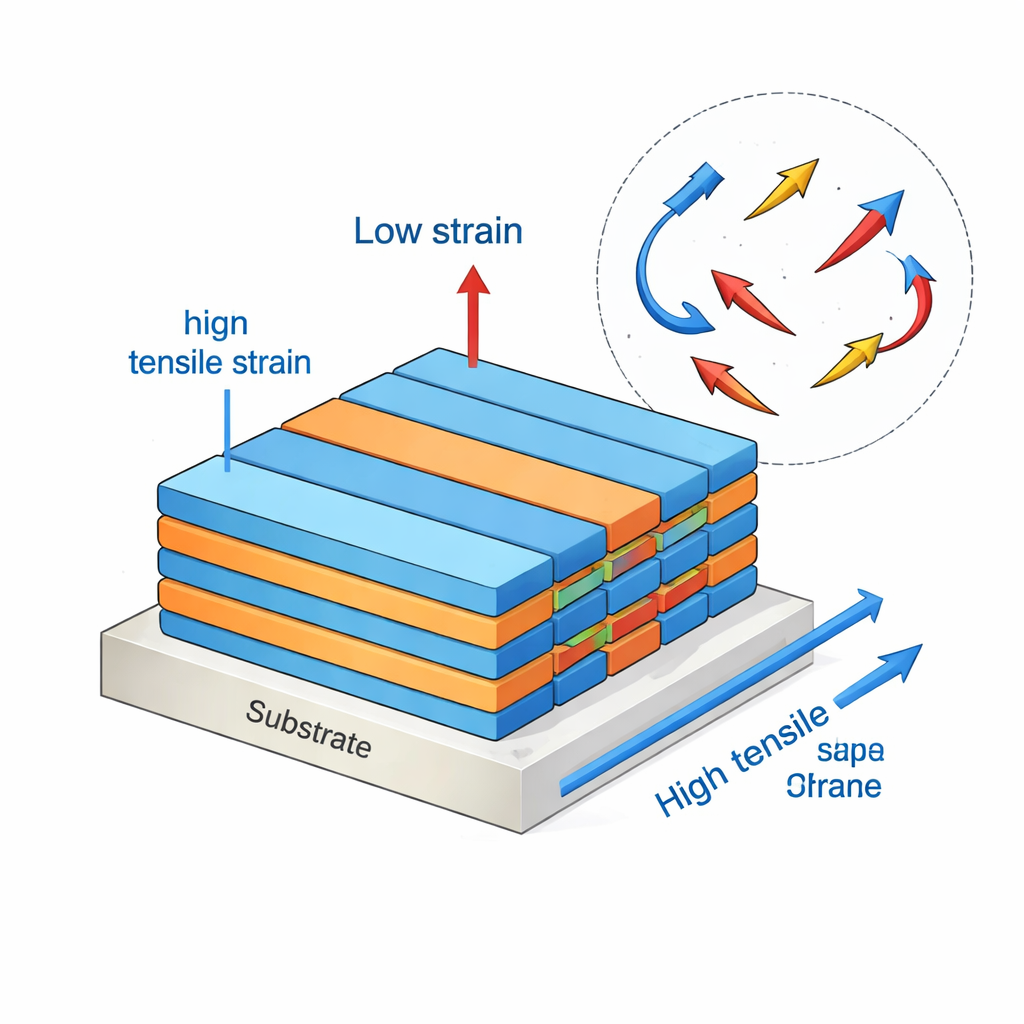
The team grew a superlattice: four repeats of two different oxide layers, LaFeO3 (an antiferromagnet) and La0.7Sr0.3MnO3 (a ferromagnet), on a DyScO3 crystal substrate. This substrate squeezes and stretches the film differently along two in‑plane directions: one direction is pulled strongly, the perpendicular one is only slightly compressed. Using high‑resolution X‑ray diffraction, the authors confirmed that the stack is highly ordered and that, on average, its lattice spacing closely resembles bulk LaFeO3. This already hints that the LaFeO3 layers dominate how the whole stack relaxes the imposed strain.
Where and How the Strain Lets Go
To see how the strain actually relaxes, the team combined several electron‑diffraction and microscopy techniques that probe local crystal spacing with nanometer precision. They found that along the direction of strong tensile strain, the first LaFeO3 layer remains tightly locked to the substrate. Relaxation begins in the very first La0.7Sr0.3MnO3 layer grown on top, where the lattice spacing changes abruptly. Above this, the in‑plane distances in both materials settle close to bulk LaFeO3, indicating that the ferromagnetic layers remain partly strained to match the antiferromagnetic ones. Along the perpendicular, low‑strain direction, however, the layers stay coherently locked to the substrate, so the relaxation is selective and highly directional.
Domains That Grow from the Steps
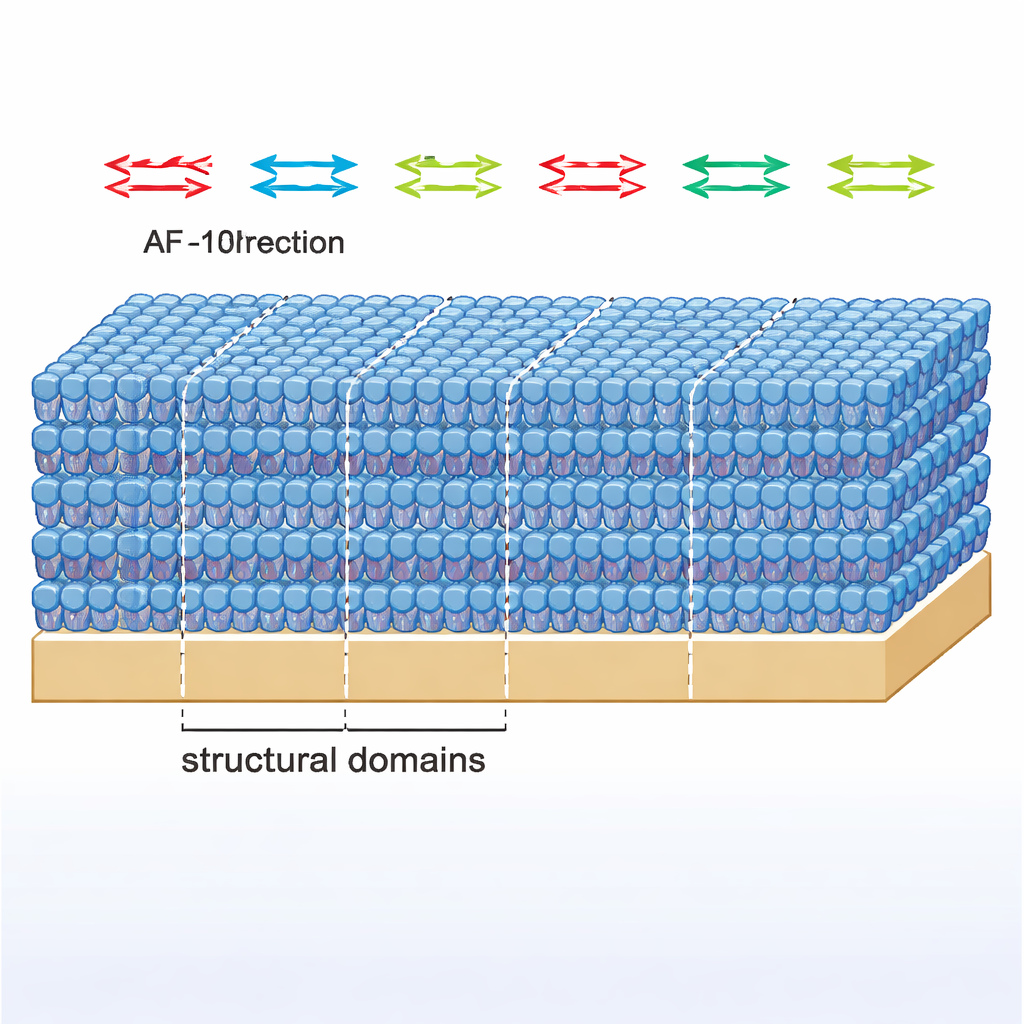
Electron‑microscopy methods sensitive to subtle diffraction features revealed that this relaxation does not create obvious crystal defects like dislocations. Instead, it leads to the formation of well‑defined structural domains inside the LaFeO3 layers. These domains appear only from the second bilayer onward and stack vertically through the film, with widths matching the natural step‑and‑terrace pattern on the substrate surface. In effect, the tiny steps on the underlying crystal act as seeds from which distinct structural variants of LaFeO3 grow side by side, providing a gentle pathway for the film to relieve strain without tearing its lattice.
From Crystal Patterns to Magnetic Patterns
Because magnetism in these oxides is closely tied to how atoms are arranged, the team investigated whether the structural domains are accompanied by magnetic ones. Using X‑ray absorption with circular and linear polarization, they probed the direction and distribution of spins in both materials. The La0.7Sr0.3MnO3 layers showed the expected in‑plane ferromagnetic response, though somewhat reduced near the surface. The LaFeO3 layers displayed signatures of multiple antiferromagnetic domains whose spin axes lie predominantly in the plane of the film. Comparing with earlier work, the authors conclude that the presence of structural domains coincides with an antiferromagnetic polydomain state, whereas fully strained LaFeO3 can be forced into a single‑domain configuration.
What This Means for Future Spintronics
To a non‑specialist, the key message is that by choosing the right substrate and stacking sequence, scientists can program where and how a thin film relaxes its internal stress, and that this, in turn, programs how its hidden magnetic regions arrange themselves. Here, strong directional strain first relaxes in one layer, then induces neat vertical structural domains in the next, which go hand in hand with multiple antiferromagnetic domains. This strain‑domain‑magnetism link suggests a route to "write" antiferromagnetic patterns already during growth, offering a new design knob for future spintronic devices that aim to use antiferromagnets as active, controllable elements rather than passive support layers.
Citation: Liu, Y., Dale, T.M., van der Minne, E. et al. Structural relaxation and domain formation in anisotropically strained La0.7Sr0.3MnO3/LaFeO3 superlattices on DyScO3(101). Sci Rep 16, 5123 (2026). https://doi.org/10.1038/s41598-026-35436-2
Keywords: antiferromagnetic spintronics, strain engineering, oxide superlattices, structural domains, thin film magnetism