Clear Sky Science · en
Optimal electric vehicle charging stations and distributed generation placement by partitioning the distribution network using the modified newman fast algorithm
Charging up cleaner cities
As more drivers switch from gasoline cars to electric vehicles, our power grids must keep up. Fast and convenient charging is essential, but if many cars plug in at once, the local network of poles, wires, and transformers can be pushed beyond its limits. This paper explores how to place both electric vehicle charging stations and small local power sources in a smarter way so neighborhoods can welcome more EVs while keeping lights steady and bills lower.
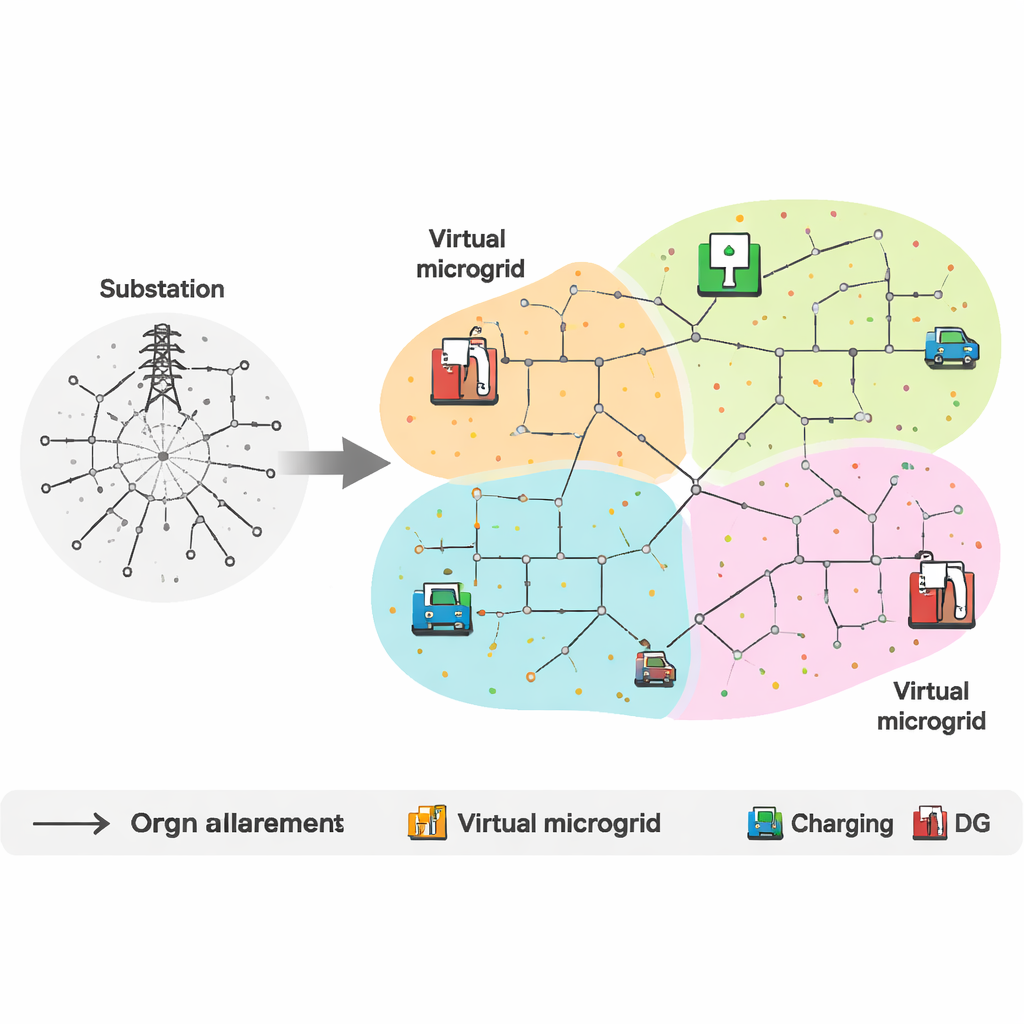
Breaking big grids into smaller neighborhoods
Instead of treating a city’s distribution network as one giant tangle of wires, the authors divide it into smaller, electrically tight “neighborhoods” called virtual microgrids. They use a technique from network science, the modified Newman fast algorithm, but adapt it to electricity by measuring how strongly any two points in the grid are linked in real electrical terms, not just by physical distance. This measure, called electrical coupling strength, blends how easy it is for power to flow between two points with how much each line can safely carry. The result is a set of clusters where the lines inside each cluster are strongly connected and operate as a coherent local zone.
Adding chargers and small power plants where they help most
Once the grid is split into these virtual neighborhoods, the next step is deciding where to put each electric vehicle charging station and each distributed generator, such as a small synchronous generator or wind‑based unit. The authors give each virtual microgrid exactly one charging station and one small power source. They then search for the best bus, or node, inside each neighborhood by focusing on the weakest spots in the system—locations where the voltage is lowest and stability is poorest. By reinforcing those points, they can reduce wasted energy and keep voltages within safe limits, even as EV charging demand grows.
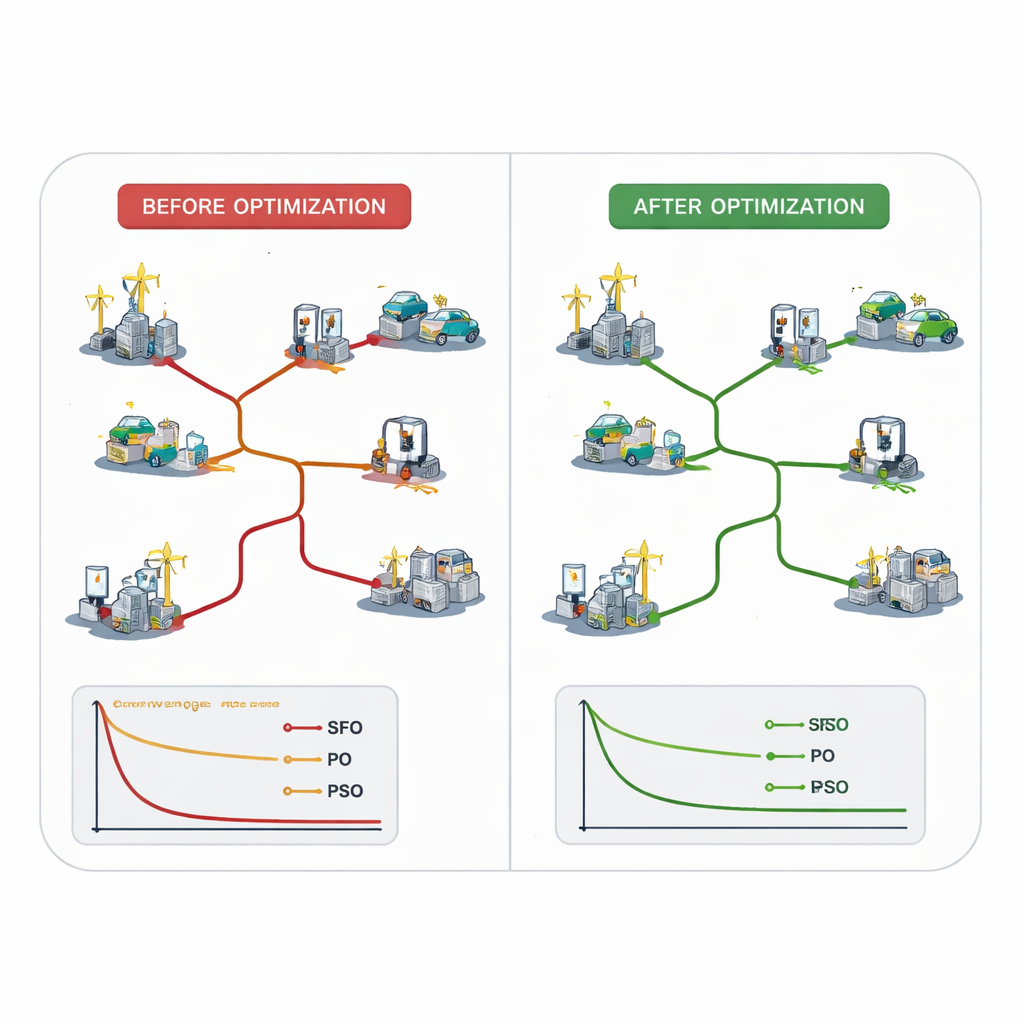
Borrowing strategies from nature to find the best layout
Finding the ideal mix of locations and sizes for chargers and generators is a huge puzzle with many moving parts. To solve it, the authors compare three advanced search methods known as metaheuristic algorithms. Two of them are new, nature‑inspired approaches: the Starfish Optimization algorithm, based on how starfish forage and regrow limbs, and the Puma Optimization algorithm, based on how pumas explore and hunt in their territory. The third, Particle Swarm Optimization, is a more established technique modeled on flocks of birds or schools of fish. All three aim to minimize power losses on the lines while improving a measure of voltage stability, and they must also respect operating limits such as line heating and generator size caps.
Big improvements on both small and large networks
The researchers test their framework on two standard benchmark networks: a modest 33‑bus system and a much larger 118‑bus system. In the smaller case, their method cuts active power losses by about 82 percent and raises the lowest voltage from a worrying level to one close to the desired value, while also greatly improving a stability index. In the larger network, losses fall by roughly 68–69 percent with similar gains in voltage quality and stability. Among the three search methods, the puma‑based algorithm converges fastest to high‑quality solutions, especially in the larger grid, suggesting it is well suited for large‑scale planning where time and computing power are limited.
Looking toward real‑time, renewable‑rich grids
Beyond static planning, the study sketches how this strategy can be extended to more realistic, time‑varying conditions. The authors build daily load profiles for different customer types and simulate uncoordinated EV charging, which raises peak demand and grid stress. They then add wind‑driven generators inside the virtual microgrids and show that these local renewables can shave peaks in both demand and losses while further supporting voltages. Although the current work focuses on technical performance rather than cost or emissions, it points to a future in which city grids are divided into intelligent neighborhoods that host EV chargers and local clean generation in precisely chosen locations.
What this means for everyday drivers
For non‑experts, the main message is that where we place charging stations and small power plants matters as much as how many we build. By first carving the grid into natural electrical neighborhoods and then using smart, nature‑inspired search methods to strengthen the weakest points, utilities can dramatically cut waste, keep voltages steady, and make room for far more electric vehicles. In practice, this means fewer blackouts and brownouts, more reliable charging, and a smoother path to cleaner transportation as renewables and EVs become central to everyday life.
Citation: Mohamed, M.A.E., Gawish, A.N.A. & Metwally, M.E. Optimal electric vehicle charging stations and distributed generation placement by partitioning the distribution network using the modified newman fast algorithm. Sci Rep 16, 6341 (2026). https://doi.org/10.1038/s41598-026-35433-5
Keywords: electric vehicle charging, power distribution networks, distributed generation, grid optimization, virtual microgrids