Clear Sky Science · en
Assessing decadal changes in human exposure near wildfires in a Mediterranean region
Why fires are getting closer to where people live
Wildfires are a familiar summer headline around the Mediterranean, but this study asks a less obvious question: even if the total area burned by fire is not exploding, are more people and homes now in harm’s way? Focusing on Catalonia in northeastern Spain, the authors trace how towns, suburbs, and infrastructure have crept into fire‑prone landscapes over 30 years, revealing that our changing patterns of where we live can quietly turn ordinary fires into major disasters.
A region on the frontline of fire
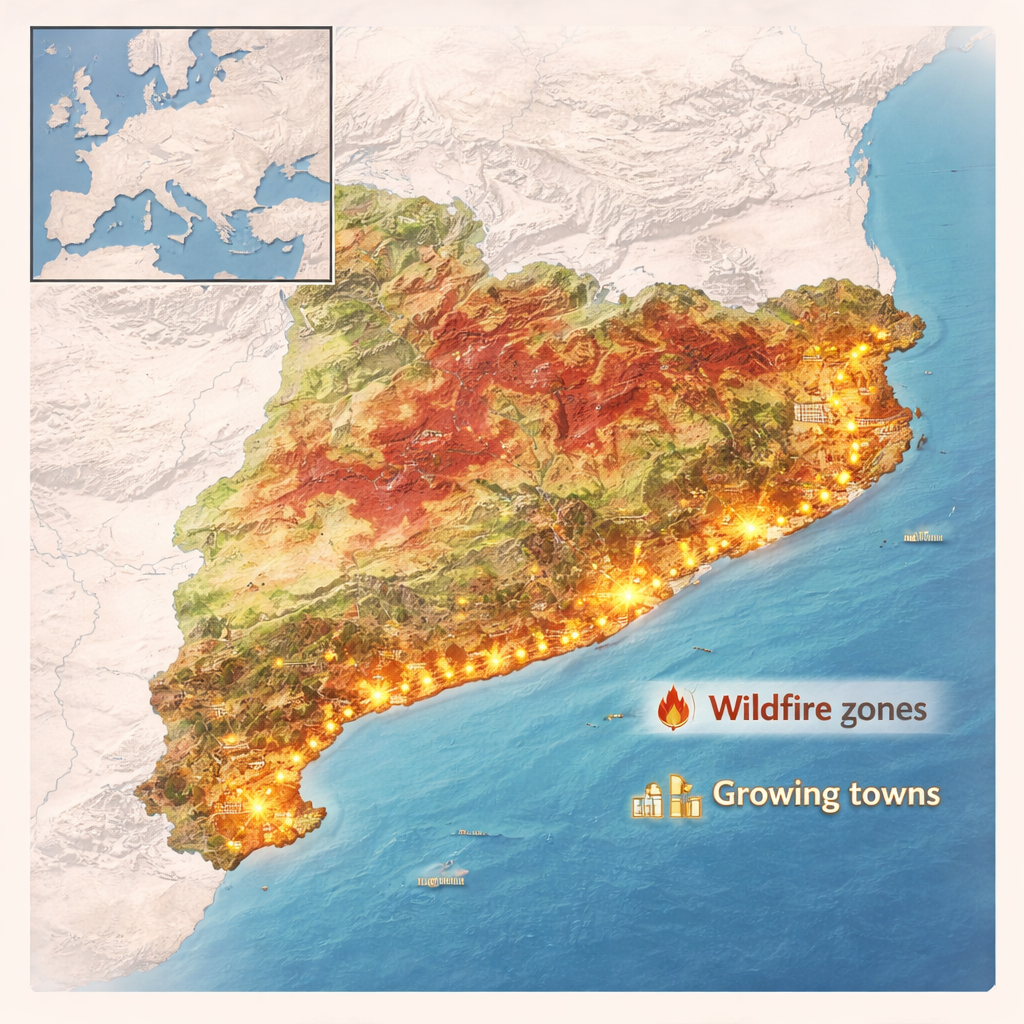
Catalonia is one of Europe’s most fire‑prone regions, with rugged hills, dense vegetation, and a busy Mediterranean coastline. Over recent decades, its towns and second homes have spread inland and along the coast, often into areas that burn naturally. At the same time, climate change has brought hotter, drier conditions that make dangerous fire weather more frequent and more intense. This mix of expanding settlements and a warming climate has already proved deadly: Spain has recorded more fire‑related deaths than any other southern European country, with many of those tragedies clustered along the Mediterranean coast.
Looking at lights, buildings, and people
To understand how human exposure to wildfires has changed from 1992 to 2021, the researchers combined several kinds of detailed maps. They used official fire‑perimeter records to show where fires actually burned. They then overlaid three different measures of human presence: satellite images of nighttime lights (which glow brighter as cities, roads, and infrastructure grow), a high‑resolution population grid that estimates how many people live in each small area, and building‑density maps that count how many structures stand on the landscape. By comparing these layers over time—both inside burned areas and within set distances around them—they could see whether more people and buildings now sit in the path of fire.
Less forest burned, but more people at risk
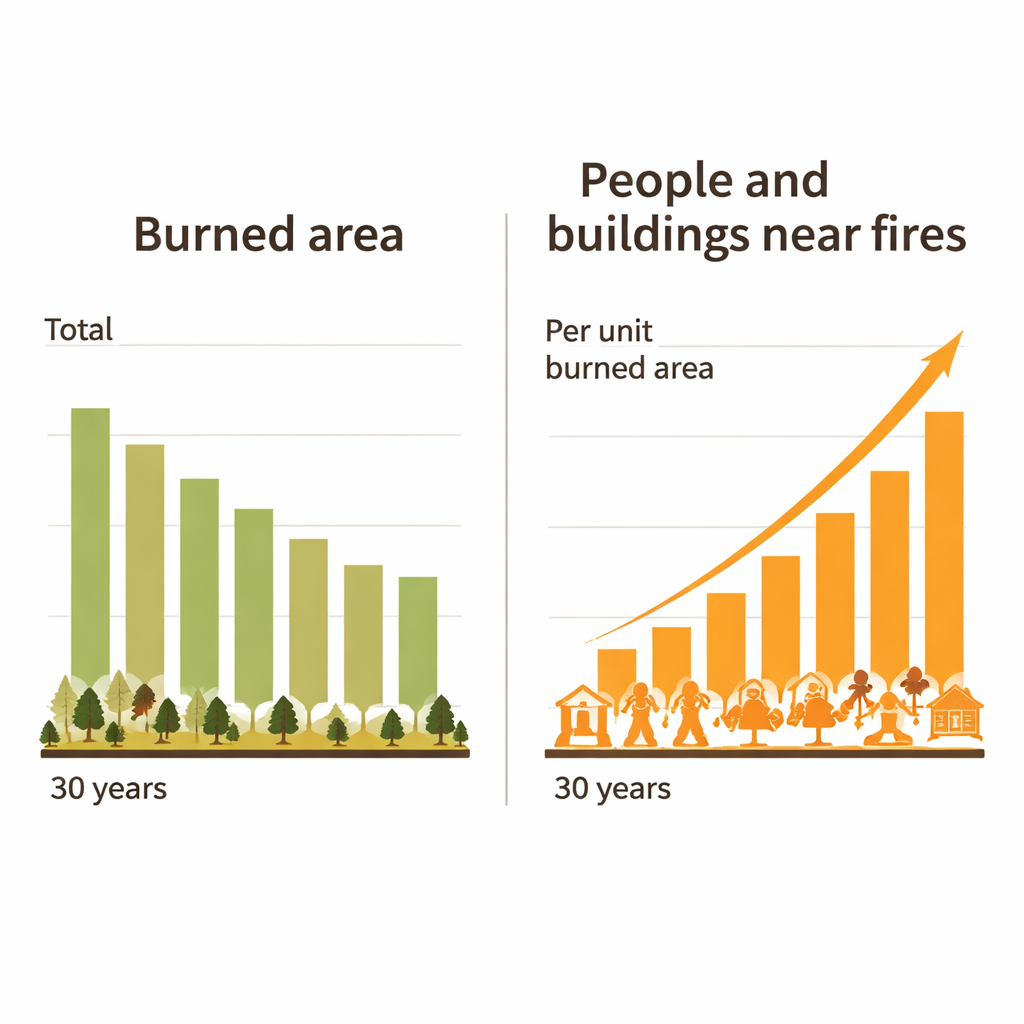
The total forest area burned in Catalonia each year bounced up and down, with an extreme year like 1994 standing out, and it showed a slight but statistically weak decline over the three decades. Yet when the team asked how many people, lights, and buildings lay within fire perimeters and within 5 kilometers of them, the story flipped. Human exposure per unit of burned land rose dramatically—by roughly 40% to more than 100%, depending on the dataset and how far from the flames you look. In other words, even if slightly less forest is burning overall, far more people and assets are now in or near those burned zones, especially in coastal and suburban areas where new housing has pushed up against flammable vegetation.
Testing a ‘what if nothing had changed’ world
To pinpoint what drives this increase, the authors built a “counterfactual” scenario: they froze the population, lights, and buildings at their early‑1990s levels and let only the fires vary from year to year. Comparing this imaginary stable world with reality showed that most of the rise in exposure comes from where and how people have chosen to build and move, not from fires simply getting bigger. In many places, new suburbs, roads, and infrastructure appeared in areas that had little sign of exposure in 1992, especially around the wildland‑urban interface—the fuzzy edge where neighborhoods meet forests and scrublands. This pattern mirrors what has been seen in places like California and Greece, where spreading communities have sharply increased the stakes of each fire season.
What this means for living with fire
The study’s message for non‑specialists is straightforward: in Catalonia, the danger from wildfires is rising not mainly because the countryside is burning more, but because we have moved more people, homes, and infrastructure into harm’s way. The authors argue that fire risk plans must look beyond how many hectares burn and focus on who and what is in those hectares. That means weaving fire awareness into urban planning and building rules, designing neighborhoods and escape routes with flames and smoke in mind, and pairing local preparedness with efforts to slow climate change. By treating wildfire as a permanent neighbor rather than an occasional surprise, Mediterranean societies can aim for a more resilient coexistence with fire.
Citation: Torres-Vázquez, M.Á., Vaglie, M.D., Kettridge, N. et al. Assessing decadal changes in human exposure near wildfires in a Mediterranean region. Sci Rep 16, 5827 (2026). https://doi.org/10.1038/s41598-026-35426-4
Keywords: wildfire risk, urban expansion, Mediterranean climate, wildland-urban interface, Catalonia