Clear Sky Science · en
Altered abundance in cancer patients gut of diadenylate cyclase-encoding bacteria
Why the Bacteria in Our Guts Matter for Cancer Care
In recent years, scientists have learned that the trillions of microbes living in our intestines can influence how our immune system spots and fights tumors. This study explores a particular chemical signal made by gut bacteria, called c-di-AMP, and asks a simple but important question: do people with cancer have fewer bacteria that make this signal than healthy people—and could that affect how well cancer treatments work?
A Tiny Signal with a Big Role
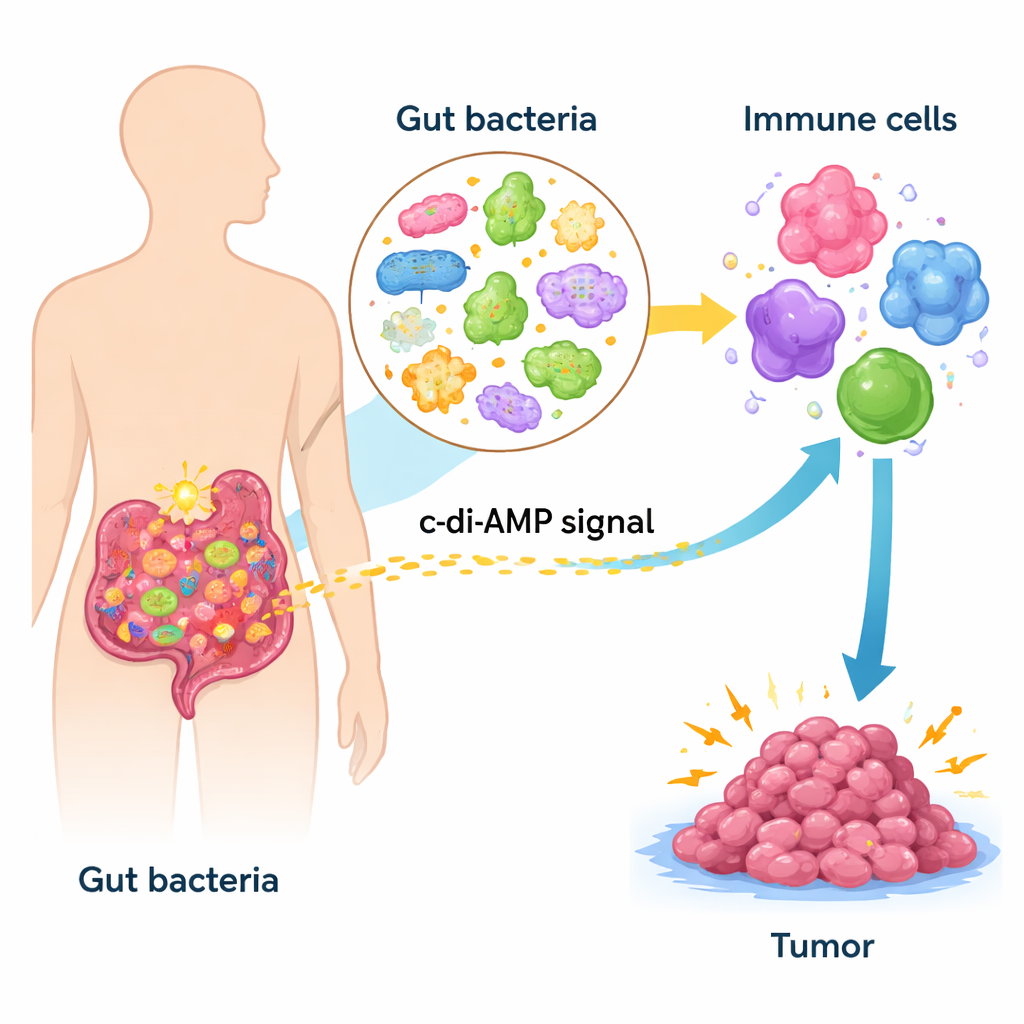
Bacteria use c-di-AMP as an internal alarm system to manage stress, repair damage, and control their growth. But this molecule doesn’t stay hidden inside microbes. Our immune cells can sense it through a protein called STING, which helps switch on antiviral and anti-tumor defenses. Earlier work in animals suggested that bacterial c-di-AMP can strengthen the effects of modern cancer treatments, such as immune checkpoint inhibitors and radiotherapy. That raised the possibility that having more c-di-AMP–producing bacteria in the gut might help the immune system keep cancer in check.
Building a Map of Helpful Gut Bacteria
To investigate this idea, the researchers first set out to identify which human gut microbes can make c-di-AMP. They mined a massive catalog of proteins from more than 289,000 gut microbial genomes and searched for the genes that make the enzyme diadenylate cyclase, which produces c-di-AMP. From this, they built a database of over four thousand such enzymes spread across nearly four thousand gut species. These c-di-AMP–capable microbes turned out to be very common in healthy intestines and widely distributed across many bacterial groups, especially those that are typical residents of a balanced gut ecosystem.
Comparing Healthy People and Cancer Patients
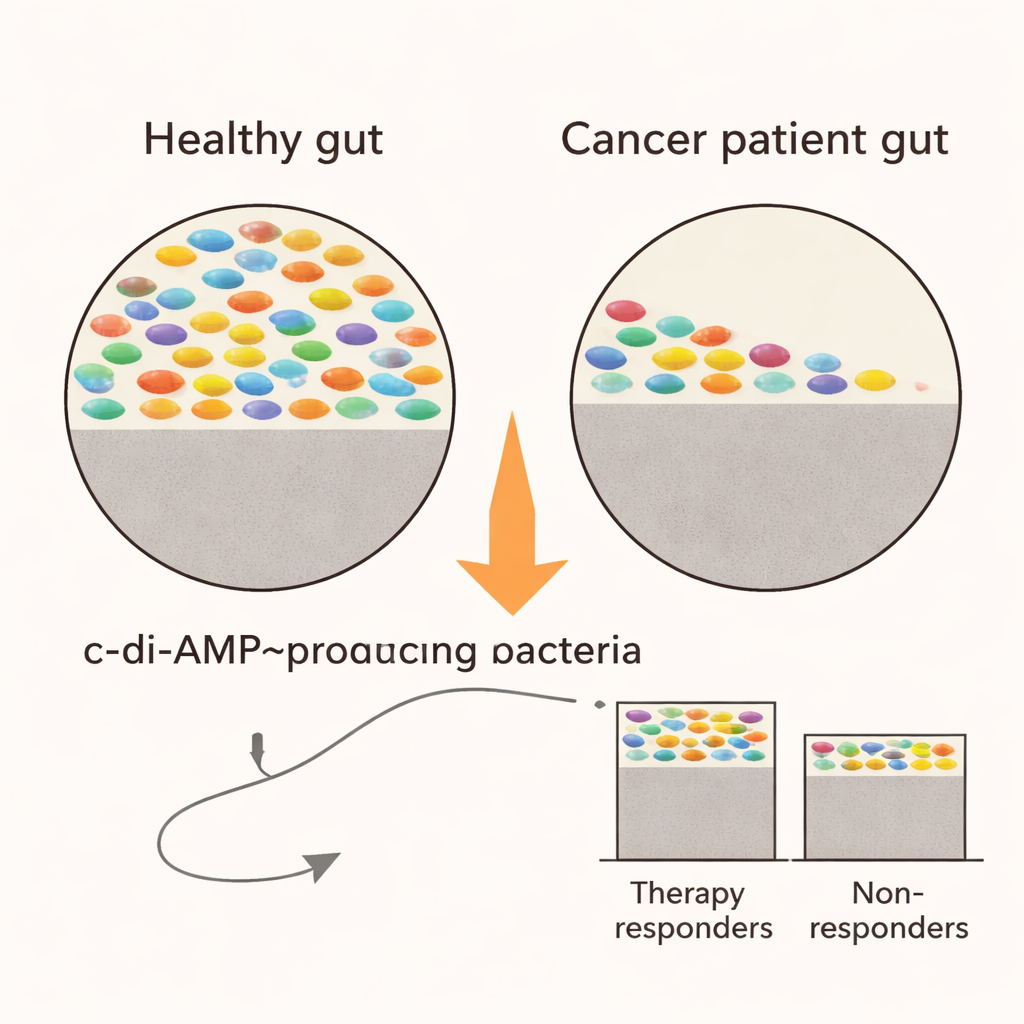
The team then analyzed gut DNA from 190 healthy volunteers and 569 patients with advanced melanoma, lung cancer, or kidney cancer, all about to start immunotherapy. They checked how many of the bacteria in each person’s gut belonged to species able to make c-di-AMP. Healthy individuals had very high levels: on average, about 96% of their gut bacteria could produce this molecule. Cancer patients, however, had a noticeable drop, down to roughly 92%, with some patients showing much lower levels. At the same time, cancer patients had more of certain microbes, such as Escherichia coli and other Proteobacteria, as well as many Bifidobacteria—groups that generally do not carry the genes needed to make c-di-AMP.
Links to Treatment Response—But No Clear Cut-Off
Because earlier studies hinted that higher c-di-AMP levels might improve responses to cancer therapy, the researchers also compared patients who responded to immunotherapy with those who did not. Responders tended to have slightly more c-di-AMP–producing species and less variation between individuals, but these differences were too small to reach clear statistical proof. The study was based on which bacteria were present, not on direct measurements of c-di-AMP in stool or blood, and it did not track exactly how or when bacteria release this molecule for the immune system to sense. Those gaps may help explain why treatment outcomes did not line up neatly with the bacterial profiles.
What This Could Mean for Future Cancer Treatments
Overall, the results suggest that bacteria able to make c-di-AMP are a core part of a healthy gut community and that cancer patients often show a shift toward microbes that lack this function. For a layperson, the takeaway is that some of our everyday gut bacteria may quietly support the body’s anti-cancer defenses by sending molecular “help” signals to the immune system. While this study cannot yet say that restoring these bacteria will make immunotherapy work better, it points to promising new ways to design probiotics, diets, or microbial therapies that boost c-di-AMP signaling and, one day, potentially help cancer treatments hit harder.
Citation: Candeliere, F., Sola, L., Busi, E. et al. Altered abundance in cancer patients gut of diadenylate cyclase-encoding bacteria. Sci Rep 16, 6070 (2026). https://doi.org/10.1038/s41598-026-35425-5
Keywords: gut microbiome, cancer immunotherapy, bacterial signaling, c-di-AMP, STING pathway