Clear Sky Science · en
Investigation of airborne microplastics emission and characteristics in hospital laundry environments
Invisible Plastic in the Hospital Air
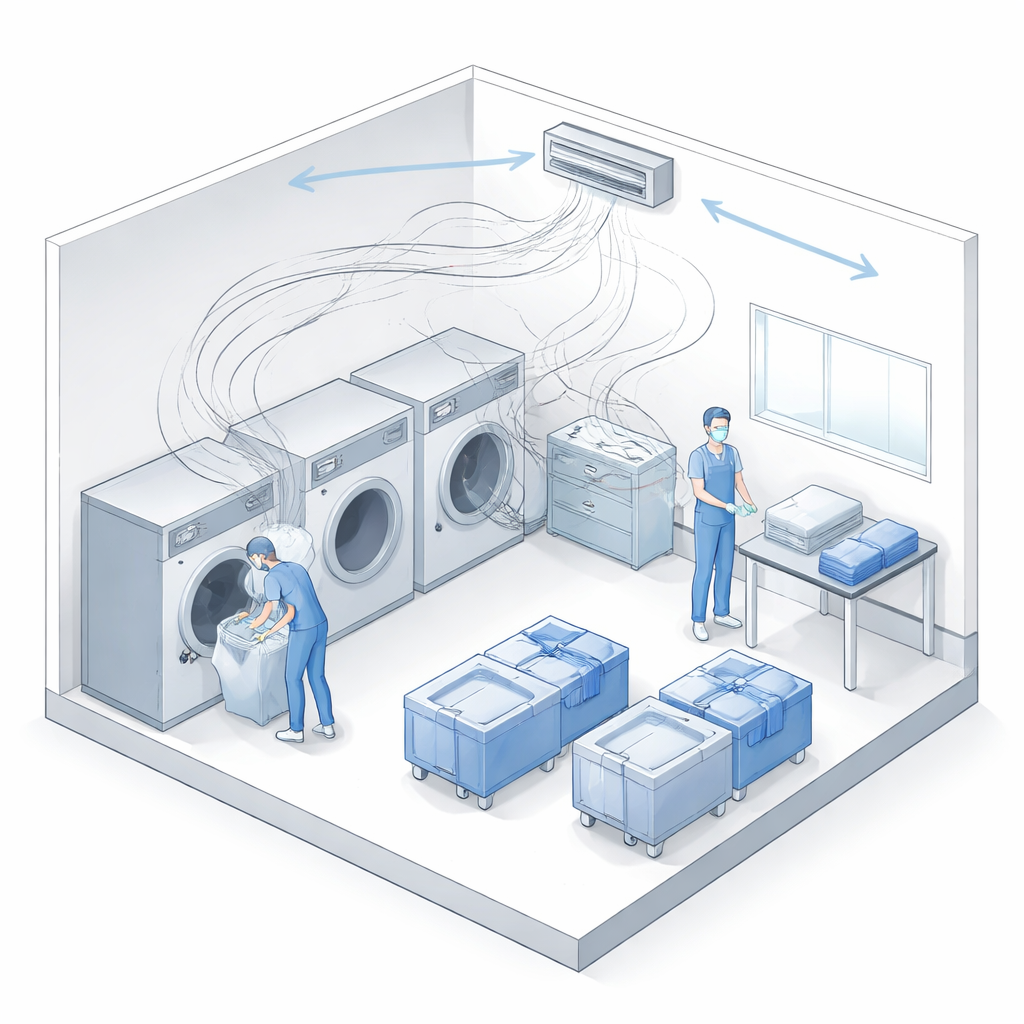
When we think about hospitals, we imagine places focused on healing, not hidden pollution. Yet this study reveals that a quiet, everyday corner of the hospital—the laundry room—may be filling the air with tiny plastic fibers that can be breathed into our lungs. By looking closely at the air around washing and drying hospital textiles, the researchers uncovered large numbers of airborne microplastics and raised new questions about how safe these workspaces really are for staff and nearby patients.
Tiny Plastics and Why They Matter
Microplastics are tiny pieces of plastic smaller than a grain of rice, created when larger plastic items wear down and break apart. We usually hear about them in the oceans or in drinking water, but they can also float through the air we breathe. Inside buildings, these particles often come from synthetic fabrics, packaging, and everyday plastic products. Hospitals are especially plastic-heavy settings, full of synthetic gowns, uniforms, curtains, and bedding. Until now, most research has focused on microplastics in hospital wastewater. This study turned instead to the air, zeroing in on the laundry department—a place where large volumes of synthetic textiles are constantly washed, dried, and handled.
Measuring the Air in a Busy Laundry Room
The research team worked in the central laundry of Imam Reza Hospital in Mashhad, Iran, one of the country’s major medical centers. Using a portable air pump worn at breathing height, they collected air samples twice a day, morning and afternoon, over four consecutive days, at different spots near washing, drying, and folding stations. The air was pulled through fine filters that trapped particles, which were later examined in the lab with microscopes and specialized instruments. The scientists were careful to avoid contaminating the samples, using ethanol-cleaned tools, protective gowns that shed minimal fibers, and blank control filters to subtract any background particles.
What the Tiny Fibers Looked Like
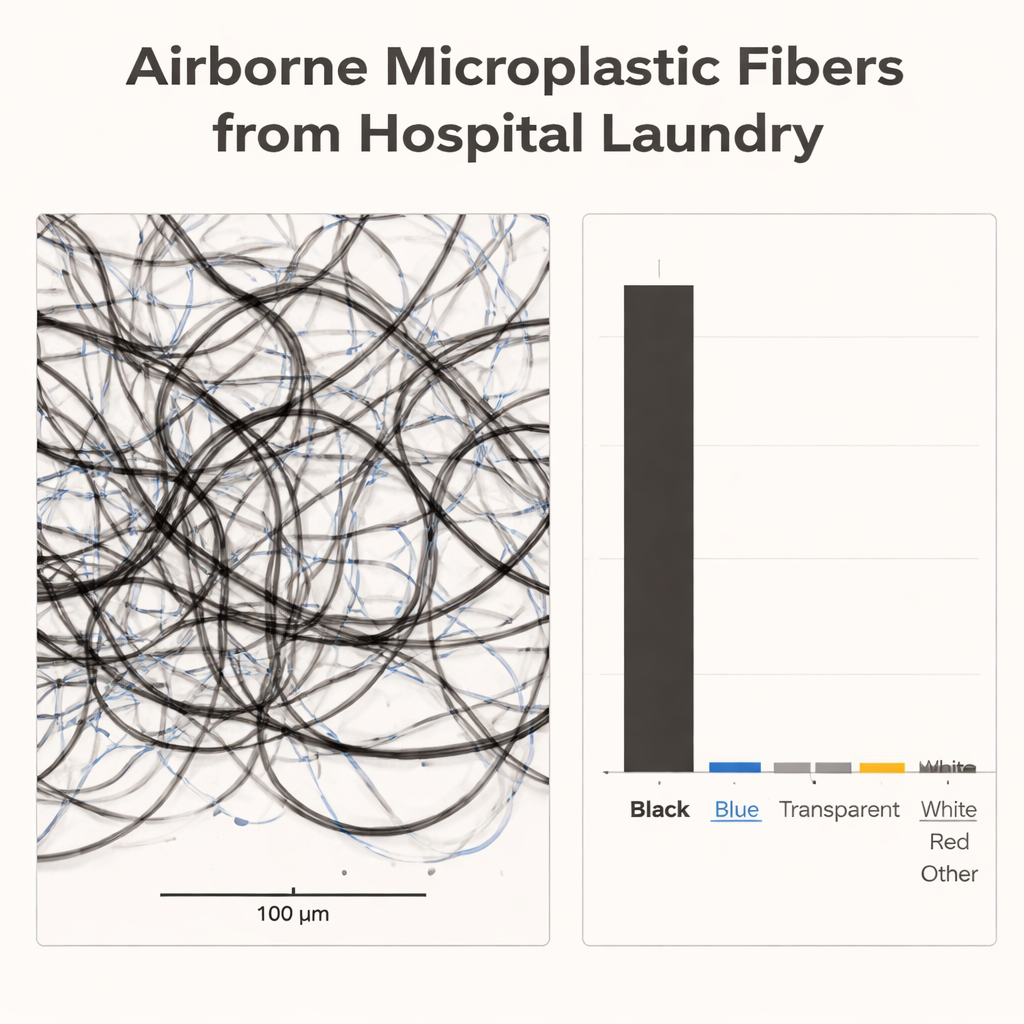
Under the microscope and more powerful electron imaging, the trapped particles were mainly thin, hair-like fibers, often tangled together. They were small enough to float in air and be inhaled—thinner than a human hair and up to about a millimeter long. Chemical fingerprinting showed that most of these fibers were a type of plastic called polyamide, better known as nylon, commonly used in textiles. Element analysis confirmed a composition rich in carbon and nitrogen, again matching nylon. When the researchers looked at color, black fibers overwhelmingly dominated, making up about 97% of all particles, with only tiny fractions of blue, red, orange, yellow, pink, green, and other colors. These shades match the dark uniforms, gowns, blankets, and other textiles widely used in hospitals, reinforcing the idea that routine washing and drying sheds clouds of microscopic fibers into the laundry air.
How Much Plastic Was in the Air?
Across the sampling period, the number of airborne microplastic particles ranged from roughly 43,600 to 67,000 per cubic meter of air—a surprisingly high level compared with many other indoor spaces. Although there were differences from day to day and between morning and afternoon, statistical tests showed that these variations were not clearly linked to temperature, humidity, or air movement in the room. The study was designed as a pilot, with modest air volumes and only four days of measurements, so the authors stress that the exact numbers should be seen as approximate. Still, the results strongly suggest that hospital laundries can be important hotspots for microplastic exposure, on par with other busy indoor environments where synthetic fabrics are constantly used and disturbed.
What This Means for Health and Hospitals
Scientists are only beginning to understand what breathing in microplastics does to the human body, but early work hints at possible irritation, inflammation, and the ability of particles to carry other chemicals deep into the lungs. This study does not measure health effects directly, but it highlights that laundry workers, and perhaps people nearby, are regularly breathing air full of synthetic fibers. The authors argue that hospital design and safety standards should start to consider microplastics alongside more familiar pollutants like dust and germs. Better ventilation, local exhaust near washers and dryers, and filtration could help reduce exposure. They also call for longer-term monitoring and toxicology studies so that hospitals can make evidence-based decisions. For now, the message is clear in simple terms: keeping clothes clean in hospitals may come with an unseen plastic cost, and it is time to bring this hidden pollution into view.
Citation: Rangrazi, A., Bonyadi, Z. & Sarkhosh, M. Investigation of airborne microplastics emission and characteristics in hospital laundry environments. Sci Rep 16, 6107 (2026). https://doi.org/10.1038/s41598-026-35421-9
Keywords: microplastics, hospital laundry, indoor air, occupational exposure, synthetic textiles