Clear Sky Science · en
Secure IoMT smartwatch-based blood glucose monitoring using multimodal activity and nutrition data with transfer learning
Why your smartwatch could help manage blood sugar
Many people live with rising blood sugar, whether they have diabetes or are simply under too much stress and eating on the run. Traditional finger-prick tests or separate glucose sensors can be inconvenient, and they rarely capture how everyday choices like meals, walks, or long hours at a desk affect your body in real time. This study explores how ordinary smartwatches, combined with secure internet-connected health systems, might quietly watch over your blood sugar throughout the day—linking what you eat and how you move to rapid, personalized warnings and advice.
A watch that sees more than steps
The researchers propose an "enhanced body sugar monitoring" system that turns a smartwatch into a central hub for health signals. Modern watches can already measure heart rate, blood pressure, oxygen levels, temperature, movement, and sometimes glucose. In this work, the watch also records your activities—such as sitting, walking, jogging, or sleeping—and your nutrition, including different types of food and drinks. All these streams of information are treated together as a multimodal dataset, painting a richer picture of how your body responds to daily life than glucose readings alone. 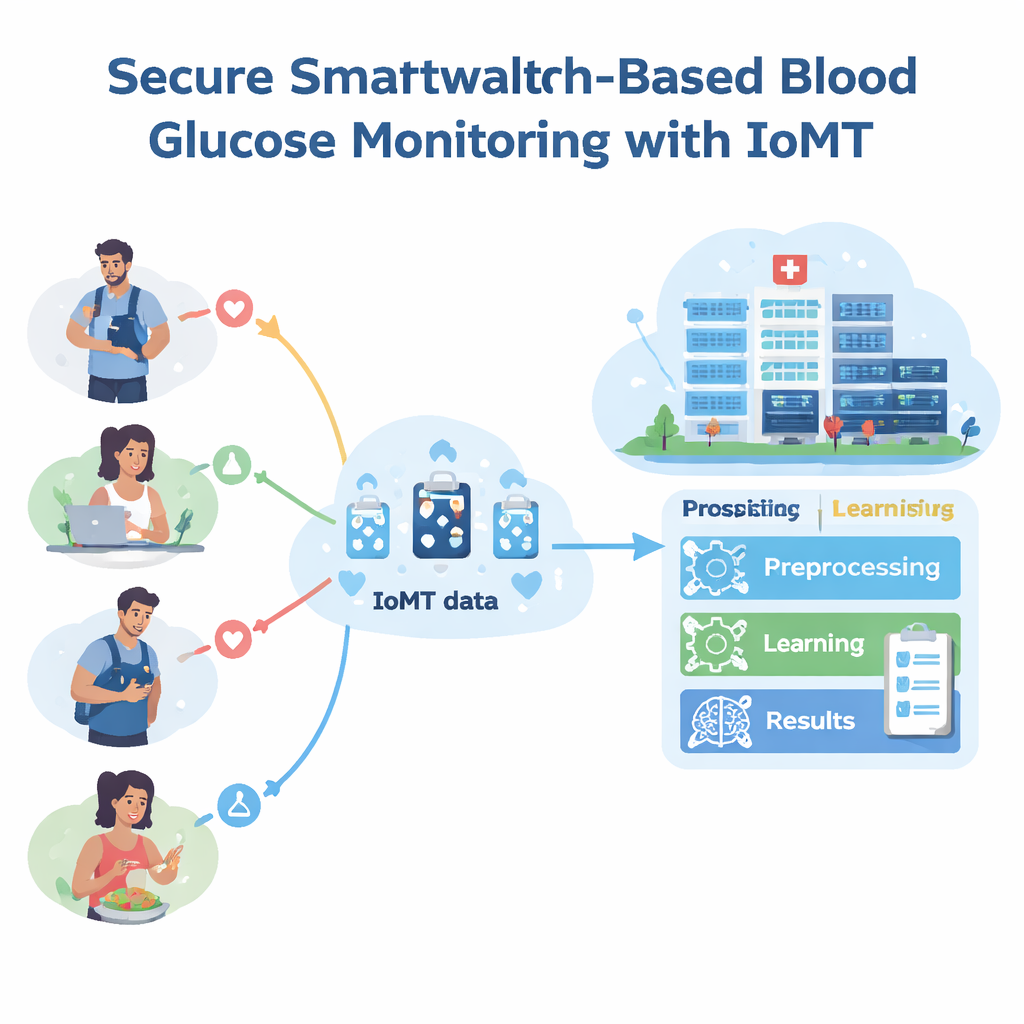
Sending data to nearby helpers, safely
Because a watch has limited battery and computing power, it cannot perform heavy analysis on its own. The system therefore treats the watch as a secure "client" that sends data to nearby medical servers at clinics or hospitals, known as edge nodes. A custom security procedure, combined with standard encryption methods, protects the data as it moves back and forth so that only authorized machines can read it. An intelligent scheduler decides when to send data away for deeper analysis and when to process it lightly on the watch itself, weighing up network quality, urgency, and energy use. For example, if your readings are stable and the network is weak, the watch may wait; if your sugar is changing rapidly after a big meal or intense exercise, it will push data out quickly for more detailed checks.
Teaching computers to recognize risky patterns
At the heart of the system is an artificial intelligence method the authors call TL-DCNNOS, which combines deep neural networks with transfer learning and smart task scheduling. First, a large open-world dataset—built from smartwatch sensors, activity logs, and food records from many people—is used to pre-train the model to recognize general patterns in how glucose behaves. Later, when your own data arrive, the model fine-tunes only its upper layers to learn your specific responses without starting from scratch. This approach lets the system pick up signs of normal and abnormal behavior, such as the difference between a gentle rise after fruit and a sharp spike after sugary drinks, even when limited personal data are available. The same framework also decides which server should handle each job so that results arrive fast enough for real-time use.
Testing the idea in a virtual clinic
To see whether this design could work in practice, the team built a detailed computer simulation that mimics many smartwatch users going about their day. They created a multimodal dataset of 1,200 records, including age, body mass index, blood pressure, diet type (such as cookies, burgers, or carbohydrates), activity (sitting, walking, running), and glucose levels. They then compared their TL-DCNNOS approach with common machine learning methods like decision trees, random forests, and k-nearest neighbors. Across measures such as accuracy, precision, and recall, the new method consistently performed best, reaching about 99% accuracy in distinguishing healthy from risky glucose patterns. It also completed its tasks with less overall processing time by splitting work across many edge servers and only sending what was necessary.
Protecting privacy while watching over health
The authors also examined how different encryption schemes affect delay when many people’s watches are sending data at once. Their simplified smartwatch security algorithm (SWSA) produced lower and more stable delays than widely used public-key methods, which can be heavy for small devices. This suggests that with the right balance of security and efficiency, it is possible to keep sensitive medical information private without slowing down urgent alerts. The system is designed to comply with major privacy and medical-device rules such as HIPAA and GDPR, and the authors have released their dataset and code so others can test and improve the ideas. 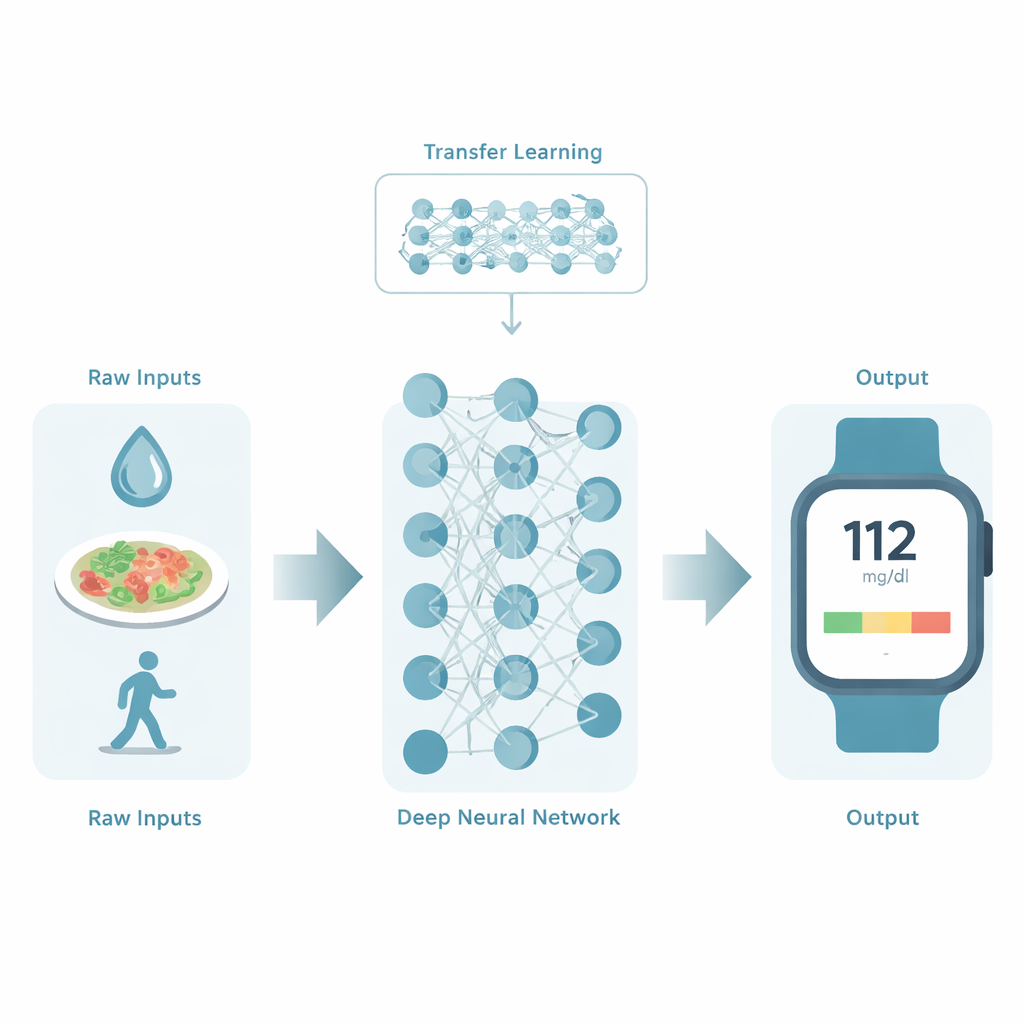
What this could mean for everyday life
For non-specialists, the key outcome is that a familiar gadget—the smartwatch—could evolve into a powerful, continuous blood sugar guardian. By securely linking your watch to nearby medical servers and using advanced learning techniques, the system can relate what you eat and how active you are to rapid, individualized predictions of glucose swings. In the long run, such tools could help people with diabetes avoid dangerous highs and lows, and help those at risk see the impact of their habits early enough to change course. While real-world clinical trials are still needed, this work lays the groundwork for safer, smarter, and more personal glucose monitoring woven into the devices many of us already wear.
Citation: Mohammed, M.A., Ghani, M.K.A., Memon, S. et al. Secure IoMT smartwatch-based blood glucose monitoring using multimodal activity and nutrition data with transfer learning. Sci Rep 16, 6736 (2026). https://doi.org/10.1038/s41598-026-35419-3
Keywords: blood sugar, smartwatch health, wearable sensors, digital diabetes care, internet of medical things