Clear Sky Science · en
Wideband tilted beam end-fire antenna using double semi-circular rings
Sharper Wireless Beams for Busy Indoor Spaces
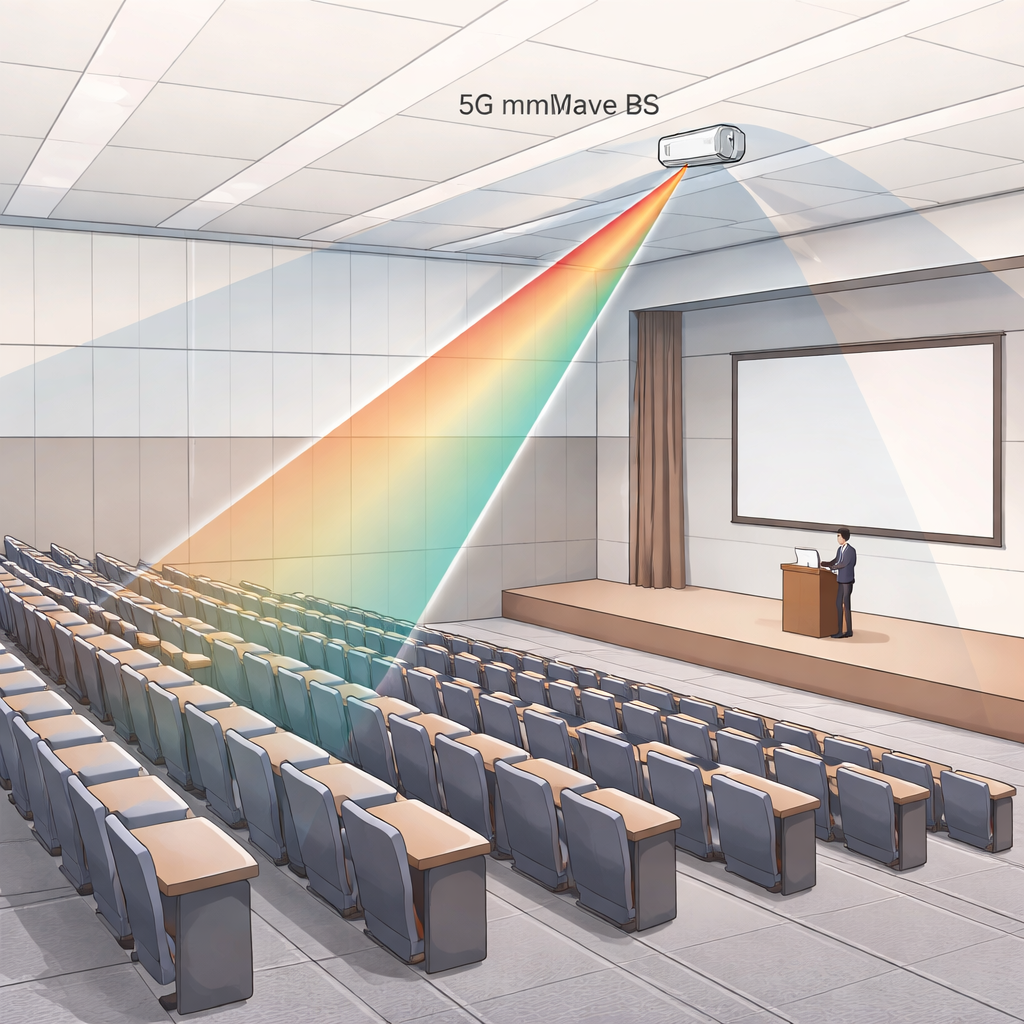
Imagine a crowded lecture theater or shopping mall where everyone is streaming video or joining video calls at once. Today’s Wi‑Fi and 5G networks can struggle to deliver fast, reliable connections in such demanding spaces. This article explores a new kind of tiny antenna that can send a strong, highly focused wireless beam toward where the users are, across a huge span of high‑frequency 5G and WiGig channels, potentially boosting speed and signal quality indoors.
Why Future 5G Needs New Antennas
Our smartphones and connected devices keep asking for more data, and lower‑frequency “Sub‑6 GHz” bands are becoming crowded. To keep up, 5G networks are moving into millimeter‑wave frequencies, far higher than those used by traditional mobile phones. These bands, including the 24–40 GHz 5G New Radio ranges and the unlicensed 60 GHz band, can carry huge amounts of information but have a drawback: signals at these frequencies fade quickly and struggle with walls and obstacles. To make them practical, base stations and access points need antennas that are compact, can be integrated easily into equipment, and can push energy strongly and directionally toward users rather than spraying it everywhere.
A Compact Antenna with a Tilted Push
The researchers introduce a small, flat antenna that does just that. Instead of relying on bulky mechanical steering or complex electronic components, they shape the metal patterns on a circuit board to naturally form a strong beam that points in a fixed tilted direction—like a spotlight angled down toward a stage. The design is based on two nested semi‑circular copper rings at the end of a thin strip (the feed line), laid on a standard high‑frequency circuit board material. Beneath this, the ground plane—the metal layer that normally sits flat—has been carefully carved into a curved shape with slots and a small reflector. Together, these features guide the radio waves so they leave the board along its edge (the “end‑fire” direction) at a tilt of about 65 degrees, ideal for covering a region such as the seating area in front of a wall‑mounted access point.

Shaping Currents Instead of Adding Complexity
Many earlier antennas achieved beam tilting by adding extra “parasitic” pieces of metal or exotic metamaterial layers, which increased size and complexity and often narrowed the useful bandwidth. In contrast, this design keeps the structure simple: there are no added active components or special materials. The key trick lies in how the electric currents are steered. Two small rectangular grooves cut into the feed line act like speed bumps for certain waves, forcing more of the current to flow through the semi‑circular rings across a wide range of frequencies. This stabilizes the direction of the main beam so that, between roughly 24 and 48 GHz, the antenna continues to “look” in nearly the same tilted direction even as the operating frequency changes.
Wideband Performance in a Tiny Footprint
Despite its simplicity and small size—the whole antenna is only about 18 by 12 millimeters—the prototype covers an extremely wide frequency range from 11.5 to 62.5 GHz. Within this span lie key 5G millimeter‑wave bands (such as those around 26–29 GHz and 37–40 GHz) and part of the popular 60 GHz WiGig band. Across the measured 24–40 GHz window, the antenna maintains a tilted, end‑fire beam while providing a gain above 6.5 dB and peaking at around 11.6 dB, meaning it concentrates power much more strongly than a simple low‑gain radiator. Laboratory tests in an anechoic chamber show that the real‑world performance—how well it reflects little power back into the feed, how efficiently it radiates, and how the beam is shaped—matches computer simulations closely, giving confidence that the design behaves as intended.
What This Means for Everyday Connectivity
For non‑specialists, the main takeaway is that this work demonstrates a very small, flat antenna that can cover nearly all key 5G millimeter‑wave and WiGig channels while pushing a strong, steady beam toward a desired region in space. Instead of relying on moving parts or complicated electronics, it uses clever geometry to bend and focus radio energy. Such antennas could be built into indoor 5G base stations, access points, or even compact devices to deliver faster, more reliable high‑frequency links in places like lecture halls, offices, or malls. As future versions are combined into arrays or paired with simple lenses, they may help turn today’s patchy high‑frequency coverage into robust, targeted “wireless spotlights” wherever high data rates are needed most.
Citation: Patel, A., Panagamuwa, C. & Whittow, W. Wideband tilted beam end-fire antenna using double semi-circular rings. Sci Rep 16, 5628 (2026). https://doi.org/10.1038/s41598-026-35414-8
Keywords: 5G millimeter wave, tilted beam antenna, end-fire antenna, wideband planar antenna, indoor wireless coverage