Clear Sky Science · en
The mechanism of indigo naturalis and its active ingredients against ulcerative colitis
Ancient Blue Remedy Meets Modern Gut Science
Ulcerative colitis is a painful, long-lasting disease in which the body’s own immune system attacks the lining of the large intestine, causing ulcers, bleeding, and urgent diarrhea. Many standard drugs help some patients but often bring side effects or lose their punch over time. This study takes a fresh look at an old herbal dye called Indigo Naturalis, long used in Chinese medicine, to see how it might calm this kind of gut inflammation and whether its main ingredients can work together as a modern, more precise treatment. 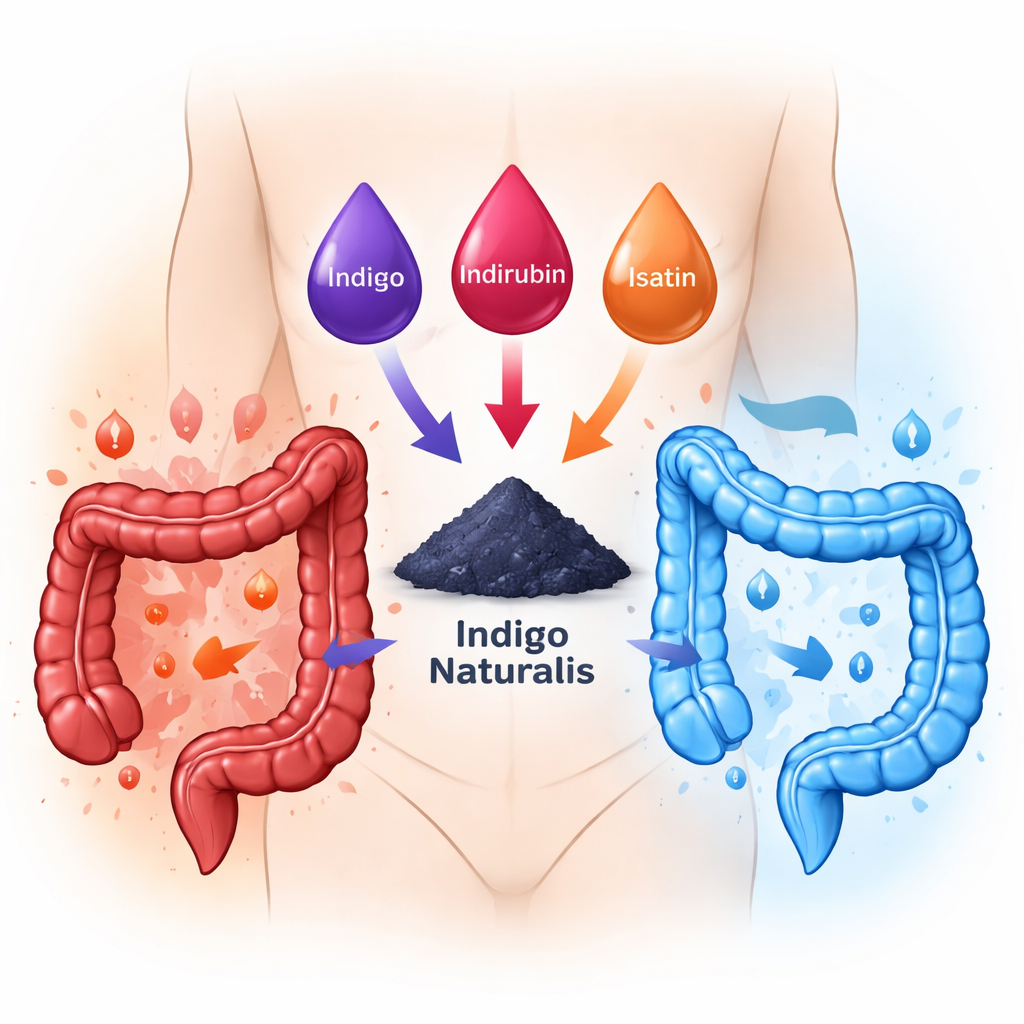
What Is Indigo Naturalis and Why It Matters
Indigo Naturalis is a deep blue powder prepared from several plants that were once prized mainly as fabric dyes. Traditional healers have also used it for centuries to “clear heat,” stop bleeding, and treat stubborn inflammatory illnesses. In recent years, doctors and scientists noticed that patients with ulcerative colitis sometimes improved when given this remedy. Chemical analysis shows that Indigo Naturalis is rich in three small molecules—indigo, indirubin, and isatin. Each has been linked separately to anti-inflammatory or immune-balancing effects, but no one knew whether they truly cooperate inside the body, or which biological switches they flip in the inflamed intestine.
From Cells in a Dish to Mice With Colitis
The researchers first turned to immune cells grown in the lab, using a standard model in which bacterial fragments spark a strong inflammatory reaction. They tested Indigo Naturalis and each of its three ingredients to see how they affected cell survival and the production of nitric oxide and inflammatory messengers, which are chemical signals that drive tissue damage. At certain doses, Indigo Naturalis, indirubin, and isatin all reduced harmful signals while keeping the cells alive. When the team mixed indigo, indirubin, and isatin together in the same ratio found in the raw herb—a blend they called MIX—the combination did something intriguing: at low concentrations that were ineffective on their own, the three molecules working together strongly dampened inflammation-related outputs.
How the Blue Molecules Tame Overactive Signals
To understand how this works, the scientists examined several key signaling routes inside the immune cells that act like master volume knobs for inflammation. These included NF-κB, STAT3, and MAPK, three protein networks that, when switched on, tell cells to churn out inflammatory molecules and enzymes. Indigo Naturalis itself turned down all three pathways, keeping NF-κB from moving into the cell nucleus and cutting levels of activated STAT3 and MAPK proteins. Indirubin mainly blocked NF-κB and STAT3 and dialed down one branch of the MAPK system, while isatin focused more on MAPK and NF-κB. The MIX combination, even at low doses, sharply reduced activated STAT3 and one of the MAPK components, and lowered levels of an enzyme that produces nitric oxide. These patterns suggest that the three compounds hit overlapping but slightly different targets, reinforcing one another when used together. 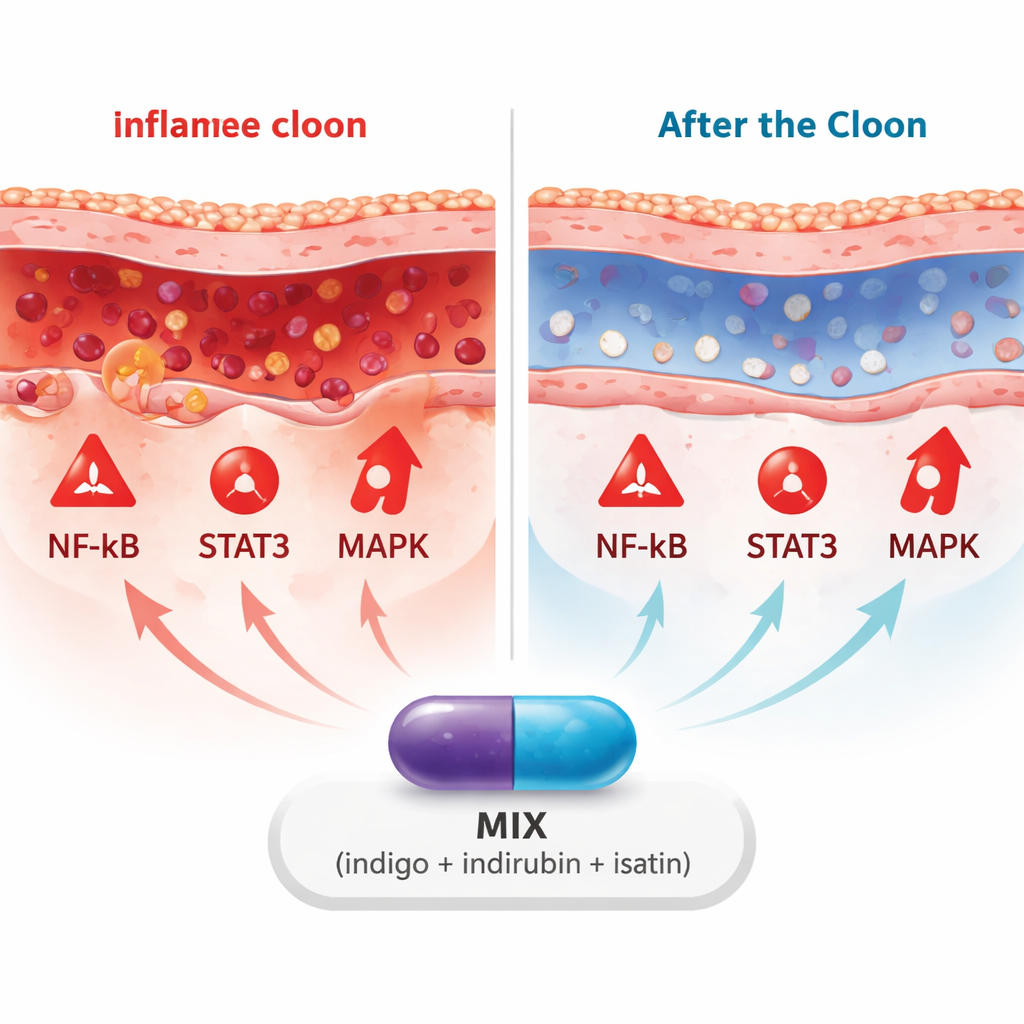
Testing the Mix in an Animal Model of Disease
The team then moved into a mouse model that closely mimics human ulcerative colitis by chemically irritating the colon. These mice develop weight loss, diarrhea, bleeding, shortened colons, and microscopic signs of severe tissue injury and immune cell invasion. Mice treated with Indigo Naturalis or with the MIX blend showed longer, healthier colons, less tissue destruction, and fewer invading neutrophils, the white blood cells that act as front-line storm troops of inflammation. Blood tests showed lower levels of pro-inflammatory proteins such as TNF-α and IL-6 and higher levels of IL-10, a natural “brake” on inflammation. Overall disease scores dropped to levels comparable to those seen with a standard drug used for colitis, sulfasalazine.
What This Means for People With Colitis
In simple terms, this work shows that the blue plant powder Indigo Naturalis can protect the colon in ulcerative colitis, and that three of its natural ingredients—indigo, indirubin, and isatin—work better together than alone. By softening several major inflammatory signaling routes at once, their MIX blend quiets overactive immune cells and helps the gut lining heal in mice. While more studies are needed to confirm safety and effectiveness in people and to refine doses, the findings hint that a carefully designed combination of these long-known molecules could one day offer patients a plant-derived, multitarget tool to help keep their disease under better control.
Citation: Ma, KY., Hou, BL., Fan, AQ. et al. The mechanism of indigo naturalis and its active ingredients against ulcerative colitis. Sci Rep 16, 5220 (2026). https://doi.org/10.1038/s41598-026-35413-9
Keywords: ulcerative colitis, Indigo Naturalis, herbal medicine, intestinal inflammation, NF-kB STAT3 MAPK