Clear Sky Science · en
Salicylic acid induces cultivar specific compromises in yield, fruit quality and defense metabolism of heat stressed strawberry
Why hot days matter for your strawberries
Strawberries may look delicate, but they are surprisingly picky about temperature. When a sudden heat wave hits a greenhouse, farmers can lose much of their crop, along with the sweetness and vitamin content that make strawberries so appealing. This study asked a practical question with big implications for growers and consumers: can spraying plants with salicylic acid—a simple aspirin-like compound—help strawberries survive sudden bursts of high heat without sacrificing yield and fruit quality, and does the answer depend on the variety being grown?
Testing strawberries in a controlled heat wave
Researchers in southern Iran focused on two popular greenhouse varieties, ‘Camarosa’ and ‘Paros’, which regularly face heat spikes when cooling systems fail. Plants were grown under comfortable conditions, then some were sprayed twice with a mild salicylic acid solution while others received only water. Afterward, all plants were either kept at normal temperatures or exposed to an 8‑hour heat shock at 42 °C, mimicking a short but intense hot spell. Over the following weeks, the team measured plant growth, root and shoot weights, leaf greenness, and detailed fruit traits such as size, number, total yield, sweetness, acidity, and vitamin C. They also tracked key defense enzymes that plants switch on under stress. 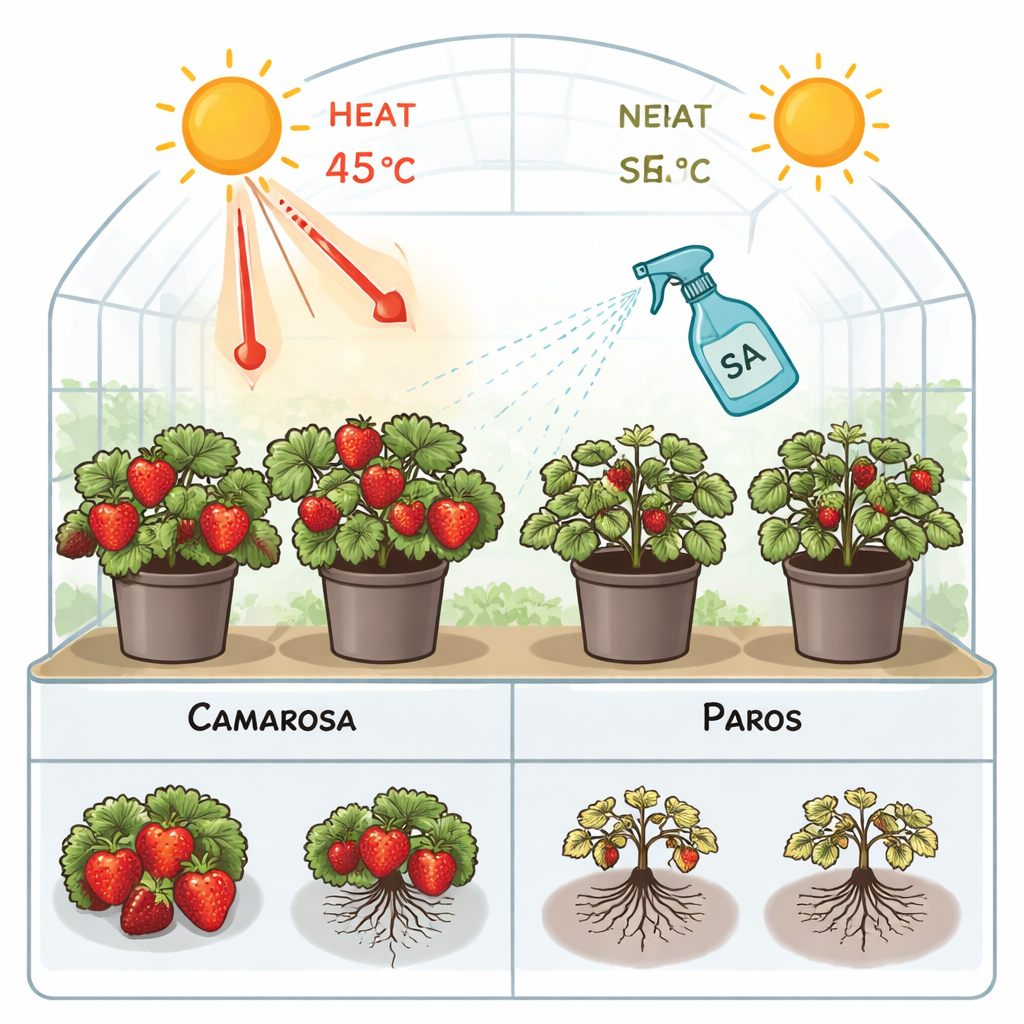
Heat slashes harvests, whatever the treatment
The headline result is sobering: the heat shock itself was the main driver of damage. On average, the number of fruits per plant fell by about half, and total fruit yield dropped by roughly 61 percent compared with plants kept cool. This collapse occurred regardless of whether plants had been sprayed with salicylic acid or not. Fruit length, diameter, and weight all shrank under heat, and leaves lost chlorophyll, meaning the plants’ ability to photosynthesize was impaired. At the same time, vitamin C levels in the berries plunged, especially in ‘Camarosa’. In other words, a short, intense heat wave hurt both the quantity and nutritional quality of the crop, and salicylic acid did not “rescue” yield.
Two varieties, two survival strategies
Although the damage was broad, the two strawberry varieties coped in different ways. ‘Camarosa’ responded to heat with a highly active adjustment strategy: plants grew taller, shifted more biomass into their roots, and strongly boosted the activity of a defense enzyme that feeds a pathway making protective compounds. This helped ‘Camarosa’ keep more of its individual fruit weight under stress, but at a cost—resources were diverted away from vitamin C and reproductive output. ‘Paros’, in contrast, showed less reshaping of roots and shoots, suggesting a more “fixed” tolerance strategy. Yet its fruits were more sensitive: under heat, ‘Paros’ lost a larger share of its fruit size and weight, revealing weaker protection of the harvest despite its steadier growth form.
Salicylic acid: a tuner, not a silver bullet
Salicylic acid behaved less like a protective spray and more like a fine‑tuning signal that amplified each variety’s natural tendencies. Under heat, treated plants became even taller than untreated stressed plants, hinting that the hormone reinforced the stress‑growth signal rather than calming it. In ‘Camarosa’, salicylic acid pushed the plant to favor shoots over roots under normal conditions and further strengthened certain defense reactions, which in turn was linked to lower vitamin C. In ‘Paros’, the same spray nudged plants to invest more in roots and helped prime a key defense enzyme while tamping down another that signals cell damage. Sophisticated statistical analyses showed a clear trade‑off: traits tied to defense were strongly and negatively linked to yield and vitamin C, confirming that turning up the biochemical shield drains resources from fruit production and nutritional quality. 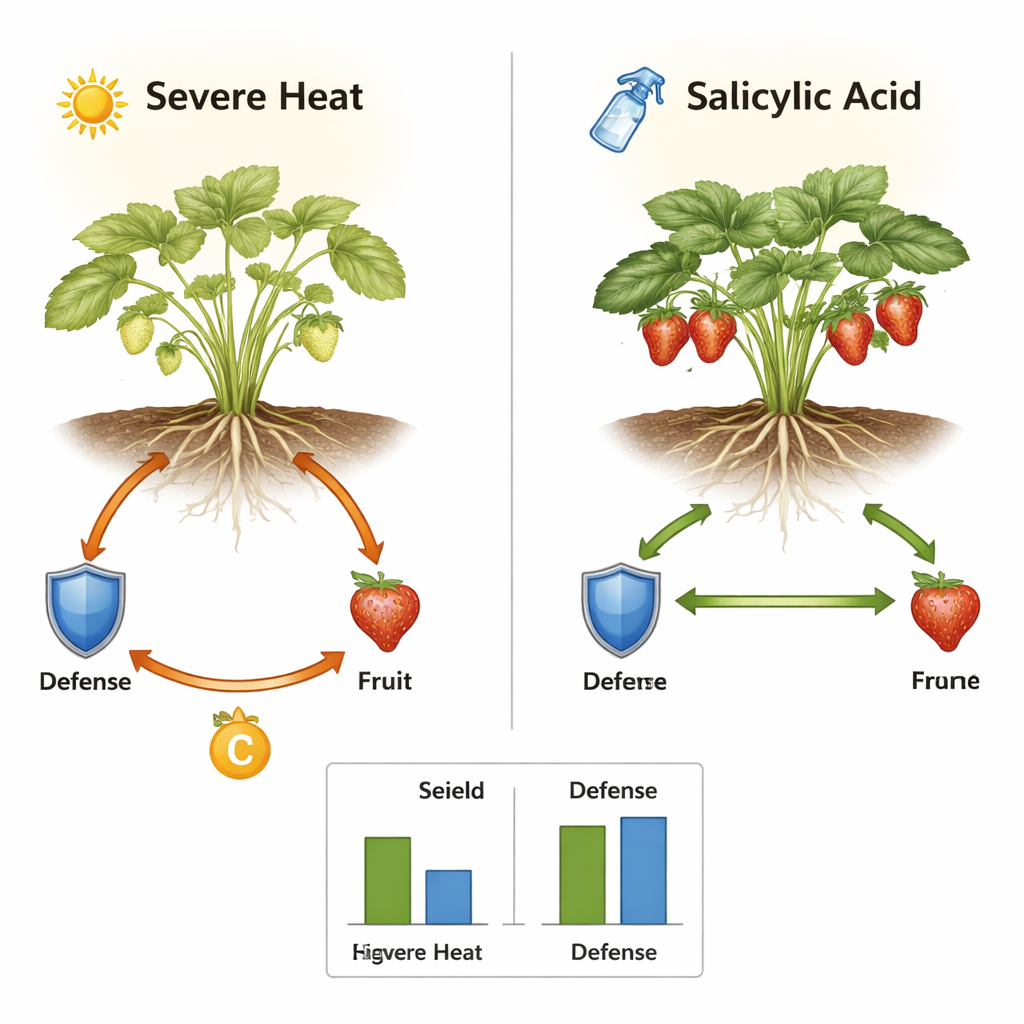
What this means for growers and eaters
For farmers and breeders, the message is that there is no free lunch: strawberries cannot fully protect themselves from sudden high heat and still deliver maximum yield and top‑tier fruit quality. Salicylic acid at the tested dose did not prevent heat‑induced crop losses, but it did reveal how different varieties juggle the balance between survival and productivity. ‘Camarosa’ pays a higher metabolic price to defend itself yet better shields its fruits, while ‘Paros’ suffers more in the harvest. Future heat‑resilient strawberries will likely need a smart combination: plants that can switch on strong defenses when needed but still keep enough resources flowing to flowers and fruits so that the berries remain plentiful, flavorful, and rich in vitamins even when the weather turns extreme.
Citation: Khajeh Sorkhoeih, M., Hamidi Moghaddam, A. & Seyedi, A. Salicylic acid induces cultivar specific compromises in yield, fruit quality and defense metabolism of heat stressed strawberry. Sci Rep 16, 4874 (2026). https://doi.org/10.1038/s41598-026-35412-w
Keywords: strawberry heat stress, salicylic acid, fruit yield, plant defense trade-off, cultivar differences