Clear Sky Science · en
Acoustic and thermal insulation properties of rubberhemp shive composite bonded with regenerated polyurethane resin
Turning Trash into Quiet, Cozy Walls
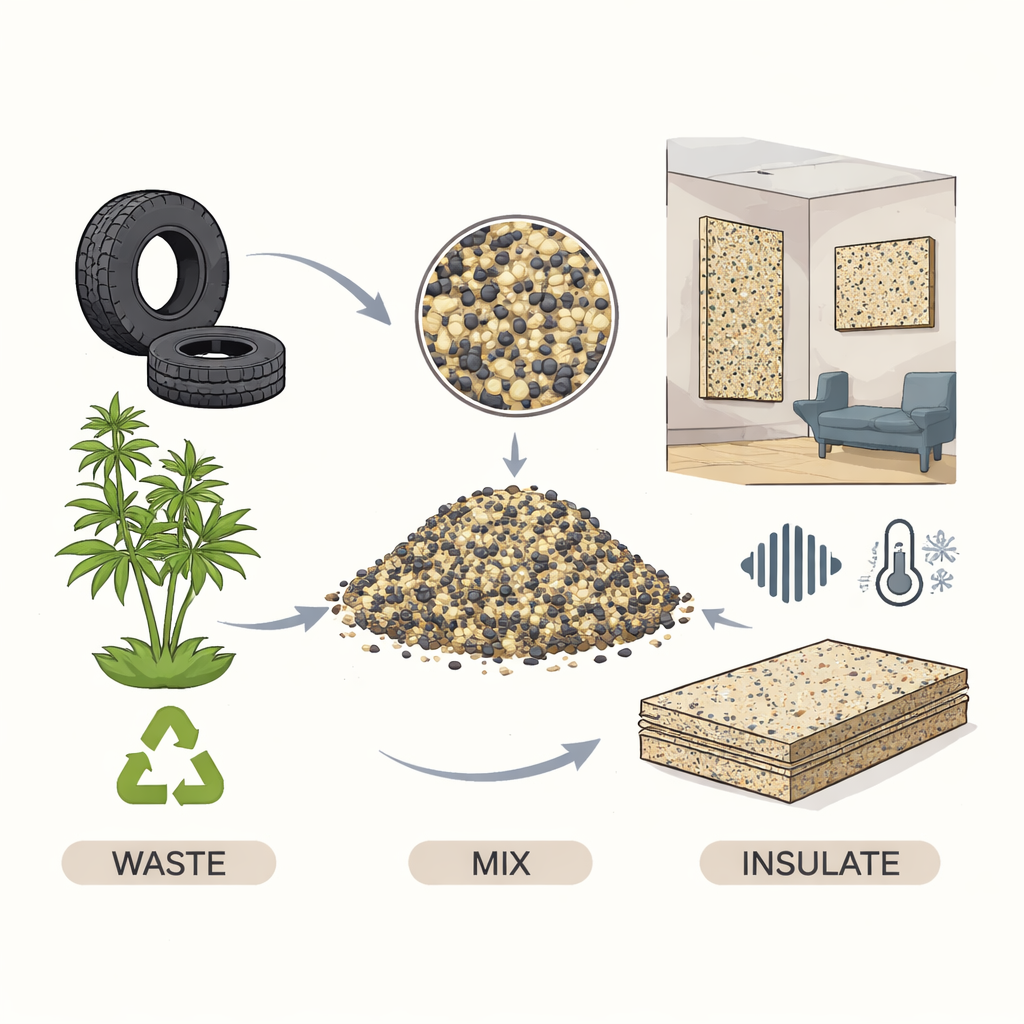
Old car tires and hemp-processing leftovers usually end up as difficult-to-handle waste. This study asks a simple but powerful question: can we turn both into a single material that makes buildings quieter and better insulated, while also cutting environmental impact? The researchers mixed rubber granules from scrap tires with woody hemp shives and a recycled polyurethane resin to create lightweight panels that both absorb sound and slow down heat loss.
Why Noise and Heat Loss Matter at Home
Unwanted noise from traffic, neighbors, or machinery is more than a nuisance; it can affect sleep, stress levels, and even long-term health. At the same time, buildings leak heat through poorly insulated walls, driving up energy bills and climate-warming emissions. Conventional insulation materials—such as mineral wool or foam—work well but often rely on energy-intensive production from non-renewable resources. The idea behind these rubber–hemp panels is to create a greener option that tackles both problems at once: soaking up sound while providing decent thermal insulation, all from materials that would otherwise be thrown away.
From Scrap Tires and Hemp Stems to Solid Panels
The team started with two industrial by-products. The rubber came from end-of-life tires, ground into small black granules. The hemp shives were the woody pieces left behind after fiber is stripped from the hemp plant. These were mixed in different ratios and combined with a regenerated polyurethane resin that glues everything together. By changing rubber grain size (fine to coarse), the amount of hemp shive, and the thickness of the panels (from 1 to 5 centimeters), the researchers produced 18 distinct panel types and cut them into test samples for laboratory measurements.
Peering Inside and Listening to the Panels
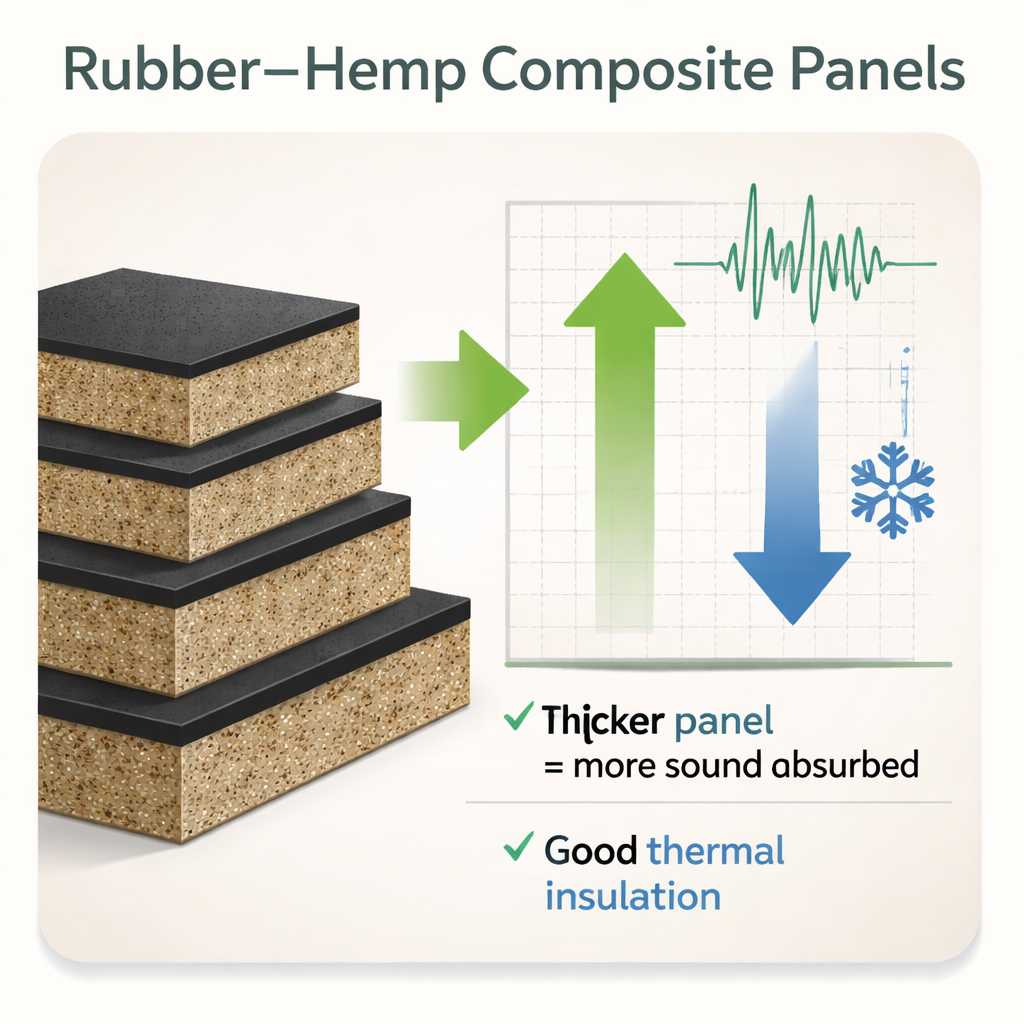
To understand how the material behaves, the scientists examined tiny fragments under a scanning electron microscope. The images revealed rough, cracked rubber particles and highly porous, fibrous hemp shives, both full of small gaps where air can move and sound can be dissipated. They also measured how much air can flow through the material, how dense and porous it is, how well it absorbs sound over a wide range of frequencies, and how easily heat passes through it. Sound tests in specialized tubes showed that thicker panels shifted their best performance to lower, more useful frequencies and could absorb up to about 97% of incident sound at around 1 kilohertz—comparable to commercial acoustic materials.
What Matters Most for Sound and Heat
Although hemp shives changed several internal properties—lowering bulk density by roughly a quarter and increasing porosity by more than 10%—their effect on overall sound absorption was modest. Statistical analysis showed that how thick the panel is and how fine the rubber particles are matter far more for noise control than how much hemp is added. The best sound performance (a high average absorption across mid-range frequencies) came from a 50 mm-thick panel with the finest rubber grains and a moderate hemp content. For heat flow, the picture was slightly different. Panels made with medium-sized rubber grains and higher hemp content achieved the lowest measured thermal conductivity, about 0.07 W/m·K—within the range of some wood-based and loose-fill insulation products, though not as low as top-tier mineral wool or foam.
Lightweight, Recycled Panels for Greener Buildings
Overall, the study shows that panels made from recycled tire rubber and hemp shives can combine strong sound absorption with respectable thermal insulation, while also being lighter than rubber-only panels. Adding hemp reduces weight and can modestly improve insulating power without sacrificing acoustic performance, especially when panel thickness and rubber grain size are chosen wisely. For a layperson, the takeaway is straightforward: noisy, energy-hungry buildings could one day be quieted and insulated using materials built from two kinds of waste that are currently environmental headaches. These rubber–hemp composite panels are a promising step toward walls that are quieter, warmer, and kinder to the planet.
Citation: Astrauskas, T., Balčiūnas, G., Bradulienė, J. et al. Acoustic and thermal insulation properties of rubberhemp shive composite bonded with regenerated polyurethane resin. Sci Rep 16, 4851 (2026). https://doi.org/10.1038/s41598-026-35411-x
Keywords: recycled building materials, sound absorbing panels, thermal insulation, waste tire rubber, hemp shive composites