Clear Sky Science · en
Quercetin attenuates high glucose-induced VEGFA expression in ARPE-19 cells by inhibiting ROS generation, p38 MAPK phosphorylation, and NF-κB activation
Why a common plant pigment matters for vision
Diabetic eye disease is a leading cause of vision loss, yet most treatments target only one part of the problem: the fragile, leaky blood vessels that form in the retina. This study looks at quercetin—a natural compound found in apples, onions, berries, and tea—to see whether it can calm the stressed cells at the back of the eye before damage becomes severe. By exploring how quercetin behaves in retinal cells exposed to high sugar, the researchers ask a simple question with big implications: can something already present in our diet help protect eyesight in diabetes?
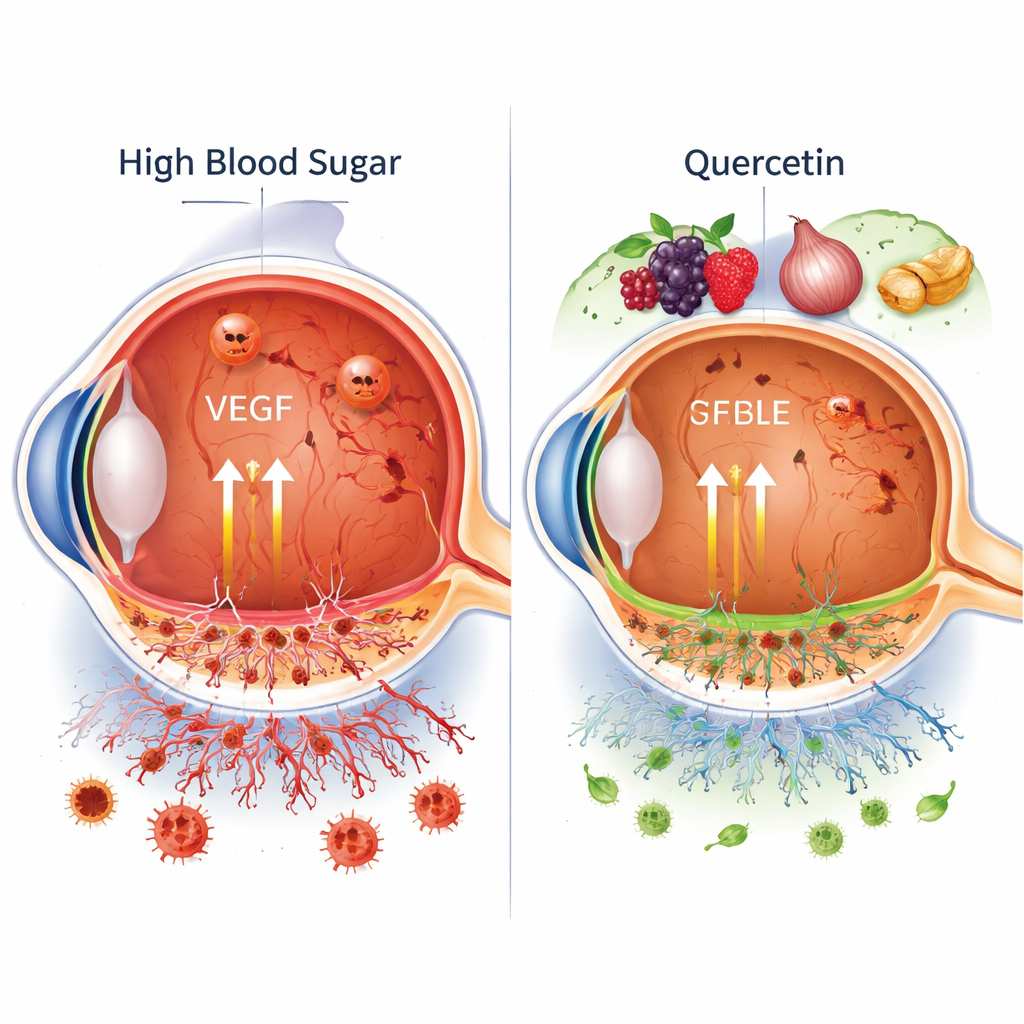
How high blood sugar harms the back of the eye
In diabetes, years of high blood sugar gradually injure the fine blood vessels that nourish the light-sensitive tissue of the eye. A key troublemaker is a signal called VEGF, which tells new blood vessels to grow and existing ones to become more leaky. In the retina this can lead to swelling, bleeding, and, ultimately, loss of central vision. The layer of retinal pigment epithelium cells, which supports the retina like fertile soil under a garden, responds to high sugar by releasing more VEGF. High sugar also boosts unstable, reactive molecules known as oxidative stress and turns on inflammatory switches inside these cells, further cranking up VEGF production and worsening diabetic retinopathy.
Testing quercetin’s safety and impact on harmful signals
The researchers first checked whether quercetin itself was harmful to retinal pigment cells grown in the lab. At modest doses, the cells remained healthy over several days, but very high doses began to reduce cell survival. They then chose two non-toxic concentrations and exposed the cells to high glucose, with or without quercetin. Under high sugar alone, VEGF levels rose sharply at both the gene and protein level. When quercetin was added, this surge in VEGF was substantially blunted, similar to the effect of a known antioxidant drug used as a comparison. This meant quercetin could dial down one of the main drivers of leaky retinal vessels without killing the cells that produce it.
Quieting oxidative and inflammatory cascades
To understand how quercetin achieved this, the team measured oxidative stress and specific signaling pathways inside the cells. High sugar increased reactive oxygen species, a hallmark of oxidative damage. Quercetin significantly reduced these damaging molecules, again in line with the antioxidant control. The researchers also tracked two molecular routes that respond to stress: one involving a protein called p38 and another controlled by the NF-κB complex, a major on–off switch for inflammation. High glucose strongly activated p38 and pushed NF-κB into the cell nucleus, where it turns on genes like VEGF. Quercetin selectively dampened p38 activity and kept NF-κB from fully entering the nucleus by preserving its inhibitor, IκBα, effectively turning down the volume on inflammatory gene programs while leaving a related pathway, ERK, largely untouched.
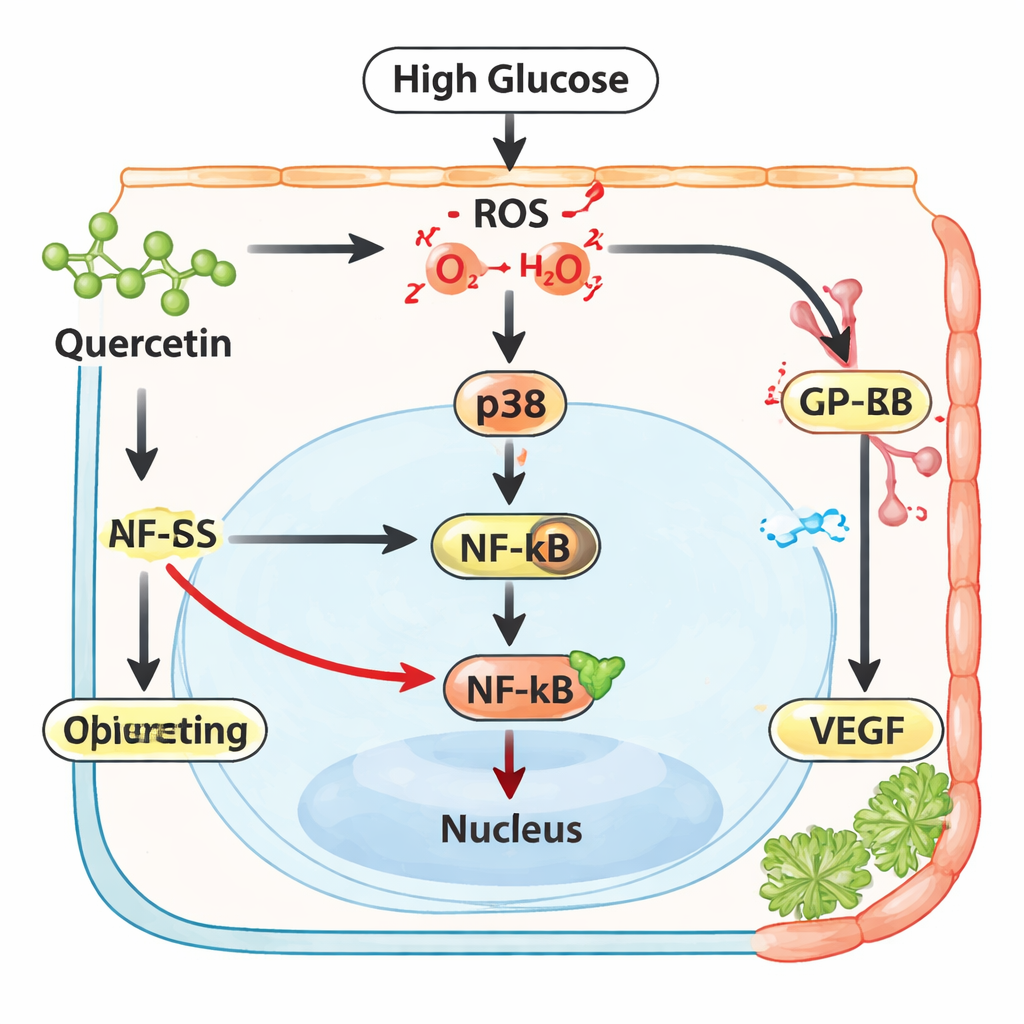
From cell signals to leaky vessels and back again
The study also moved one step closer to real tissue by using primary mouse retinal pigment cells and an indirect test of blood-vessel leakiness. In mouse cells, high sugar again drove up VEGF, and quercetin brought it back toward normal. The team then collected the “soup” surrounding human retinal pigment cells grown in high sugar and poured it over a layer of human blood-vessel cells. Fluid leakage across this vessel layer increased, mimicking the breakdown of the retinal barrier seen in diabetic eyes. When the pigment cells had been treated with quercetin or an antioxidant, the resulting leakage dropped markedly, suggesting that changing what the pigment cells secrete—especially VEGF—can help preserve vessel tightness.
What this could mean for people with diabetes
Taken together, the work supports a simple but powerful idea: quercetin, acting as both an antioxidant and an anti-inflammatory agent, can interrupt the chain reaction by which high blood sugar pushes retinal cells to overproduce VEGF and weaken blood vessels. This does not mean that eating quercetin-rich foods or taking supplements will replace current eye injections that block VEGF directly; the doses used in dishes are not the same as those in a laboratory dish, and the compound is not easily absorbed or delivered to the eye. But the findings suggest quercetin, or better-formulated versions of it, might one day serve as an add-on therapy that helps lower the underlying stress and inflammation in diabetic eyes, reducing treatment burden and slowing the march toward vision loss.
Citation: Liu, PK., Chi, YC., Chang, YC. et al. Quercetin attenuates high glucose-induced VEGFA expression in ARPE-19 cells by inhibiting ROS generation, p38 MAPK phosphorylation, and NF-κB activation. Sci Rep 16, 4987 (2026). https://doi.org/10.1038/s41598-026-35409-5
Keywords: diabetic retinopathy, quercetin, oxidative stress, VEGF, retinal pigment epithelium