Clear Sky Science · en
A channel water temperature prediction method based on transfer learning and spatial-temporal graph neural networks
Why winter water in canals matters
Every winter, the giant canals of China’s South-to-North Water Diversion Project must keep flowing despite freezing air. If canal water gets too cold, ice can clog channels, damage structures, and interrupt supplies to millions of people. Yet in new canal sections there is very little historical data, making it hard to forecast water temperature with conventional methods. This study introduces a new artificial-intelligence approach that borrows knowledge from a well‑monitored canal system to improve winter water-temperature predictions in a newer, sparsely monitored extension.
Two long canals, one shared challenge
The research focuses on two linked mega-projects: the long-established Central Route and the newer North Extension of the Eastern Route. Both run through similar climates and use open channels, gates, and pumping stations to move water northward. The Central Route has operated for more than a decade and is densely instrumented, with years of records on air temperature, water temperature, and flow. In contrast, the North Extension has only a short, patchy record from a single winter season. The authors’ key idea is to treat the Central Route as a “teacher” canal and the North Extension as a “student,” transferring patterns learned from the older system to help predict temperatures in the newer one. 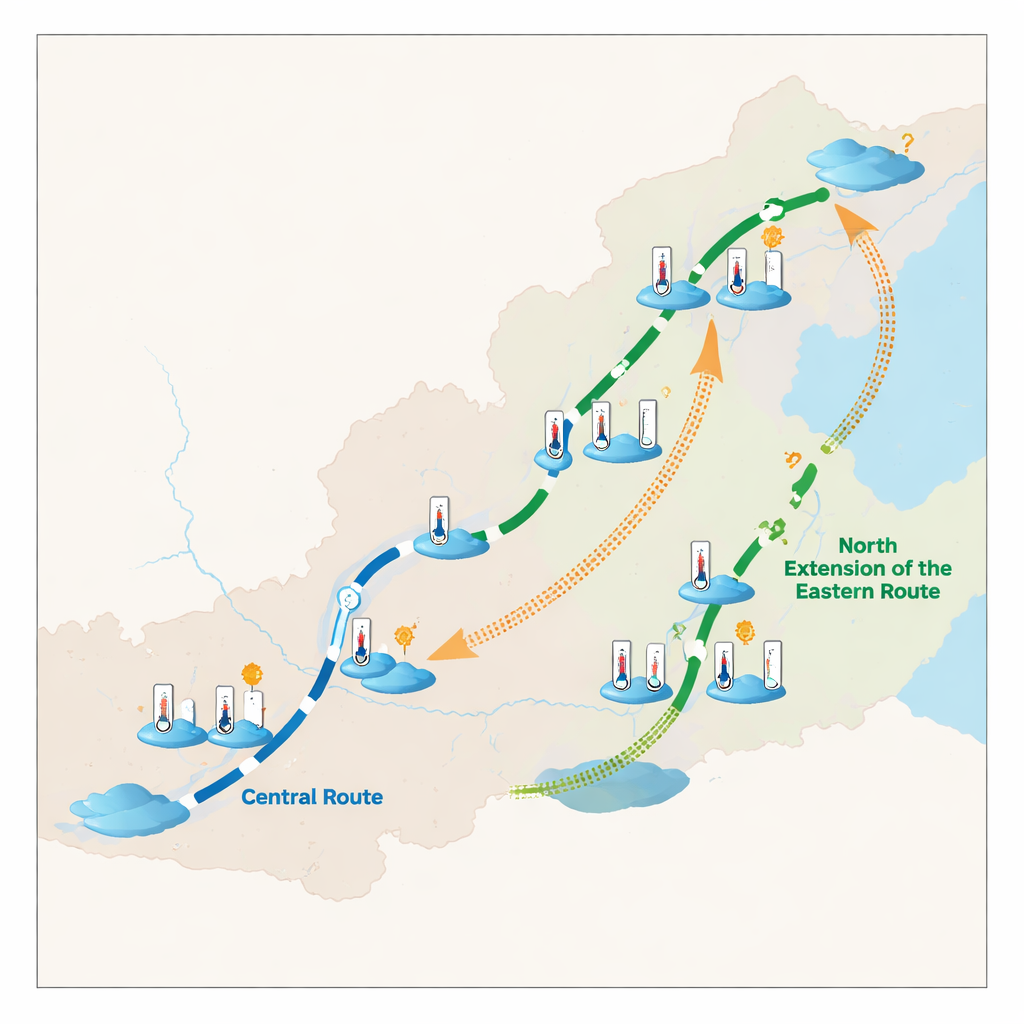
Teaching a model to learn from another river
To achieve this, the team uses a strategy called transfer learning. They first build a deep-learning model and train it on three winters of data from three Central Route stations. During this pretraining stage, the model discovers how air temperature, water temperature, and flow typically rise and fall together, and how these links repeat over days and weeks. Next, the researchers adapt the same model to the North Extension, freezing some of its internal settings so that it retains what it “knows” about general winter behavior, while gently fine‑tuning other parts with the limited North Extension data. This allows the model to reuse broad physical patterns from the Central Route without needing years of local observations.
Turning canals into a network of connected nodes
Beyond reusing knowledge, the study also captures how different locations along the canal influence one another. The authors represent each monitoring point—air temperature in nearby cities, water temperature at gates, and flow at key cross-sections—as a node in a graph. Links between nodes reflect physical relationships, such as shared water sources or geographical proximity. On top of this graph, they build a spatial‑temporal neural network called TF‑GTCN. One part of the model looks along the time axis, using specialized one‑dimensional convolutions to detect short‑term swings and longer periodic cycles. Another part spreads information across the graph, allowing the model to learn, for example, that changes in air temperature at one city consistently precede changes in water temperature at a nearby gate. 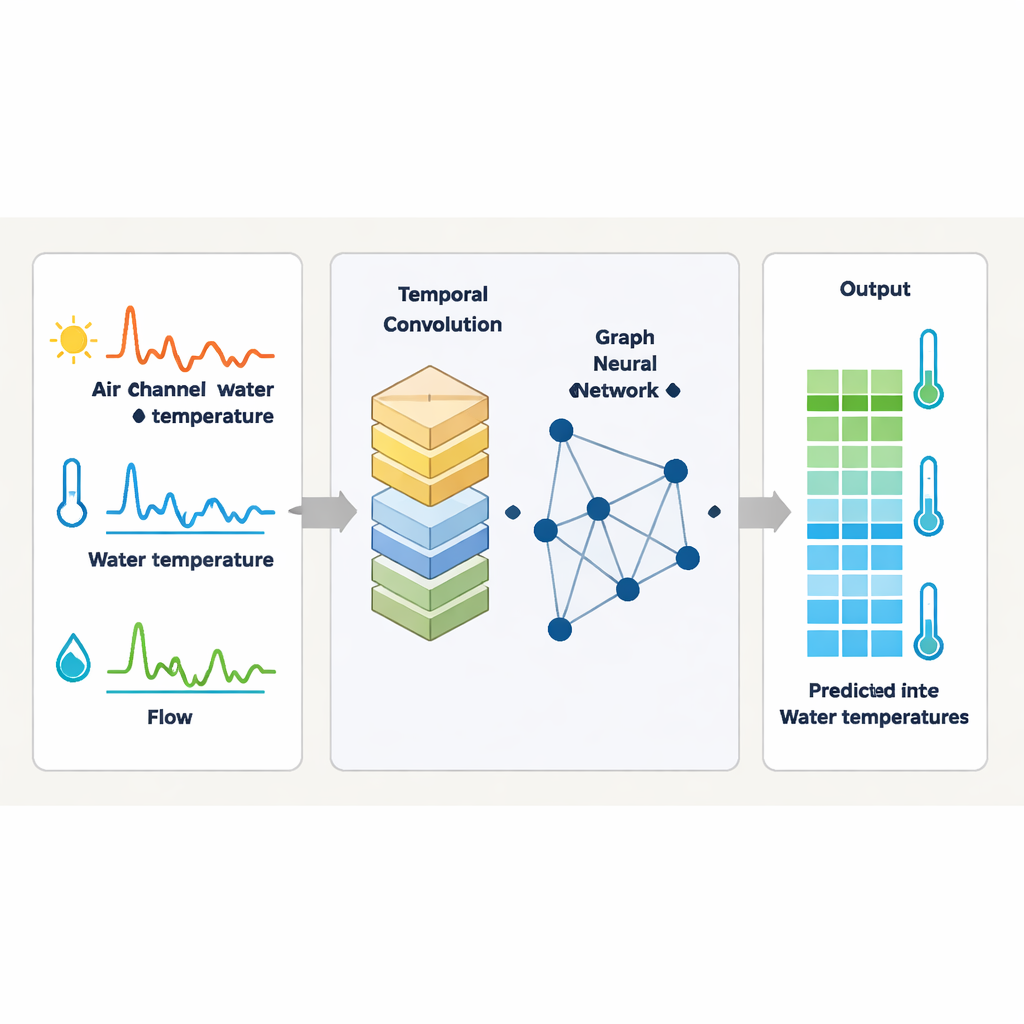
How well does the new approach work?
The researchers compare their TF‑GTCN model with a range of common deep‑learning tools, including recurrent networks (RNN, LSTM, GRU), convolutional networks, and simpler graph‑based models. Across many test settings—predicting one, three, seven, or fourteen days ahead—the new method generally produces the lowest errors. At key stations, it cuts the average absolute temperature error to roughly 1–1.4 °C and reduces error by up to about 3 °C compared with traditional models. Graph‑based baselines already do better than purely time‑based models, but adding transfer learning and a more refined temporal module improves performance further, especially when data are scarce. Detailed analyses show that air temperature is the dominant driver of water‑temperature changes, while previous‑day water temperature and flow provide important secondary clues.
What this means for winter operations
For water managers, the practical message is straightforward: with the right kind of AI, even a short record from a new canal can support useful winter forecasts, provided there is a related, data‑rich system to learn from. The TF‑GTCN model offers a way to anticipate when and where water temperatures may approach freezing, buying time to adjust flows or operations before ice forms. While the method still needs to be tested with more environmental factors and under more extreme weather, it points toward smarter, more resilient management of large water‑transfer projects, helping keep taps running and infrastructure safe during the coldest months.
Citation: Lu, H., Tian, Y., Weng, P. et al. A channel water temperature prediction method based on transfer learning and spatial-temporal graph neural networks. Sci Rep 16, 5793 (2026). https://doi.org/10.1038/s41598-026-35408-6
Keywords: water temperature forecasting, transfer learning, graph neural networks, water diversion canals, hydrological modeling