Clear Sky Science · en
Exploring the links between swimming performance, glucocorticoid profiles, behavioral types and cardiac morphology in migrating Atlantic salmon (Salmo salar) smolts
Why this matters for wild salmon
As young Atlantic salmon leave their home rivers for the open ocean, their survival shapes both wild populations and fisheries that people rely on. This study asks a deceptively simple question with big implications: are the strongest swimmers really the best equipped to survive this dangerous journey, or do personality and stress biology matter just as much as muscle power?
Testing small fish on a big journey
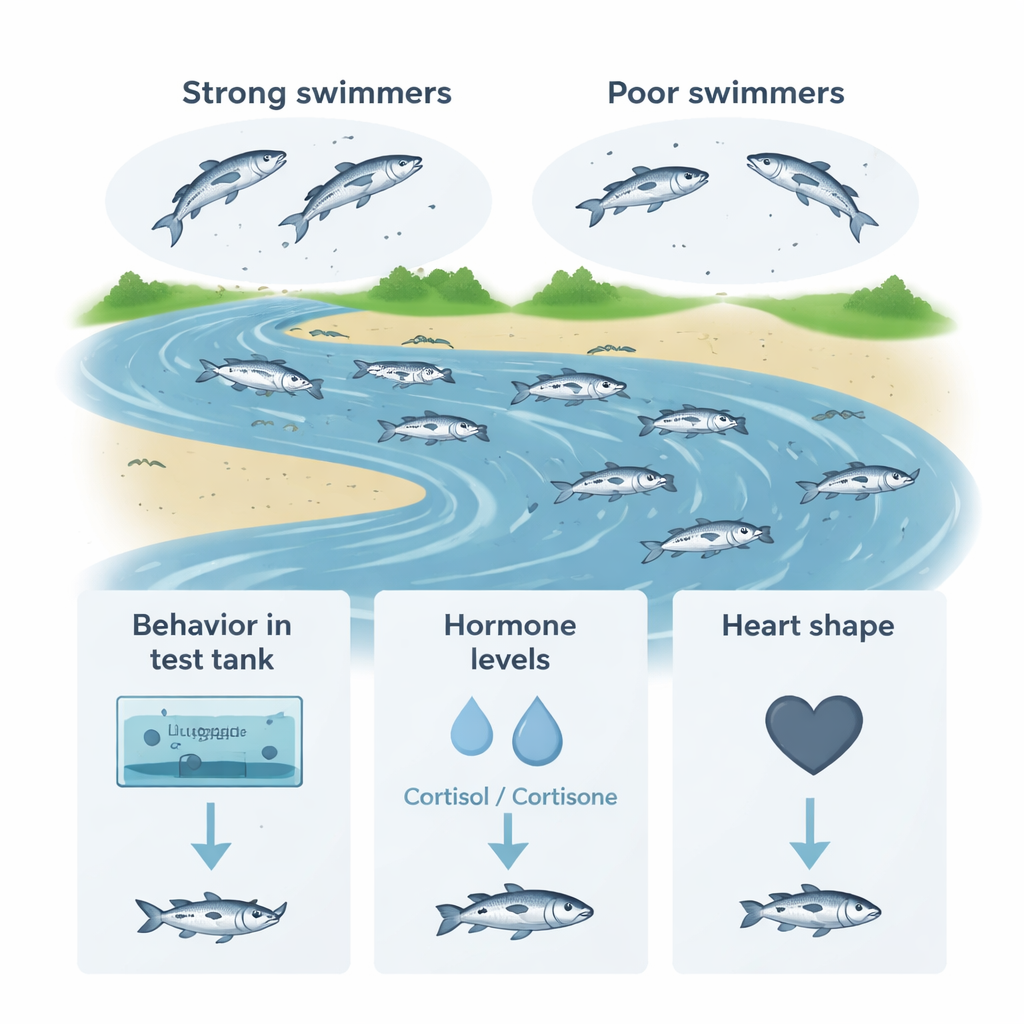
The researchers worked on a Norwegian river where salmon smolts begin their downstream migration. They first captured wild smolts as they naturally headed toward the sea. In a special circular tank with flowing water, they pushed groups of fish to swim against a strong current until they tired out. The first fifth of the fish to quit were labeled “poor swimmers,” and the last fifth still going were labeled “strong swimmers.” The middle group was not used further, allowing the team to focus on clear extremes in swimming performance.
Looking inside hearts and hormones
Next, the team examined whether internal body traits could explain these differences in swimming. They measured heart size and shape in detail, using standardized photographs and image analysis to capture subtle features. At the same time, they measured two related stress hormones in blood taken about 24 hours after the swim test: cortisol, a well-known stress signal, and cortisone, a closely linked compound that is less active. Surprisingly, strong and poor swimmers did not differ in overall heart size or form, nor in cortisol levels. However, strong swimmers had higher cortisone, hinting that they might be better at converting cortisol into its less harmful form, potentially protecting their bodies from the downsides of prolonged stress.
Personality in a new tank
The scientists also asked whether “personality” might be tied to swimming ability. To probe this, they placed individual smolts into small, unfamiliar tanks that were mildly stressful due to both confinement and novelty. They then tracked how much each fish moved over a 20-minute period. Poor swimmers started out relatively active but gradually calmed down, while strong swimmers showed the opposite pattern—lower initial activity that rose over time. These patterns fit with a bold–shy style seen in other fish studies, where individuals that are quieter at first but more persistent later are considered more proactive or bolder in facing challenges.
Following tagged fish downriver
To see how these traits played out in the wild, a subset of strong and poor swimmers were implanted with tiny acoustic tags and released back into the river below a hydropower plant. Listening stations tracked which fish made it the nine kilometers to the river mouth. Although the numbers were small, there was a notable trend: poor swimmers were more likely to be detected at the river mouth than strong swimmers, even though both groups took a similar number of days to get there. The release area is known to harbor pike, a major fish predator, raising the possibility that bolder, strong swimmers may take riskier paths or behave in ways that expose them more to being eaten.
What this means for salmon and conservation
For a lay reader, the key message is that “strongest” does not simply mean “fittest” for young salmon on the move. In these wild fish, top swimming performance was linked to distinctive behavior in stressful situations and to a hormone pattern that hints at different ways of handling stress. Yet strong swimmers did not have better-shaped hearts, and they may even be slightly more likely to die in predator-rich stretches of river. The work suggests that survival depends on a blend of swimming ability, stress chemistry, and bold–shy tendencies, rather than on muscle power alone. Understanding this mix of traits could help managers design river systems, dam operations, and stocking practices that give migrating salmon the best possible chance to reach the sea and return as adults.
Citation: Höglund, E., Johansen, K., Ulset, S.M. et al. Exploring the links between swimming performance, glucocorticoid profiles, behavioral types and cardiac morphology in migrating Atlantic salmon (Salmo salar) smolts. Sci Rep 16, 5560 (2026). https://doi.org/10.1038/s41598-026-35402-y
Keywords: Atlantic salmon smolts, swimming performance, fish behavior, stress hormones, migration survival