Clear Sky Science · en
Clinicopathological characteristics and prognostic model validation for mucinous gastric carcinoma
Why this stomach cancer study matters
Mucinous gastric carcinoma is a rare but especially aggressive form of stomach cancer. Because it is uncommon and often diagnosed late, doctors have struggled to predict which patients are most at risk and who might benefit most from intensive treatment. This study uses a large U.S. cancer registry to build a practical prediction tool that estimates a patient’s chances of survival more accurately than traditional staging alone, potentially guiding more tailored care.
Understanding a rare stomach cancer
Stomach cancer remains a major cause of cancer deaths worldwide. Mucinous gastric carcinoma is an unusual subtype in which more than half of the tumor volume is made of mucus-like material. This gives the cancer distinct features: it tends to be poorly differentiated, grow deeply into the stomach wall and spread early to lymph nodes. Past studies have disagreed on just how deadly this subtype is and which features matter most for prognosis, partly because each individual study usually included only small numbers of patients. To clarify its behavior, the authors turned to the U.S. Surveillance, Epidemiology, and End Results (SEER) database, which collects detailed information on cancer cases from many regions.
Who was studied and what was measured
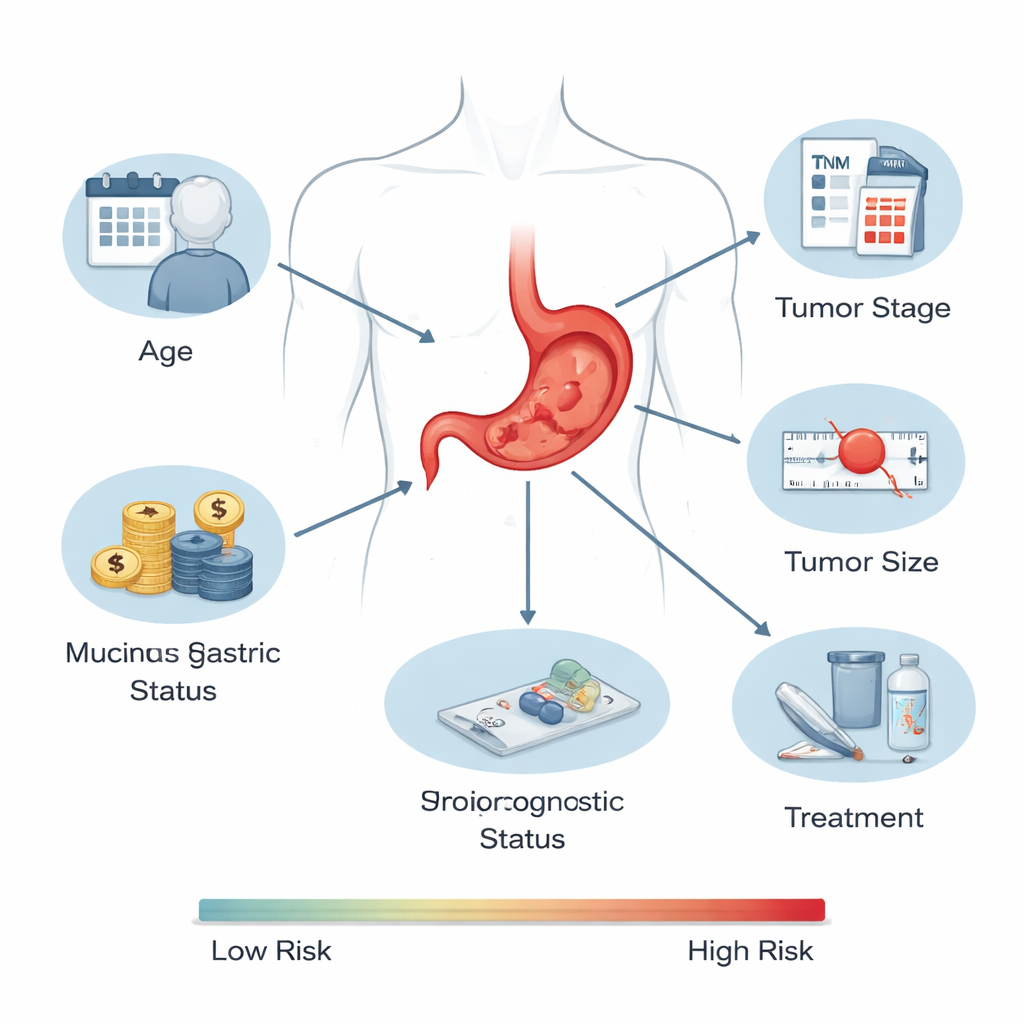
The researchers identified 719 people diagnosed with mucinous gastric carcinoma between 2000 and 2021. They recorded basic demographics (age, sex, marital status, race, household income), tumor features (location in the stomach, size, depth of invasion, lymph node involvement, spread to distant organs) and treatments received (surgery, chemotherapy and radiotherapy). They then tracked how long each person lived overall and how long they lived without dying from stomach cancer specifically. To build and test their prediction tool, the team randomly split the patients into a larger “training” group and a smaller “validation” group.
Building a personalized risk score
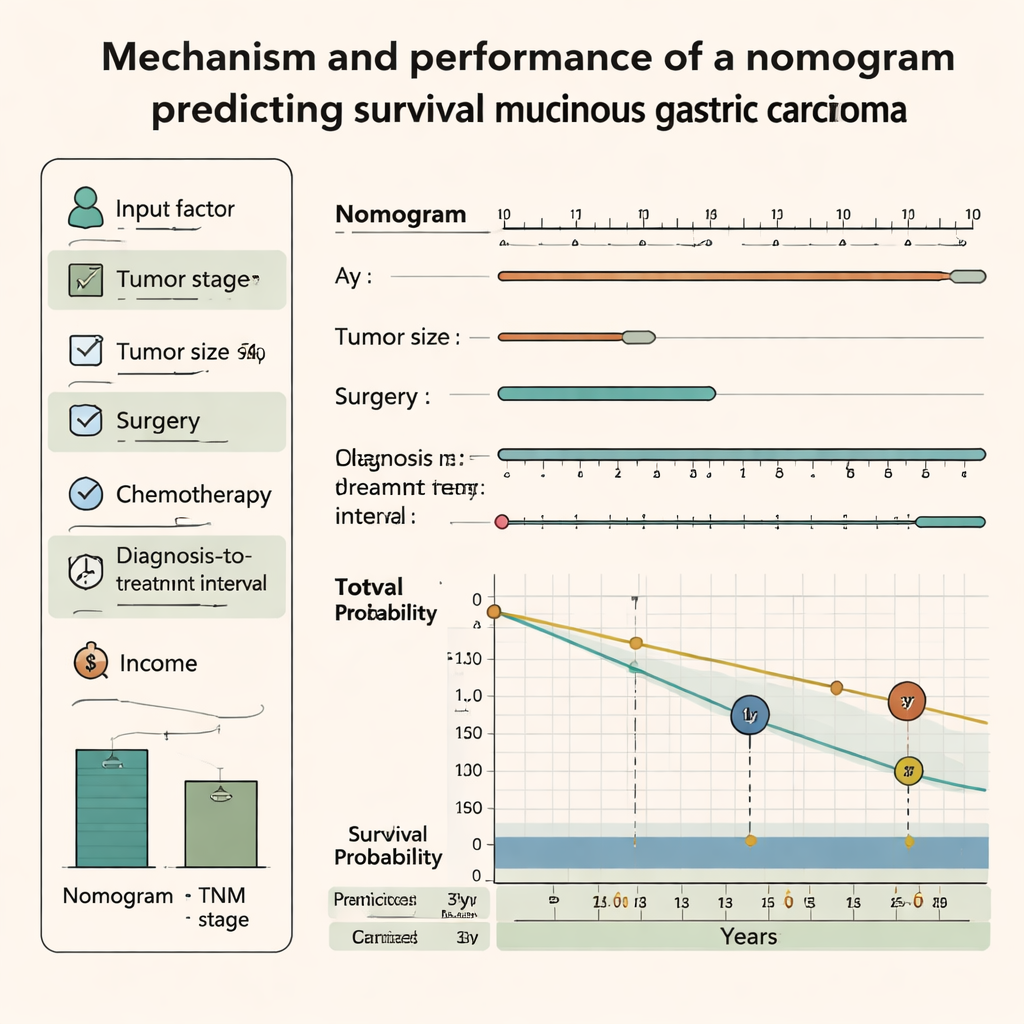
Using statistical survival models, the authors first screened many variables one by one to see which were linked with overall survival. They then combined the most informative factors into a multivariable model and translated it into a nomogram—a visual calculator that lets doctors add up points from several patient characteristics to estimate the probability of being alive at one, three and five years. The final nomogram included age, household income, tumor depth (T stage), lymph node spread (N stage), distant spread (M stage), tumor size, time from diagnosis to treatment, and whether the patient had surgery or chemotherapy. Radiotherapy did not improve predictions once the other factors were considered and was left out of the final tool.
What the model revealed about risk
Overall, patients in this study had poor outcomes: the median overall survival was 20 months, and only about one quarter were alive five years after diagnosis. Advanced tumor stage, larger tumors and the presence of metastases were all linked with worse survival, reflecting the aggressive nature of this disease. In contrast, surgery offered the greatest protective effect, strongly improving survival, and chemotherapy also contributed meaningful benefit in selected patients. Non-medical factors mattered too. People with lower household income and those who waited 20 days or more between diagnosis and treatment had poorer outcomes, highlighting the role of access to timely, high-quality care. Older age, especially 75 years and above, was associated with shorter survival, likely due to other illnesses and reduced tolerance for intensive treatments.
How well the tool worked
The team tested how accurately the nomogram could distinguish higher- from lower-risk patients and compared it with the widely used TNM staging system from the American Joint Committee on Cancer. In both the training and validation groups, the nomogram consistently outperformed TNM staging alone. Measures such as the concordance index and the area under the receiver operating characteristic curve showed that the new model provided more precise predictions at one, three and five years. Calibration plots indicated that the probabilities it produced closely matched what actually happened, and decision curve analyses suggested that using the nomogram in clinical decision-making could yield more net benefit than relying on stage alone.
What this means for patients and doctors
For patients with mucinous gastric carcinoma, this study shows that prognosis depends not only on how advanced the tumor is, but also on factors like tumor size, whether surgery and chemotherapy are given, how quickly treatment starts and even socioeconomic status. By combining these elements, the nomogram offers doctors a simple way to estimate an individual patient’s survival chances more accurately than traditional staging systems. While the model cannot replace clinical judgment and still lacks genetic and molecular information, it is a step toward more personalized counseling and treatment planning for a rare and challenging form of stomach cancer.
Citation: Meng, Q., Ma, H., Zhang, J. et al. Clinicopathological characteristics and prognostic model validation for mucinous gastric carcinoma. Sci Rep 16, 5010 (2026). https://doi.org/10.1038/s41598-026-35399-4
Keywords: mucinous gastric carcinoma, stomach cancer prognosis, nomogram, cancer survival prediction, SEER database