Clear Sky Science · en
Neural correlates of belief change in political and non-political domains among left-wing individuals confronted with counterarguments
Why our minds cling to political beliefs
Why is it so hard to change someone’s mind about politics, even when they are shown strong counterarguments or new evidence? This study peered inside the brain to explore that question. By scanning the brains of people with firmly left-wing views in Poland while their beliefs were challenged, the researchers show that political beliefs are protected in a special way—because they are tied to who we think we are. Everyday factual beliefs, by contrast, turn out to be much more flexible.
Testing stubborn beliefs in the brain
To probe how beliefs shift—or refuse to shift—the researchers recruited adults who strongly identified as left-wing and felt highly engaged in politics. Inside an MRI scanner, each person read statements they already agreed with, such as political claims about abortion laws or refugee policy, and non-political claims about health, education, or common facts. Each statement was followed by several short counterarguments. Afterward, participants rated how strongly they still believed each statement, both immediately and again about a week later. This setup let the team track changes in conviction over time while also watching which brain regions were active during the challenges. 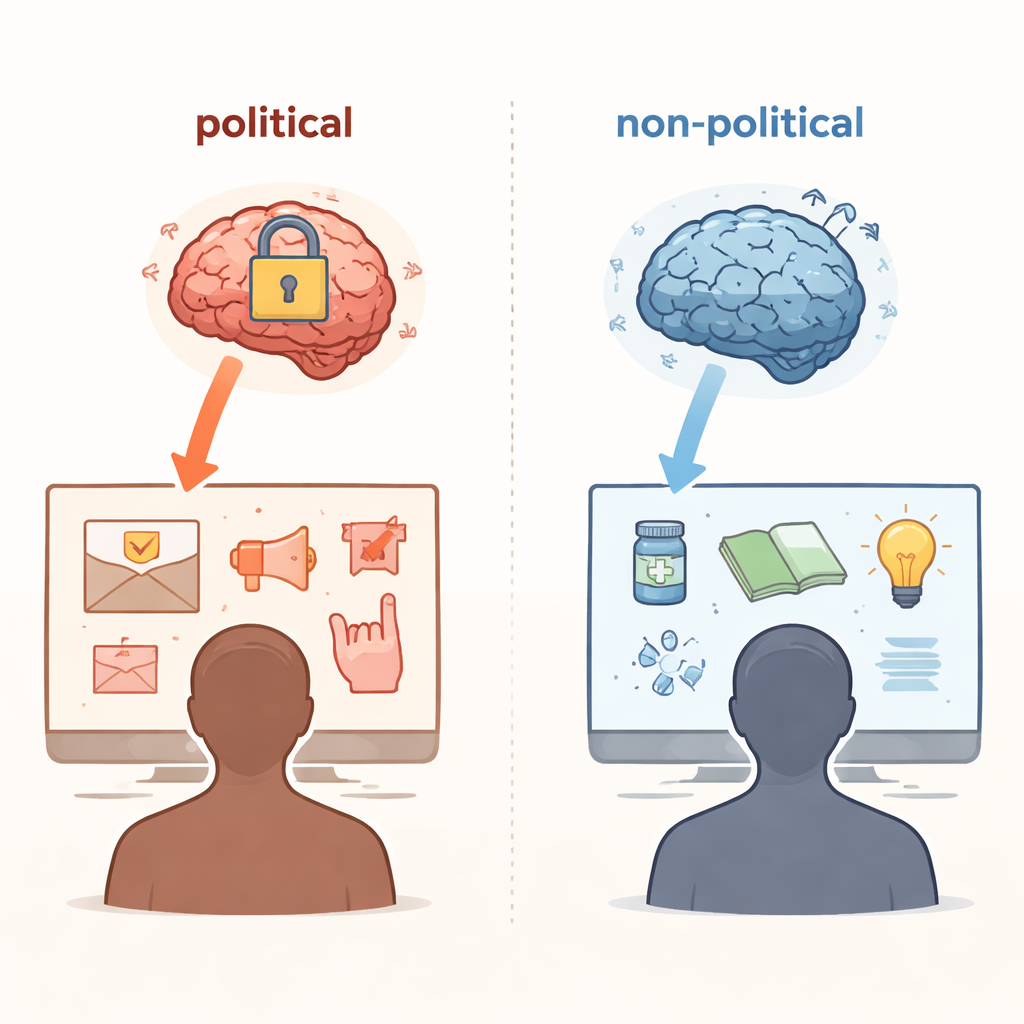
Everyday facts bend, core values barely budge
The behavioral results were striking. On average, participants lowered their confidence in non-political statements after reading the counterarguments, and this weakening of belief remained noticeable a week later. In contrast, their political beliefs hardly moved at all. The tiny drop in political conviction was so small it was not statistically meaningful. In other words, the same people who were quite willing to rethink everyday claims about things like vitamins or education outcomes were almost immovable when it came to their political positions. They also took less time to respond to political items, suggesting quick, automatic judgments rather than slow, reflective weighing of the new information.
When politics feels like the self
Brain scans revealed why political beliefs are so sticky. Challenges to political views lit up a set of regions known as the Default Mode Network, especially areas in the medial prefrontal cortex and posterior cingulate cortex. These regions are heavily involved in thinking about ourselves—our identity, values, and personal stories. When non-political beliefs were challenged, these self-focused areas were less engaged. Instead, regions tied to attention and flexible thinking, including the dorsolateral prefrontal cortex and orbitofrontal cortex, became more active. These areas help us weigh new information and update what we believe, hinting that the brain treats factual beliefs more like revisable hypotheses and political beliefs more like parts of the self.
Defensive minds without strong emotional flare
Previous research suggested that emotional centers such as the amygdala and insula might drive resistance to belief change. But in this study, activity in those regions did not reliably track how much people changed their minds. Statistical tests, including Bayesian analyses, actually favored the idea that there was no meaningful link. Instead, resistance to political belief change was associated with patterns in higher-level regions like the dorsomedial prefrontal cortex, which has been tied to protecting one’s identity and worldview. This points to a primarily cognitive form of defense: the brain seems to shield beliefs that feel like part of “me” even without dramatic emotional surges.
What this means in a polarized world
By replicating earlier work from the United States in the very different political setting of Poland, the study suggests that identity-based resistance to political belief change may be a widespread human tendency rather than a quirk of one country’s politics. Efforts to correct misinformation or persuade people on hot-button issues may fail if they treat political beliefs as simple opinions that yield to facts. The findings imply that successful approaches must address identity and belonging—reducing perceived threats to the self and creating conditions where people can reconsider views without feeling they are betraying who they are. 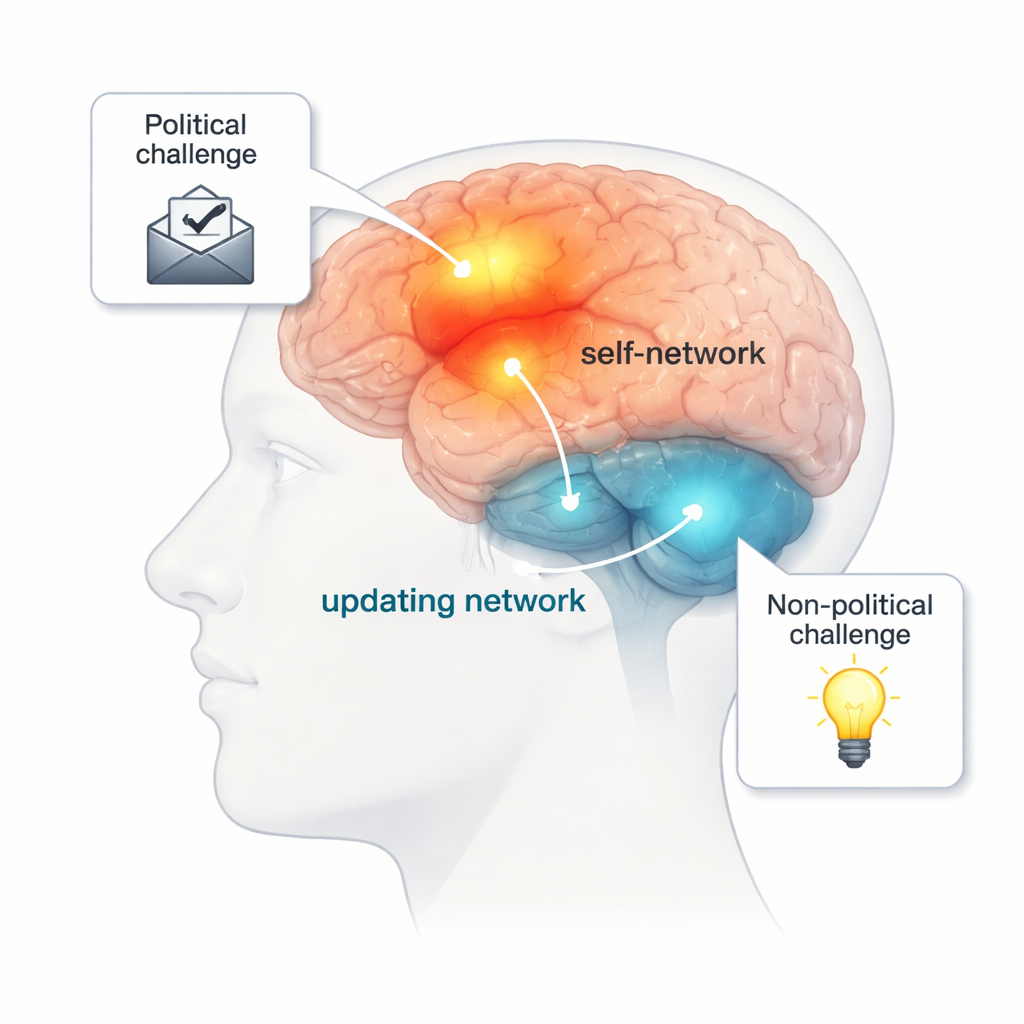
Why evidence often fails to change minds
For non-specialists, the core message is straightforward: political beliefs are hard to change not because people cannot understand evidence, but because these beliefs are woven into their sense of self. When a political stance is challenged, the brain responds as if the person is under personal threat, turning on self-focused networks and dampening the systems that would normally help them update their views. Everyday factual beliefs, by contrast, are less tied to identity, so the brain is more willing to revise them. This helps explain why debates on sensitive political topics so often reach a stalemate—and why fostering open, less identity-threatening conversations may be key to real dialogue.
Citation: Kossowska, M., Szwed, P., Czarnek, G. et al. Neural correlates of belief change in political and non-political domains among left-wing individuals confronted with counterarguments. Sci Rep 16, 4895 (2026). https://doi.org/10.1038/s41598-026-35397-6
Keywords: belief change, political polarization, motivated reasoning, identity and the brain, neuroscience of beliefs