Clear Sky Science · en
Research on self-healing photocurable 3D-printed conductive polycaprolactone-based composites
Smart Materials for Greener Gadgets
Electronics are getting smaller, softer, and closer to our bodies—but they are also creating mountains of electronic waste. This study introduces a new 3D‑printable plastic that aims to tackle both problems at once: it bends and stretches like rubber, can repair itself after damage, conducts electricity well enough for circuits, and is designed to break down more gently in the environment. For anyone interested in the future of wearable devices, medical sensors, or more sustainable tech, this work offers a glimpse of what tomorrow’s flexible electronics could be made of.
Why Flexible Circuits Need a Rethink
Today’s stretchable circuits are usually made by mixing metal or carbon particles into soft plastics, or by printing thin metal patterns on plastic films. Both methods have drawbacks. Conductive particles can clump, making current flow unreliable, while printed circuits often peel or crack when the device is bent too many times. On top of that, most of the plastics involved are long‑lasting petroleum products that linger in landfills. As wearable and disposable electronics multiply, their environmental footprint is becoming harder to ignore. The authors set out to design a material that keeps the useful features—flexibility and conductivity—while adding two more: the ability to heal small cracks on its own and to gradually degrade instead of persisting indefinitely.
Building a Plastic That Can Heal and Conduct
The team started with polycaprolactone, a biodegradable plastic already used in medical implants. They reshaped its molecules into a four‑armed “star” and gave the ends special chemical hooks that link together when exposed to light. In liquid form, this resin can be precisely shaped by a light‑based 3D printer. Once cured, it forms a solid network that is strong yet stretchable, with more than double its original length before breaking and a shape‑memory effect that lets it return to a preset form after heating. To add extra abilities, the researchers blended in three ingredients: a rubbery component rich in reversible bonds that can break and reform, tiny magnetic particles, and thin flakes of graphene, a highly conductive form of carbon. Together these create a composite that can carry electrical current, respond to a magnetic field, and repair mechanical damage by “stitching” broken areas back together. 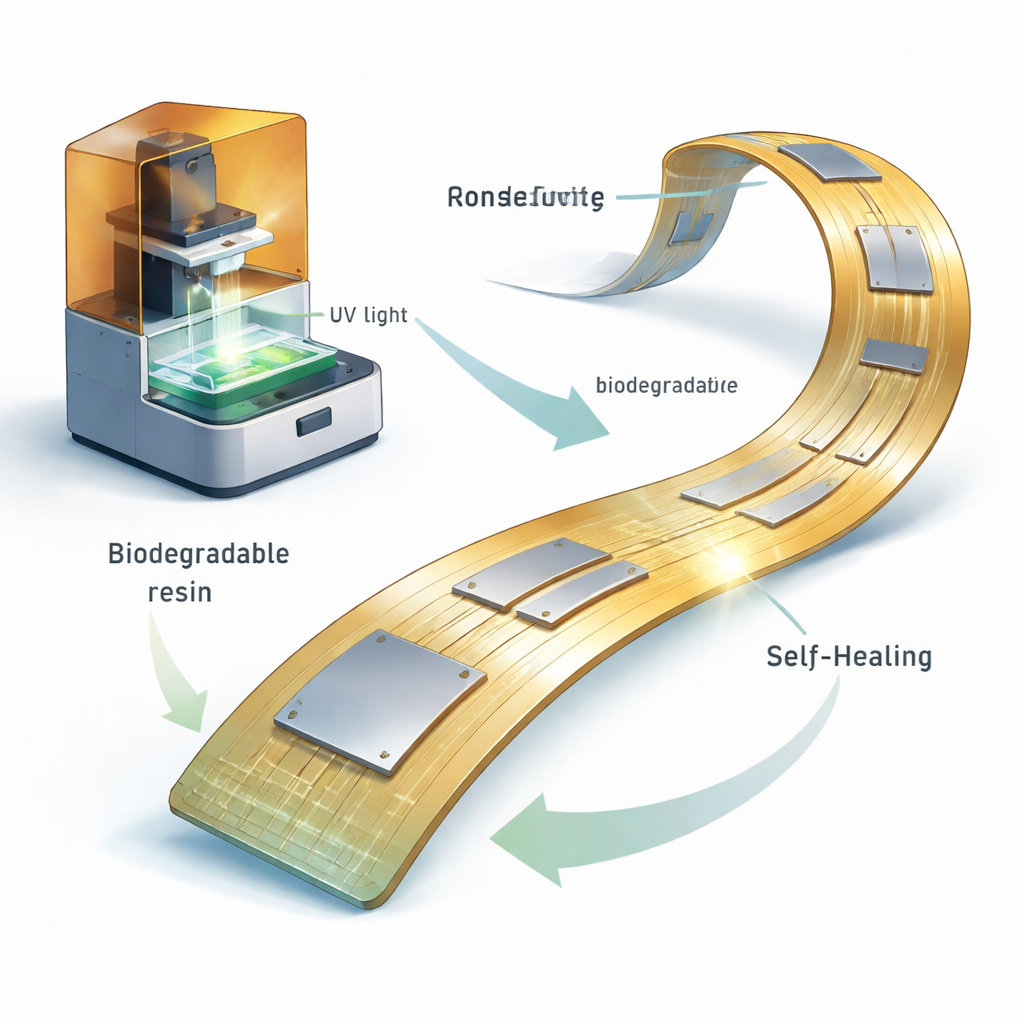
How the New Material Performs
Tests on 3D‑printed samples showed that the base resin cures efficiently under ultraviolet light, forming a tightly linked network with low swelling in liquid and good mechanical strength. When the healing and conductive additives are included, the material becomes somewhat less stretchy but gains new functions. With a modest amount of graphene—about 6 percent by weight—the composite reaches an electrical conductivity of roughly one‑tenth of a siemens per meter, enough to power small devices. In demonstration tests, a printed strip made from this resin successfully acted as a working circuit that lit up a light‑emitting diode when connected to a power source. At the same time, the presence of dynamic bonds and magnetic particles allows cut samples to regain up to 81 percent of their original toughness after four hours in a mild magnetic field and gentle heating, as broken bonds reorganize and chains slide back into contact across the crack.
Designed to Break Down, Not Build Up
Unlike many commercial resins that are engineered to last as long as possible, this material is tuned to degrade under realistic conditions. In acidic, neutral, and basic water, 3D‑printed pieces gradually lose weight over days as the polymer chains are cleaved, with faster loss in formulations that are less densely crosslinked. Weathering tests under simulated sunlight and moisture show similar trends, suggesting the printed objects would not persist indefinitely outdoors. Surface‑wetting measurements reveal that added components, especially graphene and the magnetic particles, make the material more friendly to water, which can further help natural breakdown. Throughout, the resin keeps its shape‑memory behavior: it can be temporarily deformed and then snap back to its original form when warmed, a useful trait for deployable or body‑conforming devices. 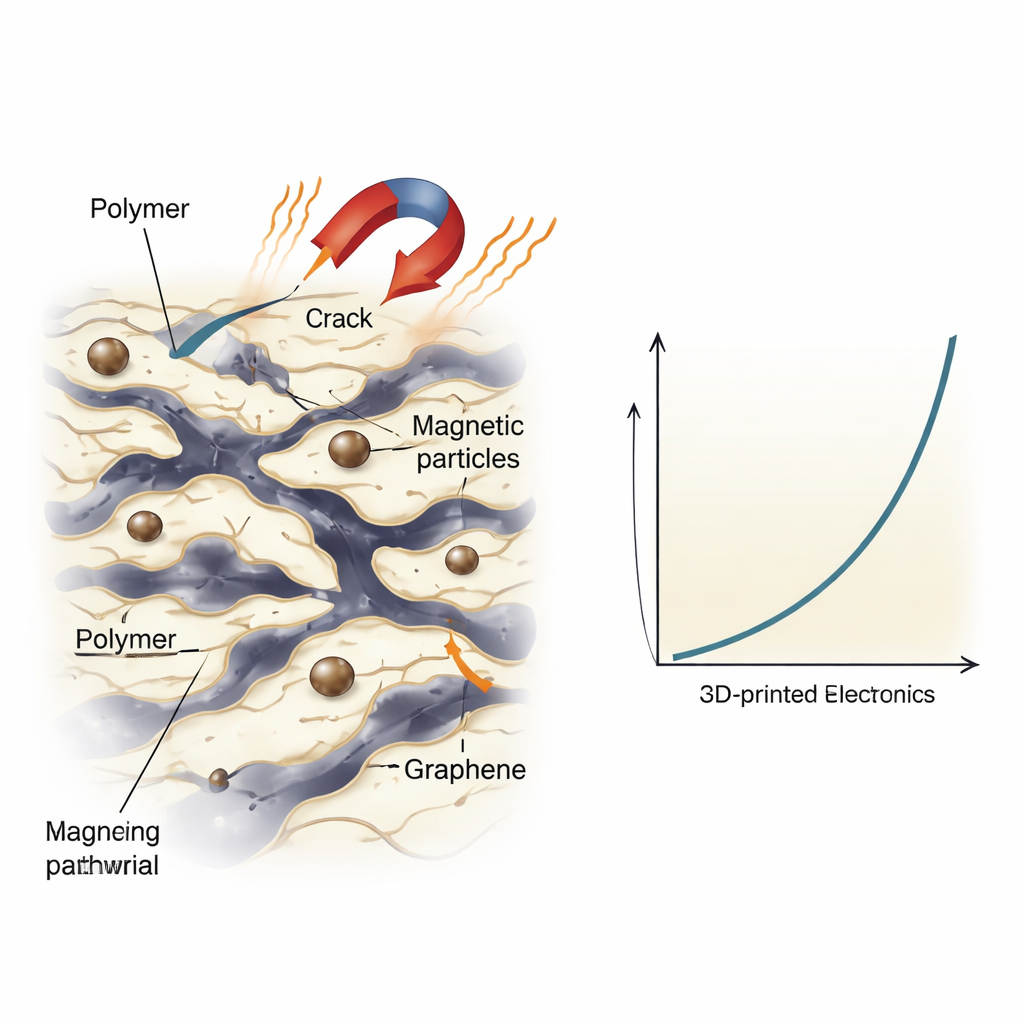
What This Could Mean for Future Devices
To a non‑specialist, the message of this paper is that it is now possible to 3D‑print soft electronic parts that are not only flexible and electrically active, but also capable of healing small cuts and designed with an end‑of‑life in mind. While more work is needed to test long‑term durability and repeated healing cycles, the material platform points toward wearable and implantable gadgets that can last longer in use yet leave a lighter mark on the planet when discarded. In short, it offers a step toward electronics that behave a bit more like living tissue—able to repair themselves—and a bit less like permanent plastic trash.
Citation: Liu, Z., Liu, Y. Research on self-healing photocurable 3D-printed conductive polycaprolactone-based composites. Sci Rep 16, 4799 (2026). https://doi.org/10.1038/s41598-026-35393-w
Keywords: flexible electronics, self-healing materials, biodegradable polymers, 3D printing, conductive composites