Clear Sky Science · en
LED lighting (350-650nm) undermines human visual performance unless supplemented by wider spectra (400-1500nm+) like daylight
Why the Light Above Your Desk Matters
Most of us spend our days under bright, efficient LED lights and rarely think about what those lights are doing to our bodies. This study suggests that the color mix of modern LEDs may quietly dull our vision and strain our cells, and that reintroducing a more “sun-like” spectrum—especially invisible deep red and infrared light—can noticeably sharpen how we see contrast and color, with benefits that last for weeks. 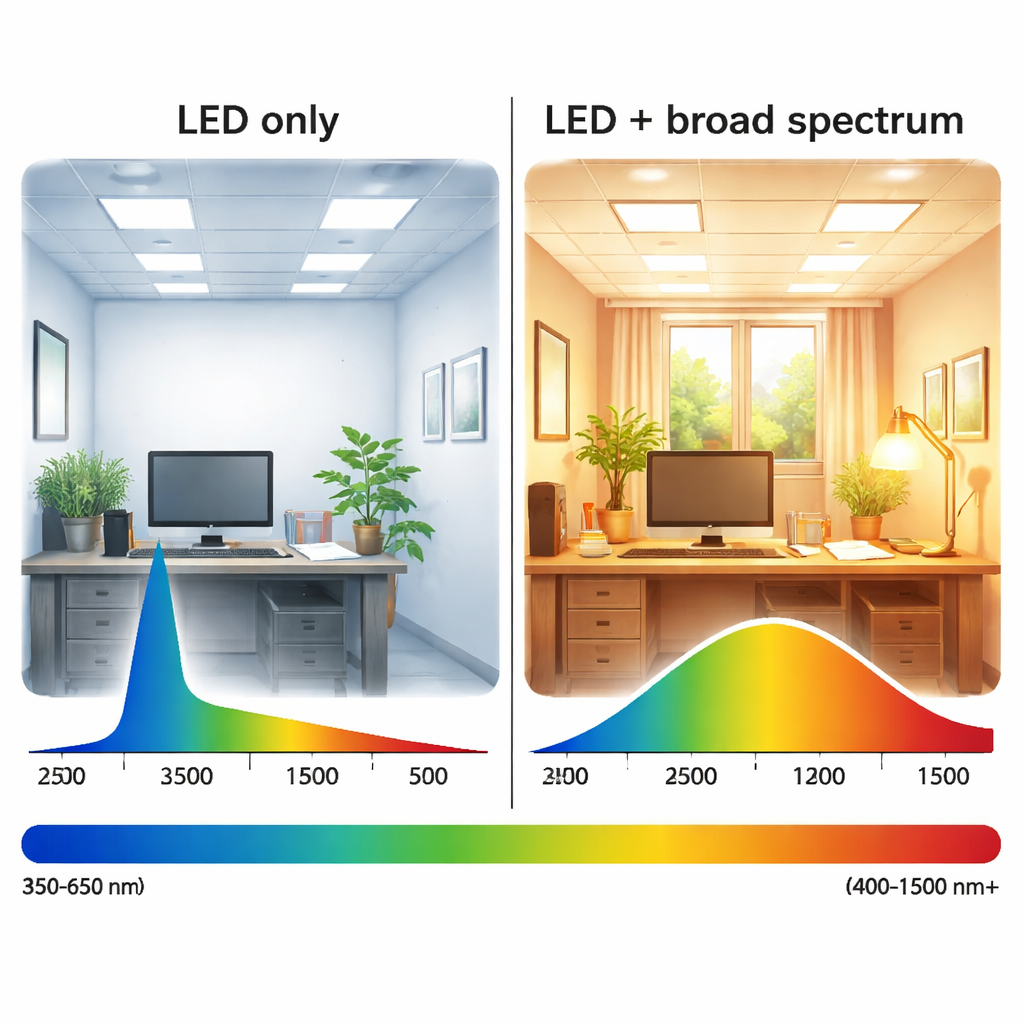
From Sunlight to Screens: A Shift in Human Lighting
Life on Earth evolved under broad spectrum sunlight stretching from ultraviolet through deep infrared. Old-style incandescent bulbs, like firelight, mimicked this wide spread of wavelengths. By contrast, common white LEDs concentrate their power in a narrow band from about 350–650 nanometers, with a strong spike in short blue light around 420–450 nanometers and very little beyond deep red. While this suits our eyes’ brightness sensitivity and saves energy, it ignores the rest of the spectrum that our cells—especially their energy factories, the mitochondria—have quietly adapted to over millions of years.
How Different Colors of Light Talk to Our Cells
Laboratory work across insects, mice, and humans has shown a striking pattern. Blue-rich light similar to that from LEDs can reduce mitochondrial efficiency, lowering the production of ATP, the molecule that powers cellular work. In animals, this has been linked to weight gain, shorter lifespan, and signs of inflammation and metabolic stress. In contrast, longer wavelengths in the deep red and near infrared (roughly 670–900 nanometers and beyond) tend to boost mitochondrial activity, increase ATP, lower blood sugar spikes, and improve movement and vision in aging eyes. These effects are not limited to the area directly lit; changes in blood signals and inflammatory molecules suggest that mitochondria in one region can influence tissues throughout the body.
A Real-World Office Test of Better Light
The authors examined a modern university workspace in London that relied entirely on overhead LEDs and blocked incoming infrared from daylight with special window coatings. Twenty-two healthy adults, who already had spent more than two years in this LED‑lit environment and had limited winter daylight exposure, were recruited. Half continued working under standard LEDs only (the control group). The other half had simple tungsten incandescent desk lamps added around their workbenches for two weeks. These bulbs emit a broad spectrum similar to sunlight, extending well into the infrared, while adding relatively little visible brightness compared to the main LEDs.
Sharper Color Vision That Lasts
All participants took a sensitive computer-based color contrast test in a dark room before any changes, then again after two weeks, and for the experimental group also at four and six weeks after the incandescent lamps were removed. Those who received the extra broad-spectrum light improved their ability to detect both red-based and blue-based color contrasts by about 25 percent, and this better performance persisted unchanged for at least six weeks after the lamps were taken away. In earlier lab studies, a brief dose of a single red wavelength (670 nanometers) improved mainly blue-based vision and faded within about five days. Here, in a normal working environment with a full spread of longer wavelengths, the gains were more balanced across color channels and far more durable. The control group, who remained under LEDs only, showed no meaningful change over the same period. 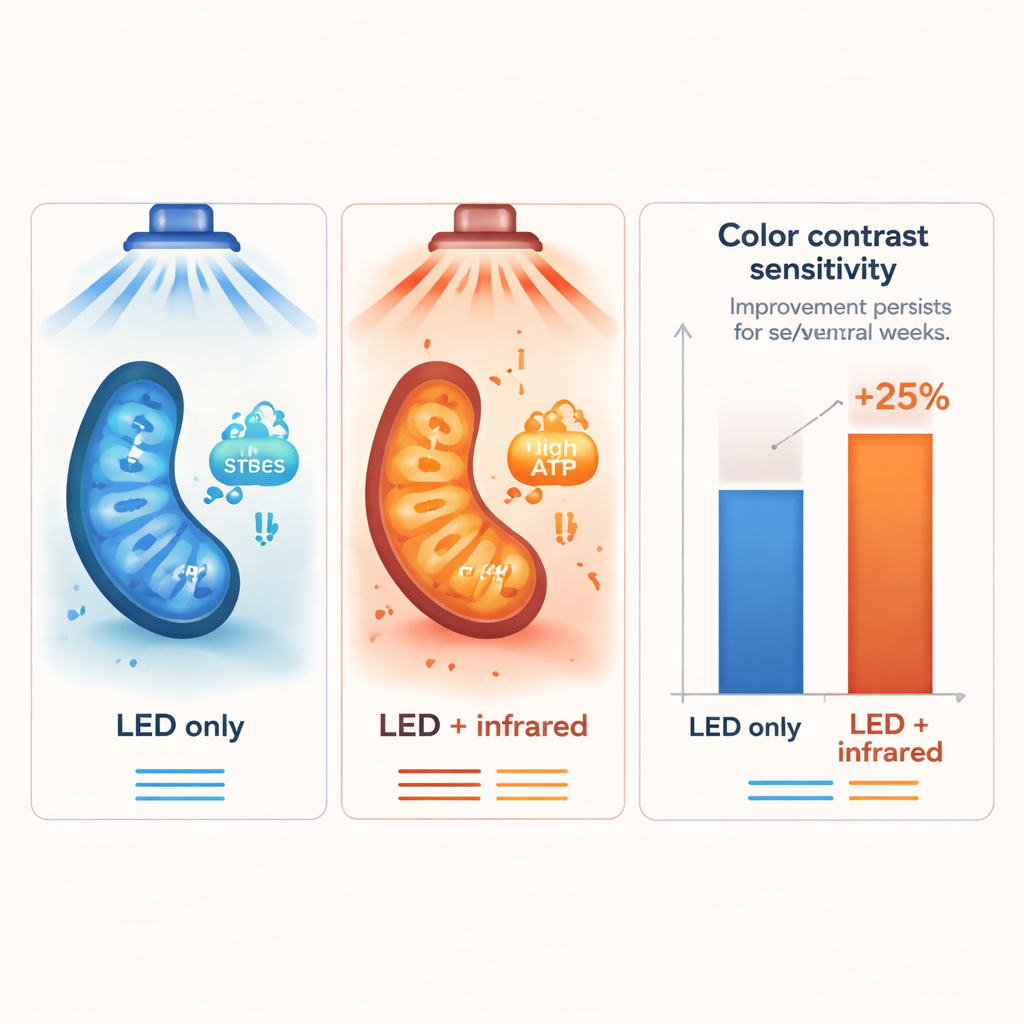
What This Could Mean for Everyday Health
The findings support the idea that common LED lighting, by favoring short wavelengths and stripping away infrared, can subtly degrade visual performance—likely by depressing mitochondrial function in the retina and perhaps elsewhere. Adding back even modest amounts of broad-spectrum, infrared-rich light appears to restore and sustain healthier mitochondrial activity, translating into clearer color contrast for weeks. Because mitochondria help govern metabolism, inflammation, and aging across the body, the authors argue that the impact of our lighting choices may reach far beyond eyesight. Rethinking how we light offices, hospitals, and homes—whether by keeping some form of infrared-rich incandescent source, redesigning LEDs to include a smoother long-wavelength component, or running halogen bulbs at lower power—could be a low-cost way to support public health in a world that increasingly lives indoors.
Citation: Barrett, E.M., Jeffery, G. LED lighting (350-650nm) undermines human visual performance unless supplemented by wider spectra (400-1500nm+) like daylight. Sci Rep 16, 3061 (2026). https://doi.org/10.1038/s41598-026-35389-6
Keywords: LED lighting, infrared light, mitochondria, color vision, indoor health