Clear Sky Science · en
Wideband nanocomposite antireflective coating based on aluminium dry powder nanoparticles embedded into a photopolymer matrix for solar cells application
Making Sunlight Work Harder
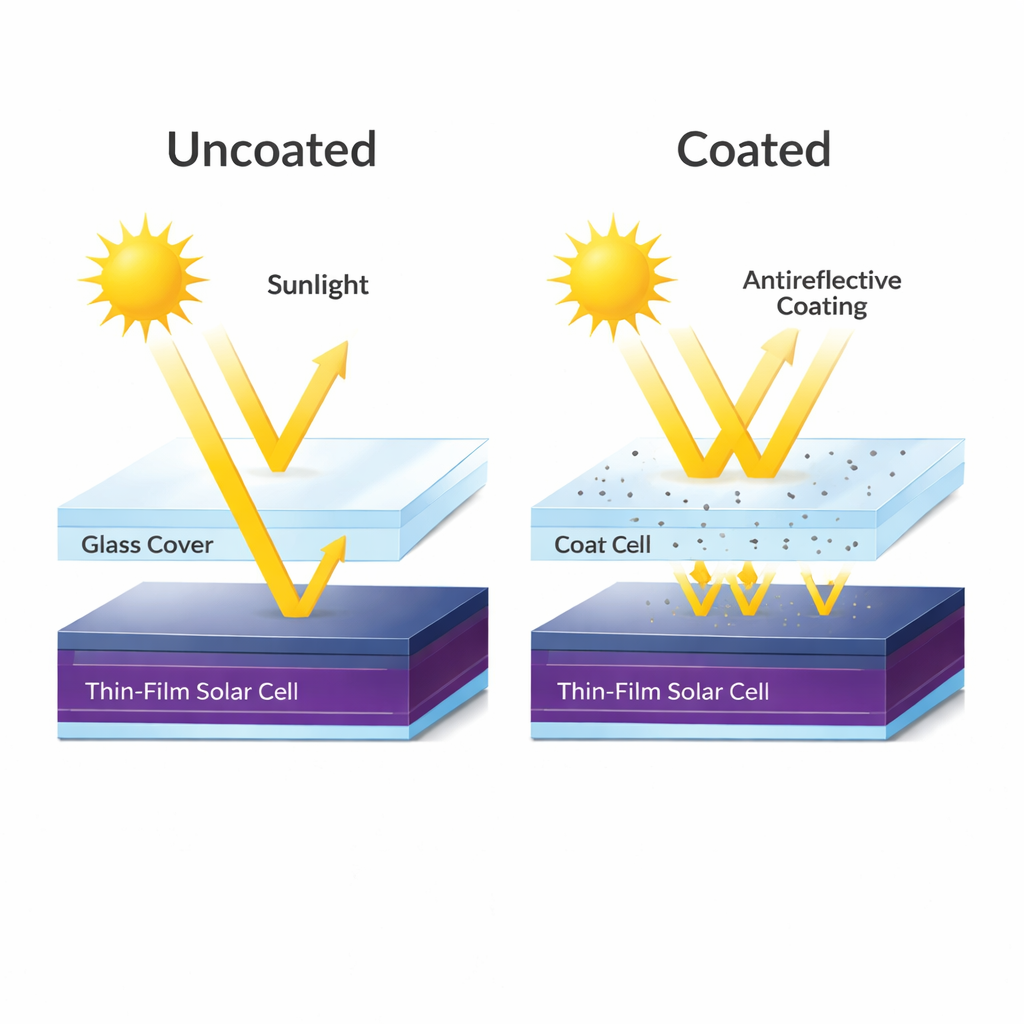
Solar panels lose a surprising amount of precious sunlight before it can be turned into electricity, simply because light bounces off their surfaces. This study reports a low-cost, easy-to-apply transparent coating that cuts those reflections across most of the visible spectrum. By sprinkling ultra‑small aluminum particles into a clear glue-like material and spreading it over glass or a thin-film solar cell, the authors show they can let more light in and squeeze extra power out of existing solar technology.
A Simple Layer with Tiny Metal Sprinkles
The heart of the work is a single, very thin layer that behaves like an “antireflection skin.” The layer is a mix of a commercial optical adhesive and aluminum nanoparticles about 110 nanometers across—roughly a thousand times thinner than a human hair. Only about 1 percent of the mixture, by weight, is metal. This modest amount is enough to change how light passes through the surface. Because both the adhesive and the nanoparticles are standard off‑the‑shelf products, the approach avoids complex chemical synthesis and fits well with cost‑sensitive industries like solar power.
From Powder to Clear Coating
Turning a jar of dry aluminum powder into a uniform, see‑through film requires careful preparation. The researchers first mix the particles into methanol to thin the adhesive and help separate clumps of particles. They heat, stir, and then sonicate the mixture—using high‑frequency sound waves—to break apart large clusters. Finally, they filter out any stubborn clumps before blending the well‑dispersed particles into the adhesive. The resulting liquid is then deposited using a “doctor‑blade” method, where a glass rod sweeps the mixture across a glass slide or a solar cell at controlled speed and spacing, creating a roughly 50‑micrometer‑thick layer that cures under ultraviolet light.
Less Glare, More Light
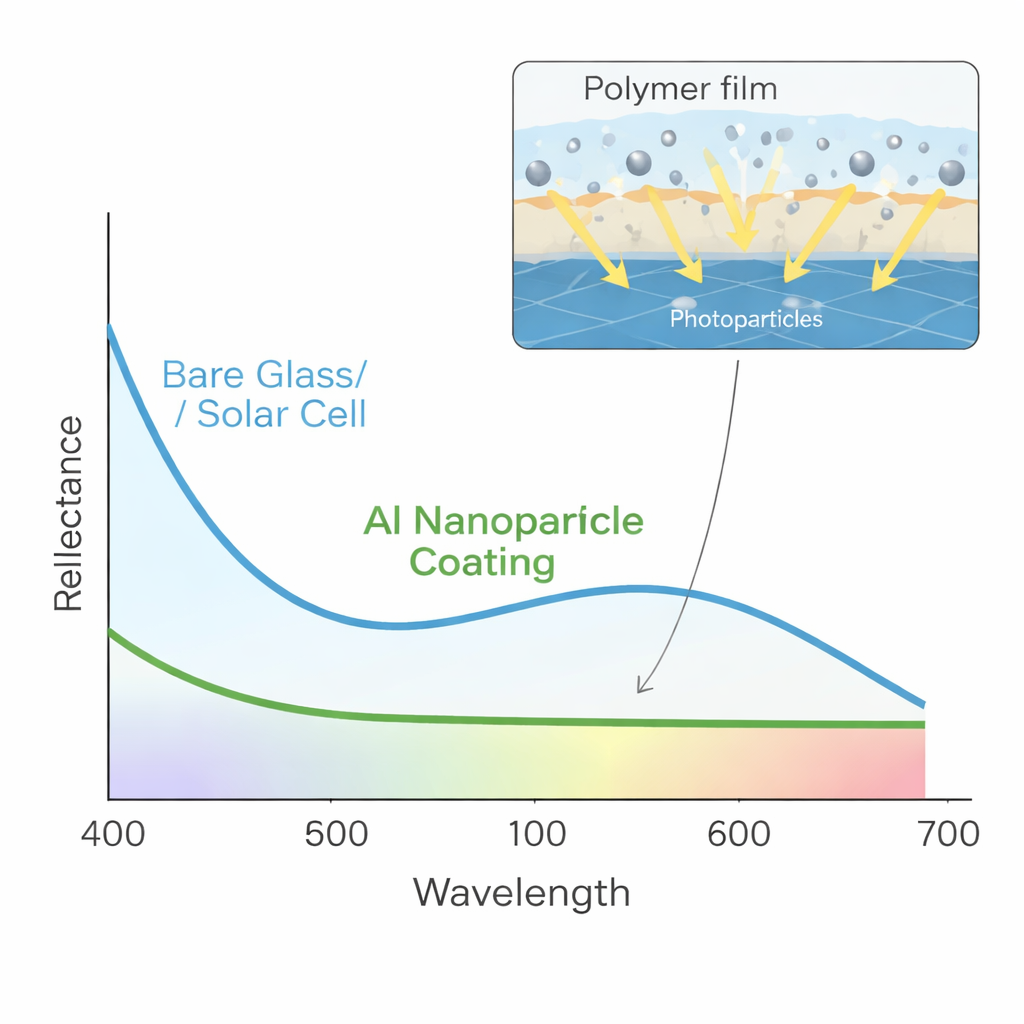
To see how well this new skin performs, the team shines a broad spectrum of visible light onto coated and uncoated soda‑lime glass, the kind commonly used to protect solar cells. Measurements show that the coated glass reflects about half as much light on average as bare glass across 400 to 750 nanometers—a drop from around 8 percent reflectance to about 4 percent. At the same time, the glass transmits about 5 percent more light, reaching roughly 94.5 percent transmission, close to the limit of the clear adhesive itself. The coating achieves this broad improvement without using multiple layers or precision nanostructuring, which are common but more expensive strategies in advanced optics.
Boosting Real Solar Cells
The researchers also test their approach on actual thin‑film solar cells made from indium nitride on silicon, a design that already has a textured surface to reduce glare. In this case, they simply deposit aluminum nanoparticles from solution onto the cell’s surface, without the polymer matrix, to avoid disturbing the device structure. Even with this simpler treatment, the average surface reflectance drops by about 24 percent, especially at shorter wavelengths where these cells are most effective. Under standard sunlight conditions, the coated devices show higher current and a modest rise in overall efficiency—from 1.78 to 1.94 percent—amounting to a 9 percent relative improvement in power conversion.
Practical Steps Toward Cheaper Solar Power
For non‑specialists, the key message is that a single, inexpensive coating layer can noticeably improve how much sunlight solar panels capture, using standard materials and simple tools. The nanocomposite film can be applied to protective glass plates or directly onto thin‑film solar cells and does not require vacuum chambers or clean‑room facilities. While further work is needed to study long‑term durability and fine‑tune scattering effects, this approach points toward practical, scalable antireflective surfaces that help solar technologies deliver more electricity from the same sunlight, at lower cost.
Citation: Sánchez, P.A., Valdueza-Felip, S., Sun, M. et al. Wideband nanocomposite antireflective coating based on aluminium dry powder nanoparticles embedded into a photopolymer matrix for solar cells application. Sci Rep 16, 5209 (2026). https://doi.org/10.1038/s41598-026-35384-x
Keywords: solar cells, antireflective coating, nanoparticles, thin-film photovoltaics, solar energy efficiency