Clear Sky Science · en
Short-term exposure to cyan light attenuates myopigenic effects of hyperopic defocus on ocular biometry in humans
Why the color of light might matter for your eyesight
Myopia, or short-sightedness, is rising rapidly worldwide and is now a leading cause of vision problems. Scientists know that spending more time outdoors seems to slow its onset in children, but they are still working out why. One key suspect is the color, or wavelength, of light that reaches our eyes. This study asks a focused question: can a particular shade of blue-green light, known as cyan, temporarily push the eye away from the changes linked with myopia when the eye is under "bad" focus conditions that usually encourage it to grow longer?
A closer look at how eyes grow
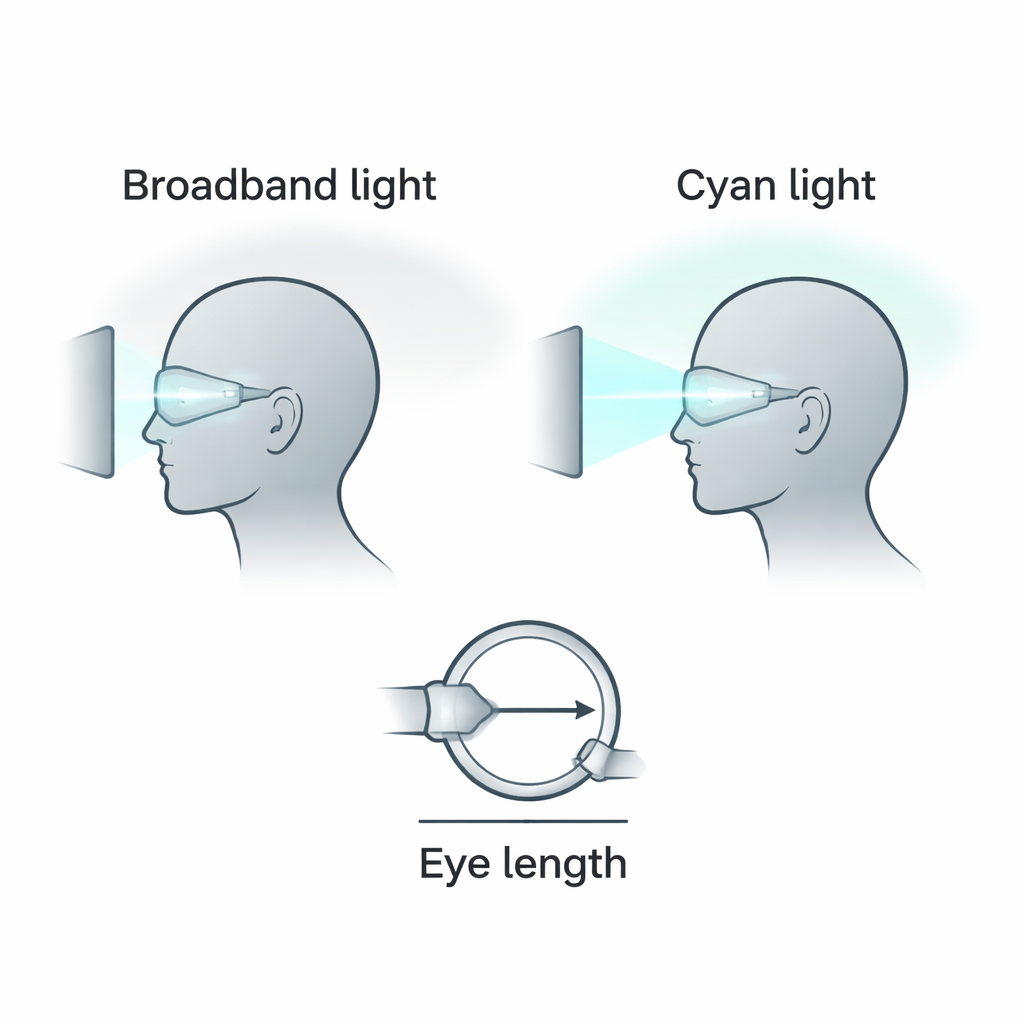
When the eye becomes myopic, it typically grows too long from front to back, so distant objects come into focus in front of the retina rather than on it. In the short term, this length can shift slightly as inner eye tissues swell or thin. One of these tissues, the choroid, lies just behind the retina and is rich in blood vessels. When the choroid thins and the eye lengthens, these changes are considered “myopigenic,” or favoring the development of myopia. In everyday life, long spells of close work can create a type of blur called hyperopic defocus on the retina, which encourages this pattern of thinning and elongation. The authors wanted to know whether the color of ambient light could soften or reverse these short-term, myopia-linked changes.
Testing cyan light in real human eyes
The researchers recruited 28 healthy young adults, some with normal vision and some with mild to moderate myopia. On two separate days, each participant wore special light-emitting glasses for two hours: once under white "broadband" light and once under narrowband cyan light centered at 507 nanometers. At the same time, the right eye viewed the world through a contact lens that imposed -3 diopters of hyperopic defocus, mimicking the kind of blur that tends to promote myopia, while the left eye had clear focus. The team measured overall eye length and the thickness of the choroid beneath the center of the retina at baseline, during light exposure, and again 30 minutes after the light was turned off.
What happened inside the eye during cyan light
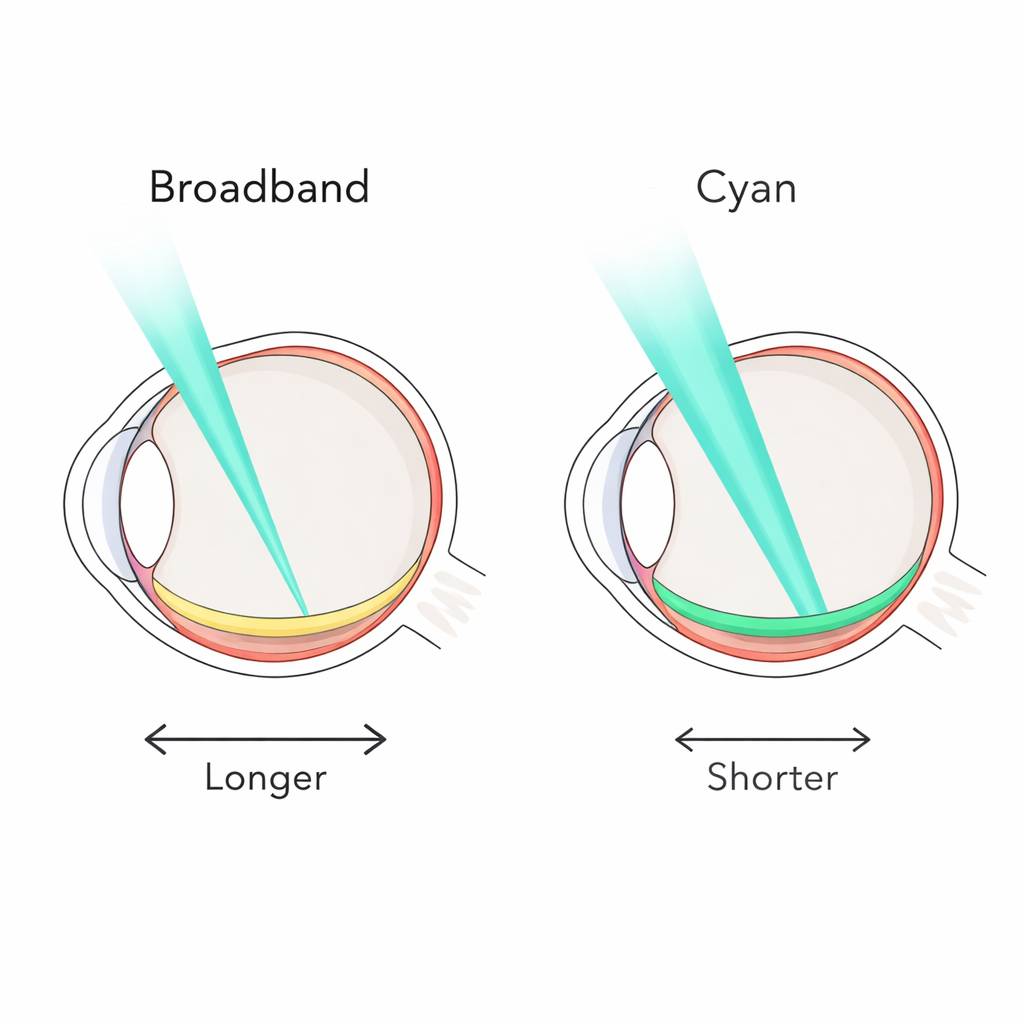
When participants were exposed to cyan light, their eyes behaved differently than under white light. In the defocused right eye, cyan light reduced the amount of axial elongation seen after two hours, and even produced a small net shortening compared with the white-light condition. At the same time, the choroid became measurably thicker under cyan light than under white light in both the defocused and non-defocused eyes. These differences—on the order of a few thousandths of a millimeter—are tiny but meaningful in eye-growth research, and they were statistically robust at the 120-minute mark. Importantly, these changes faded back toward baseline within about 30 minutes after the light was switched off, indicating a rapid, reversible response rather than permanent remodeling of the eyeball.
Who benefited and what stayed the same
The cyan-light effect appeared similar in participants with myopia and those with normal vision: the study did not find strong evidence that one group responded more than the other during this short exposure. Other eye measurements, such as corneal shape, lens thickness, and the depth of the front chamber of the eye, changed little and showed no consistent pattern tied to light color. The researchers also checked how much effort the eye used to focus at distance and at near, and found no clear differences between cyan and white lighting. This suggests that the observed changes in eye length and choroidal thickness were driven mainly by light-sensitive pathways in the retina and choroid, not by shifts in focusing effort.
What this could mean for future myopia care
To a non-specialist, the takeaway is that a specific slice of the blue-green spectrum—cyan light—can nudge the eye, at least temporarily, away from the pattern of thinning and elongation that is associated with myopia, even when the eye is experiencing a type of blur that usually encourages it to grow longer. This does not mean that a simple cyan lamp or gadget is ready to cure or prevent myopia. The effects shown here are short-lived, and it is not yet known whether repeated or longer-term cyan-light exposure would safely slow eye growth in children over months or years. Still, the findings add to growing evidence that not just how bright light is, but also what color it is, may be an important lever in protecting eyesight in our increasingly indoor, screen-heavy lives.
Citation: Hussain, A., Pic, E., Baranton, K. et al. Short-term exposure to cyan light attenuates myopigenic effects of hyperopic defocus on ocular biometry in humans. Sci Rep 16, 4909 (2026). https://doi.org/10.1038/s41598-026-35377-w
Keywords: myopia, cyan light, eye growth, choroid, light therapy