Clear Sky Science · en
Robust averaging of emotional faces and its association with psychotic-like experiences and social connection
How Our Brains Read a Crowd
Imagine walking into a party and instantly sensing whether the mood is warm and friendly or tense and hostile, without carefully inspecting every single face. This study asks how our brains pull off that trick, and whether people who report more unusual experiences or feel less socially connected process emotional crowds differently. Understanding these hidden shortcuts in perception can shed light on everyday social skills like “reading the room,” as well as on mental health conditions in which social signals can feel confusing or misleading.
Averaging Feelings at a Glance
Our senses are constantly flooded with messy information. Rather than weighing every detail equally, the brain often compresses groups of similar items into a quick “summary,” such as the average size of objects or the typical color in a scene. This paper focuses on whether we also compute an average emotional tone from many faces at once, and whether we quietly downplay faces that look very different from the rest. This strategy, called robust averaging, is like a mental version of ignoring statistical outliers so that one extreme example does not skew our overall judgment.
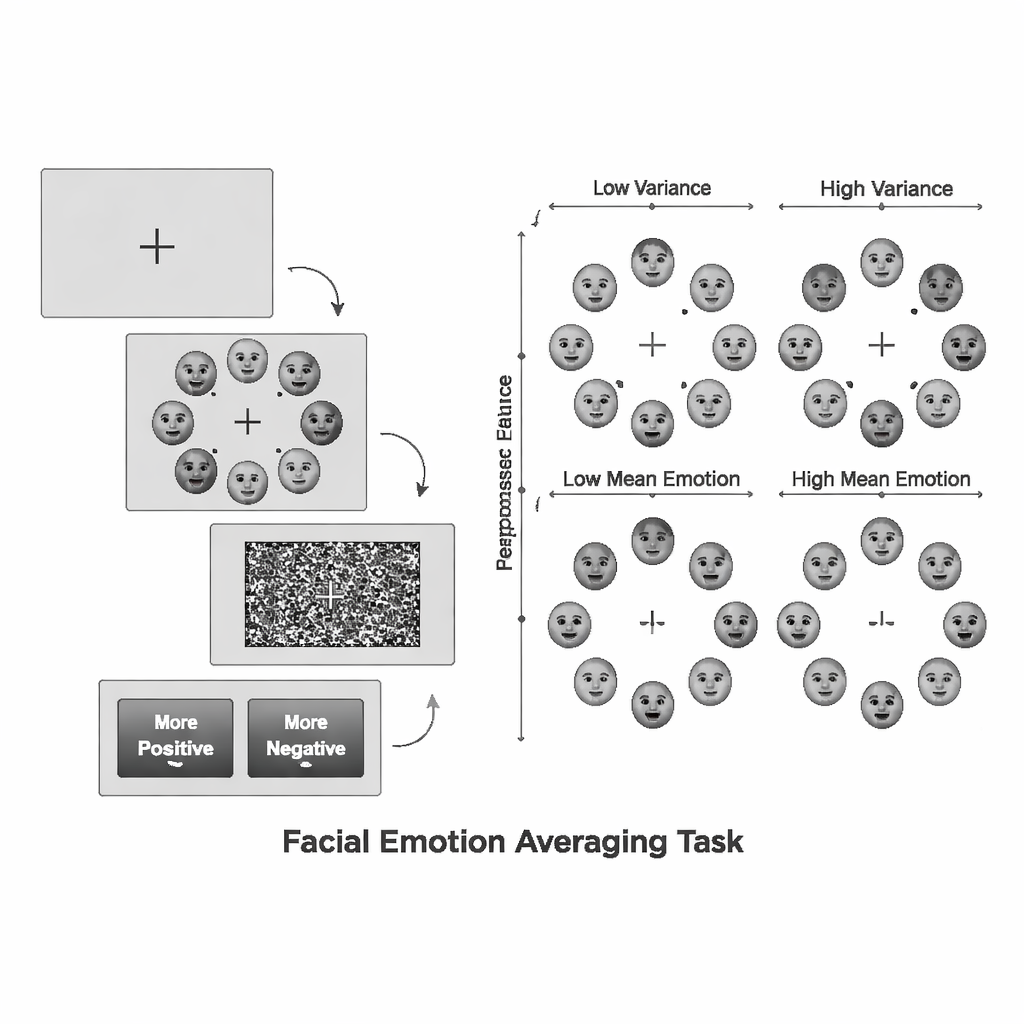
A New Test of Crowd Emotion
To examine this process, over 200 young adults completed a computerized task featuring arrays of eight faces arranged in a circle. Each face was created by smoothly morphing between very angry and very happy expressions, producing many intermediate levels of emotion. On every trial, participants briefly viewed one of these eight-face arrays and then reported whether, on average, the group looked more positive or more negative. The researchers carefully controlled two aspects of each array: the overall emotional intensity (strong vs subtle expressions) and the amount of variation among faces (similar vs very mixed expressions). Afterward, participants filled out questionnaires about psychotic-like experiences—unusual perceptions or beliefs that can occur even in people without a diagnosed disorder—as well as measures of loneliness, perceived social support, and satisfaction with friendships.
When We Ignore the Odd Face Out
Beyond simple accuracy, the key question was how much each individual face contributed to the final decision. Using detailed statistical models, the authors estimated the “decision weight” of each face in every array, from the most negative to the most positive. Across two analytic approaches, a clear pattern emerged: faces near the group’s average emotion had the strongest influence on choices, whereas very positive or very negative “odd ones out” mattered less. Crucially, this robust averaging appeared only when the array was highly varied—when some faces were much happier or angrier than others. When all faces were similar, participants treated them more evenly. In other words, people selectively downweighted outliers precisely in the noisy situations where they would be most misleading.
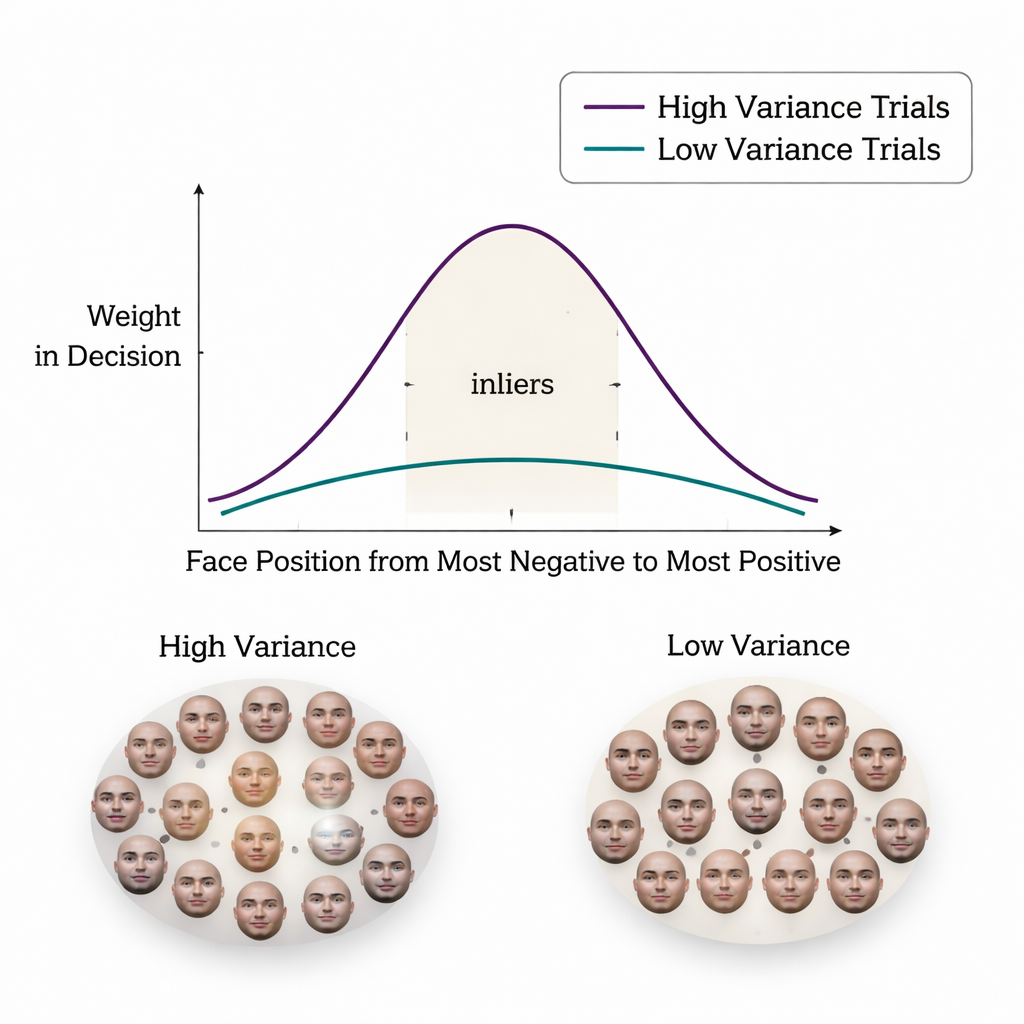
Surprising Links to Unusual Experiences
The team expected that people who endorsed more psychotic-like experiences might rely less on robust averaging, perhaps giving too much weight to striking or unusual faces. They also wondered whether people who felt lonelier or less supported would show weaker robust averaging, potentially hinting at subtle differences in how they perceive groups. However, the data did not support either idea. Robust averaging was robust in another sense: it appeared consistently across participants and did not track with levels of unusual perceptions, delusion-like beliefs, anomalous sensory experiences, loneliness, perceived social support, or satisfaction with friendships. Task accuracy was slightly higher in those reporting more unusual perceptual experiences, but this did not reflect changes in how they weighted inlier versus outlier faces.
What This Means for Everyday Social Life
For a layperson, the take-home message is that most of us naturally and adaptively “average” the emotions of a crowd, especially when expressions are mixed and potentially confusing. Our brains seem to protect us from being misled by one very angry or very happy face in an otherwise neutral group by quietly downplaying that outlier. In this study, this ability did not explain who felt more socially connected or who reported more psychotic-like experiences, at least in a non-clinical student sample. Future work will need to test whether this kind of perceptual averaging changes in people with diagnosed psychotic disorders, in more diverse populations, and in more realistic, dynamic social scenes where switching between focusing on the average and noticing the exception may be key to social success.
Citation: Gibbs, K., Dong, X., Shin, Y. et al. Robust averaging of emotional faces and its association with psychotic-like experiences and social connection. Sci Rep 16, 4965 (2026). https://doi.org/10.1038/s41598-026-35374-z
Keywords: facial emotion, ensemble perception, psychotic-like experiences, social connection, visual decision-making