Clear Sky Science · en
Green synthesis of activated carbon-ZIF-8 nanocomposites from pistachio hulls for efficient antibiotic adsorption in water remediation
Why Pistachio Waste Could Help Clean Our Water
Every year, huge amounts of antibiotics such as tetracycline and amoxicillin are used in human and veterinary medicine, and much of them ends up in rivers, lakes, and groundwater. These drugs can foster antibiotic-resistant bacteria and harm aquatic life, yet they are difficult to remove with standard water treatment. In this study, researchers found a way to turn an abundant agricultural waste—pistachio hulls—into a high‑performance material that can pull these antibiotics out of water efficiently, using a process designed to be both low‑cost and environmentally friendly.
Antibiotics in Water and Why They Are Hard to Catch
Tetracycline and amoxicillin are widely prescribed because they are effective and relatively stable. That same stability becomes a problem once they leave our bodies. Up to three quarters of a tetracycline dose, for example, can be excreted unchanged. From hospital wastewater, farms, and fish ponds, the drugs wash into streams and reservoirs. There they can disrupt microbial communities, help spread antibiotic resistance, and move up the food chain. Existing treatment methods—such as chemical oxidation, membrane filtration, or biological degradation—often struggle with these molecules or are too energy‑intensive and costly for broad use, especially in low‑resource settings.
From Pistachio Hulls to a Smart Cleaning Powder
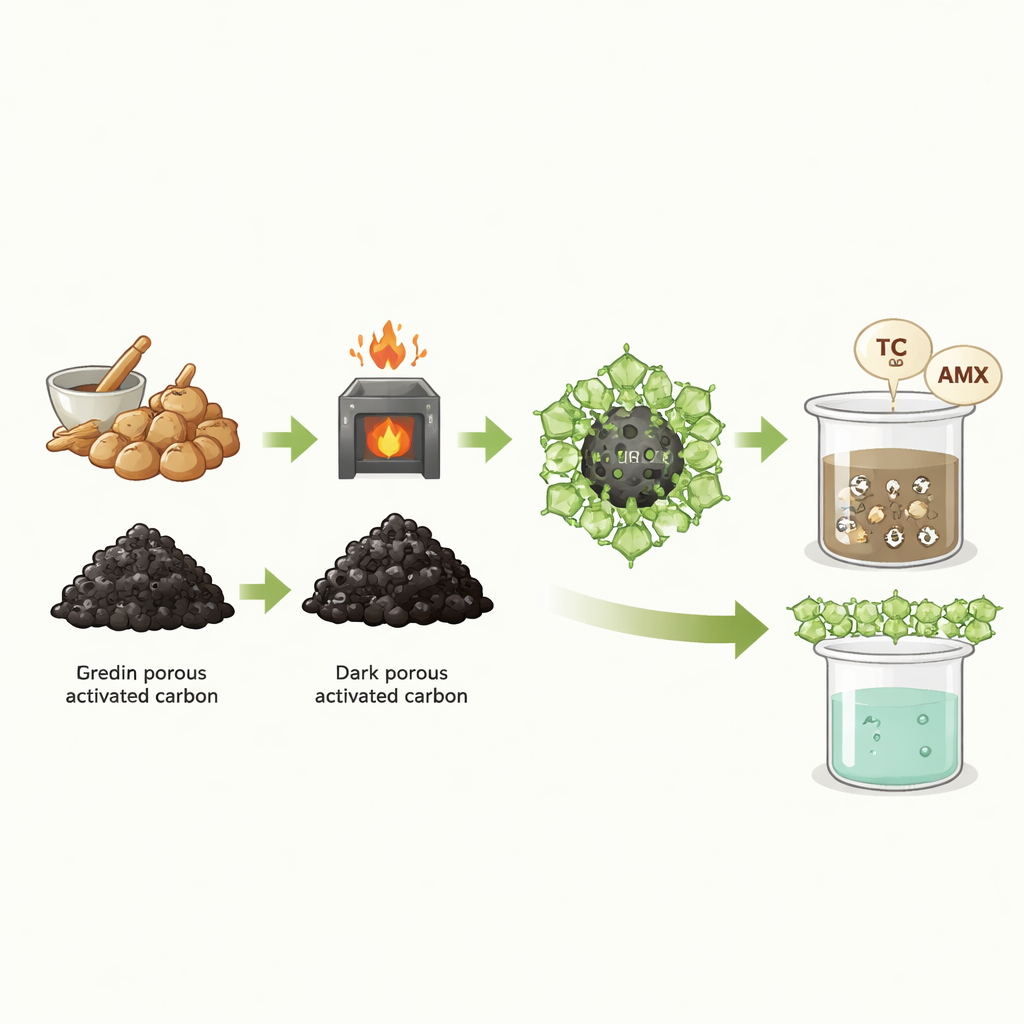
Pistachio farming generates mountains of hulls, which usually have little value and can cause disposal problems. The team dried and ground this waste biomass and converted it into activated carbon, a charcoal‑like material full of tiny pores that can trap pollutants. They then grew microscopic crystals of a porous solid called ZIF‑8 (a metal–organic framework made from zinc and an organic linker) directly on the pistachio‑based carbon. By adjusting how much carbon they added, they created three versions of a hybrid material, named ZP‑0.01, ZP‑0.02, and ZP‑0.04. Microscopy, X‑ray and surface‑area measurements confirmed that ZIF‑8 crystals coated the carbon and that the resulting powders had highly developed pore structures, offering many “parking spots” for antibiotic molecules.
How Well the New Material Grabs Antibiotics
The researchers then tested how effectively these nanocomposites removed tetracycline and amoxicillin from water under different conditions. They varied pH, contact time, temperature, pollutant concentration, and the amount of adsorbent used. Among the three versions, ZP‑0.01 performed best. Under near‑neutral pH and room temperature, it could hold up to about 38 milligrams of tetracycline and 137 milligrams of amoxicillin per gram of material, with removal efficiencies above 85% for tetracycline and over 93% for amoxicillin. Mathematical models that describe how molecules stick to surfaces showed that the data fit a “single‑layer” adsorption picture, and the rate at which the drugs were captured followed a pattern usually associated with strong, specific interactions between the adsorbent and the pollutants.
What Happens at the Nanoscale Surface
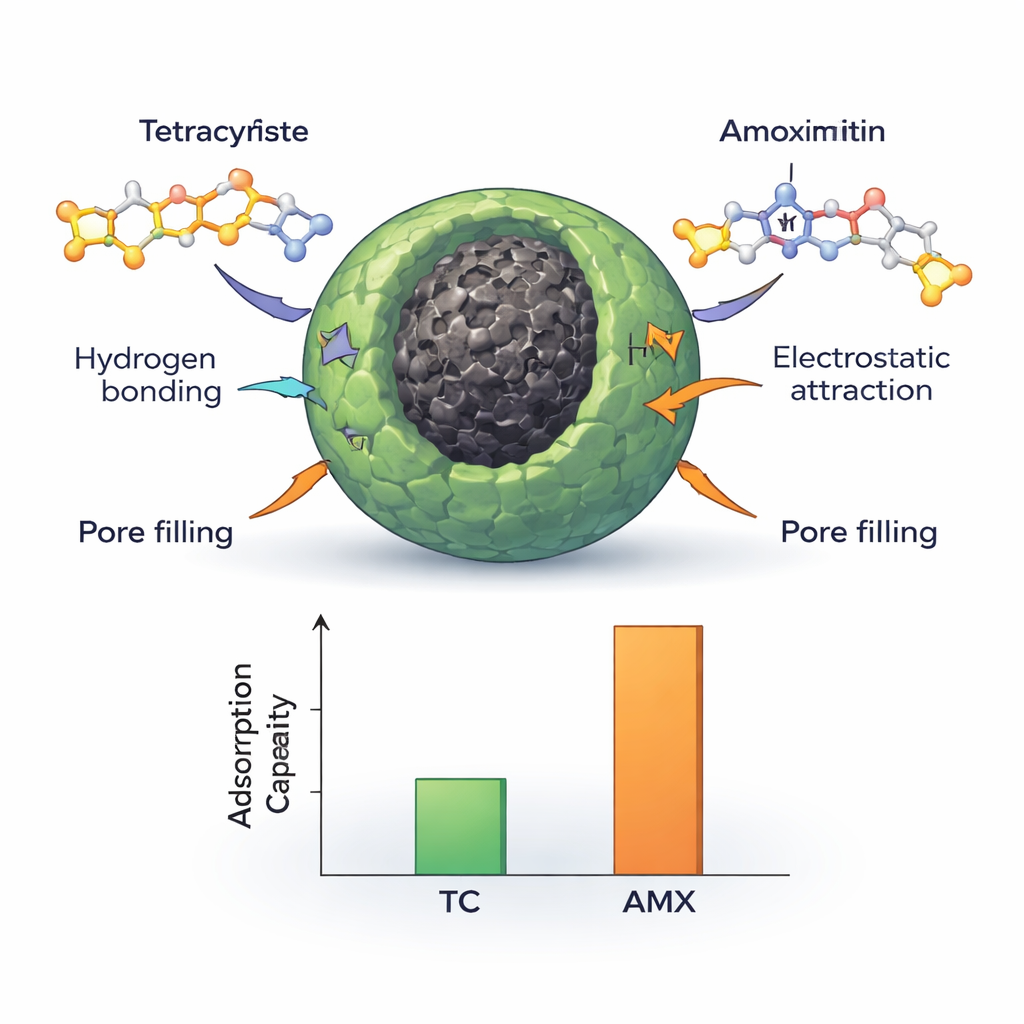
At the microscopic level, several forces work together to make this pistachio‑derived material so effective. The activated carbon provides a rough, porous scaffold that increases the overall surface area and offers aromatic regions where the ring‑shaped antibiotic molecules can stack like coins. The ZIF‑8 component adds well‑defined pores and metal sites that encourage hydrogen bonding and electrostatic attraction, especially around neutral pH, when the antibiotics carry partial charges. Some antibiotic molecules simply fill the pores; others latch on more strongly through chemical‑like bonds. This mix of physical trapping and stronger binding interactions explains both the high capacities measured in the lab and the preference for amoxicillin over tetracycline.
A Reusable, Greener Option for Water Treatment
A practical water‑treatment material must work more than once. The team cycled the best performing nanocomposite through five rounds of antibiotic capture and simple cleaning with ethanol and water. After these cycles, it still retained more than 93% of its initial capacity, indicating that it can be regenerated without harsh chemicals or major performance loss. Overall, the study shows that agricultural waste like pistachio hulls can be upgraded into an advanced, reusable filter medium for stubborn antibiotics. While further scaling and real‑world testing are needed, this approach points to a future where crop residues help safeguard drinking water and slow the spread of antibiotic resistance.
Citation: Javid, F., Azar, P.A., Moradi, O. et al. Green synthesis of activated carbon-ZIF-8 nanocomposites from pistachio hulls for efficient antibiotic adsorption in water remediation. Sci Rep 16, 6320 (2026). https://doi.org/10.1038/s41598-026-35370-3
Keywords: antibiotic removal, activated carbon, pistachio waste, water purification, metal-organic frameworks