Clear Sky Science · en
Physics-informed neural network modeling of shock waves by appropriately incorporating equation of state
Why sharp gas waves matter
When a supersonic jet rips through the sky or a shock wave races down a gas-filled tube, the fluid properties—like pressure and temperature—change almost instantly over tiny distances. Capturing these razor-thin “jumps” is crucial for designing safer aircraft, rockets, and industrial systems, but doing so accurately is difficult and computationally expensive. This study explores a new way to use physics-informed neural networks, a type of machine learning that obeys physical laws, to model shock waves more faithfully without relying on large data sets or hand-tuned tricks.
Blending equations and learning
Traditional computer simulations of fluid flows, known as computational fluid dynamics, solve the governing equations of motion directly on a grid. They are powerful but slow, and they often require expert tuning of numerical schemes and boundary conditions. Physics-informed neural networks (PINNs) take a different approach: instead of feeding them vast training data, researchers train them to minimize how badly they violate the underlying equations and boundary conditions. In principle, this lets a PINN “learn” a flow field that automatically respects the physics, even when only a small amount of labeled data is available.
The problem with sudden jumps
Shock waves pose a special challenge for PINNs. Across a shock, quantities such as density and pressure change abruptly, which makes their spatial derivatives blow up. Standard neural networks, which are biased toward smooth functions, struggle to reproduce these sharp transitions. Earlier attempts to fix this problem added artificial diffusion, clustered training points near the shock, or introduced extra entropy constraints and empirical weights. While these methods helped, they often depended on prior knowledge of where the shock sits, on experimental data, or on carefully tuned numerical parameters—reducing the promise of PINNs as general, physics-driven tools.
A key twist: choosing the right outputs
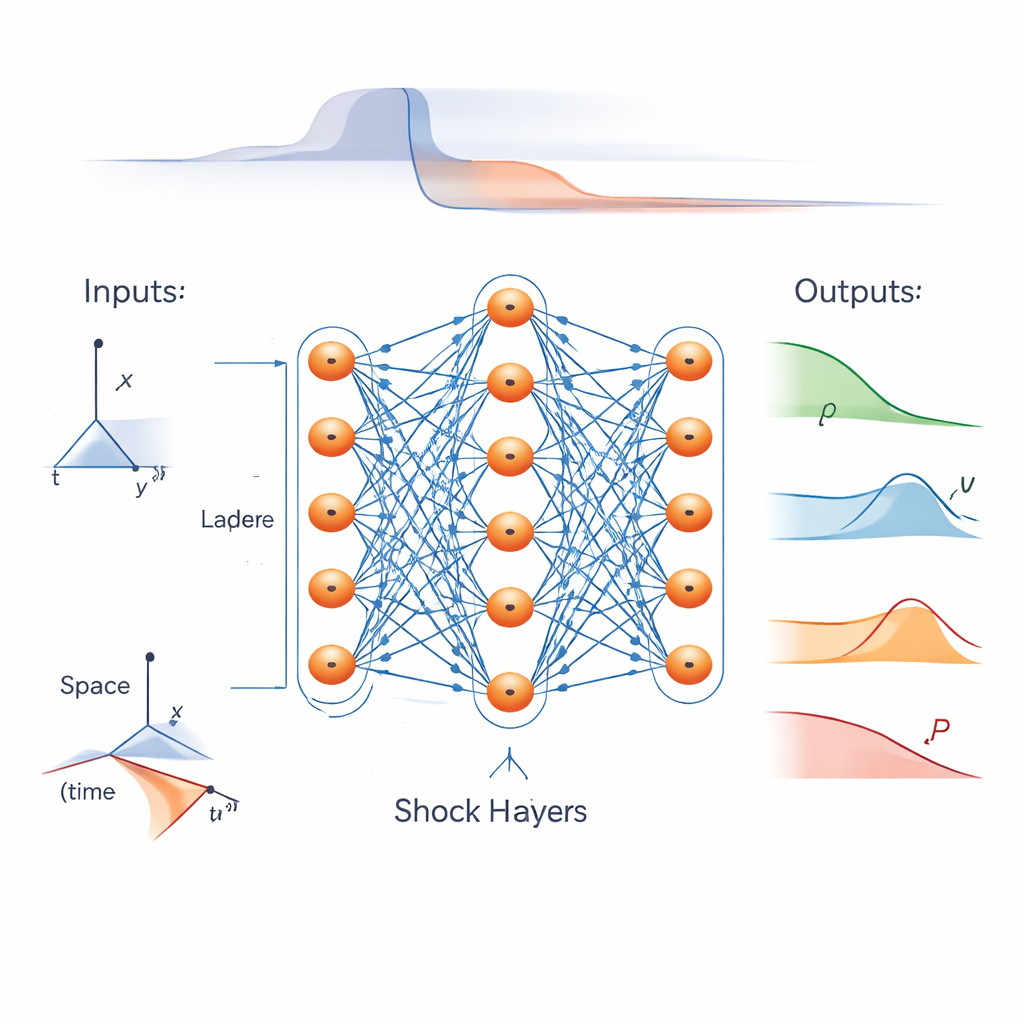
The authors propose that a surprisingly simple design choice—what the neural network is asked to predict—can make or break shock modeling. Their PINN is built on the standard Euler equations for compressible gas flow, but they explicitly add the equation of state for an ideal gas, which links pressure, density, and temperature. They then demand that the network output four quantities at every point: density, velocity, temperature, and pressure. This makes the number of unknowns match the number of equations enforced in the loss function, including the equation of state, and allows them to check energy consistency through temperature. In contrast, many previous models asked the network to predict only three of these variables and reconstructed the fourth afterward, which left one of the governing relationships under-enforced.
Testing in simple but tough shock setups
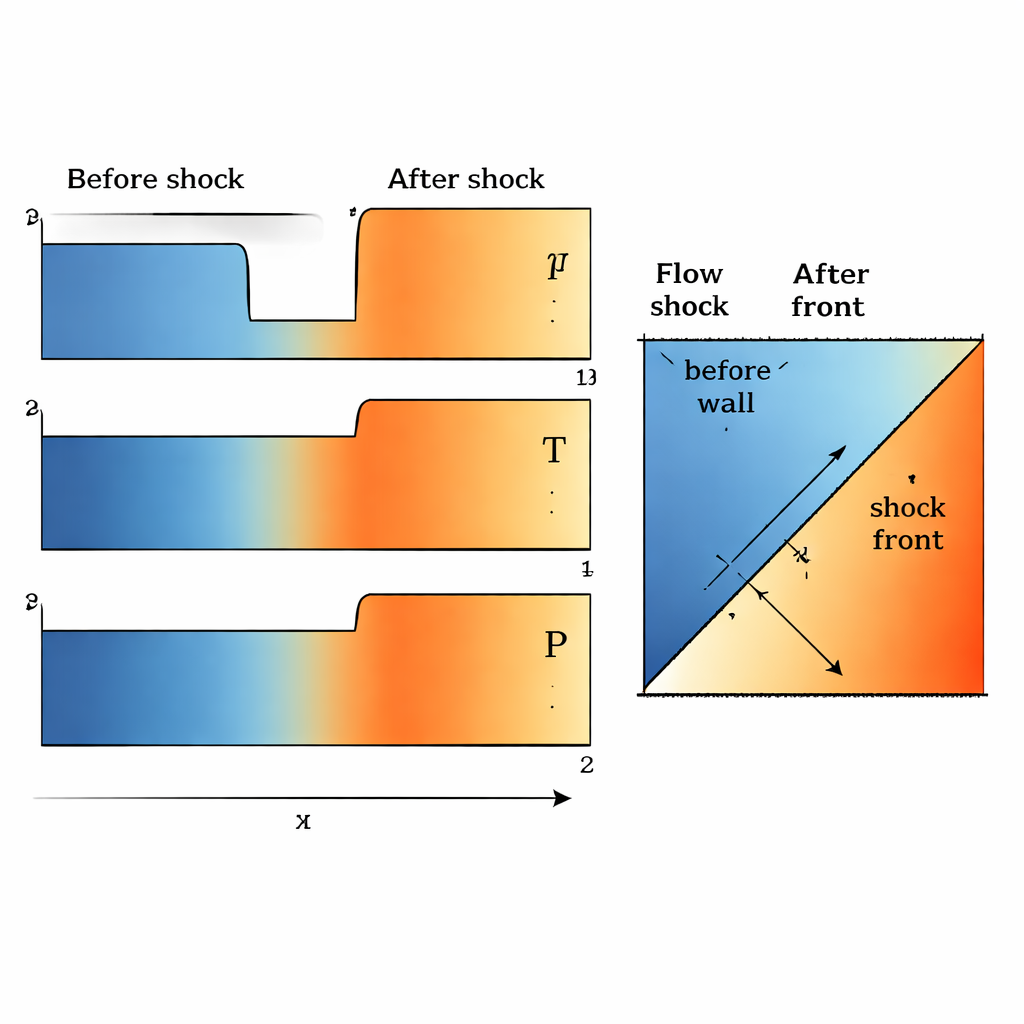
To test this idea, the researchers examined two classic problems. The first is a one-dimensional shock tube, where high-pressure gas suddenly expands into a low-pressure region, forming an expansion fan, a contact surface, and a moving shock. The second is a two-dimensional oblique shock, where supersonic flow glances off a slanted wall, generating a slanted shock front. For each case, they compared several PINN variants: networks that output only three variables and reconstruct the fourth, and the new “balanced” network that outputs all four. They found that only the four-output model could reproduce the sharp jumps and correct positions of the discontinuities, with error levels much lower than the others and good agreement with textbook theoretical solutions.
Why enforcing all the physics helps
Beyond visual agreement, the authors inspected deeper measures such as entropy, a quantity that signals whether a shock solution is physically plausible. Remarkably, their four-output PINN produced nearly correct entropy distributions without having to add any special entropy-related loss terms. This suggests that when the equation of state is built directly into the training objective, and both temperature and pressure are predicted explicitly, the network is better able to honor conservation of energy and other constraints, even around sharp discontinuities. The authors note that the precise mathematical reason for this improvement is not yet fully understood, but their results provide strong empirical evidence of its importance.
What this means going forward
For non-experts, the main takeaway is that getting machine learning to respect the laws of physics is not just about throwing equations into a loss function; it also depends critically on choosing the right set of variables for the network to learn. By matching the number of predicted quantities to the number of governing equations, and by explicitly incorporating the gas equation of state, this work shows that PINNs can accurately capture shock waves without prior knowledge of their location or ad hoc tuning. While the current study focuses on ideal gases and inviscid flows, the approach points toward more reliable, physics-grounded neural models for more complex situations, such as viscous flows, non-ideal gases, and dust-laden shock environments.
Citation: Mizuno, Y., Misaka, T. & Furukawa, Y. Physics-informed neural network modeling of shock waves by appropriately incorporating equation of state. Sci Rep 16, 4957 (2026). https://doi.org/10.1038/s41598-026-35369-w
Keywords: physics-informed neural networks, shock waves, compressible flow, equation of state, scientific machine learning