Clear Sky Science · en
Sustainable high-performance concrete: harnessing recycled rubber and slag for strength and eco-friendliness
Turning Old Tires and Industrial Waste into Stronger Concrete
Concrete is everywhere in modern life—from bridges and towers to sidewalks and tunnels—but making its key ingredient, cement, pumps large amounts of carbon dioxide into the atmosphere. This study explores an intriguing question: can we turn factory by‑products and worn‑out car tires into ingredients for high‑performance concrete that is still strong and safe, yet cheaper and far better for the planet?

Why Rethinking Concrete Matters
Cement production alone is responsible for roughly 8% of global carbon dioxide emissions, making it a major target for climate‑conscious innovation. At the same time, millions of tons of industrial slag from steelmaking and discarded rubber from end‑of‑life tires pile up as waste. The researchers set out to design a type of high‑performance concrete that replaces a sizable share of cement with granulated blast furnace slag and finely ground rubber powder. Their goal was to see how far they could cut cement content—and thus emissions and cost—while still meeting the demanding strength and durability expectations of modern infrastructure.
How the New Mixes Were Tested
The team created a series of concrete recipes by gradually substituting cement with up to 50% slag and, in the most promising slag mix, adding up to 30% rubber powder. They then cast and cured standard test specimens and measured their ability to withstand crushing, bending, and splitting forces—three fundamental indicators of structural performance. Alongside strength testing, they examined how easily the fresh concrete could flow into molds, how heavy the hardened material was, and how it fractured under load, which reveals whether it fails in a brittle or more forgiving manner. To understand what was happening inside the material, they also used laboratory techniques that probe the internal crystal structure and microstructure of the hardened paste.
Strength, Flexibility, and the Best recipe
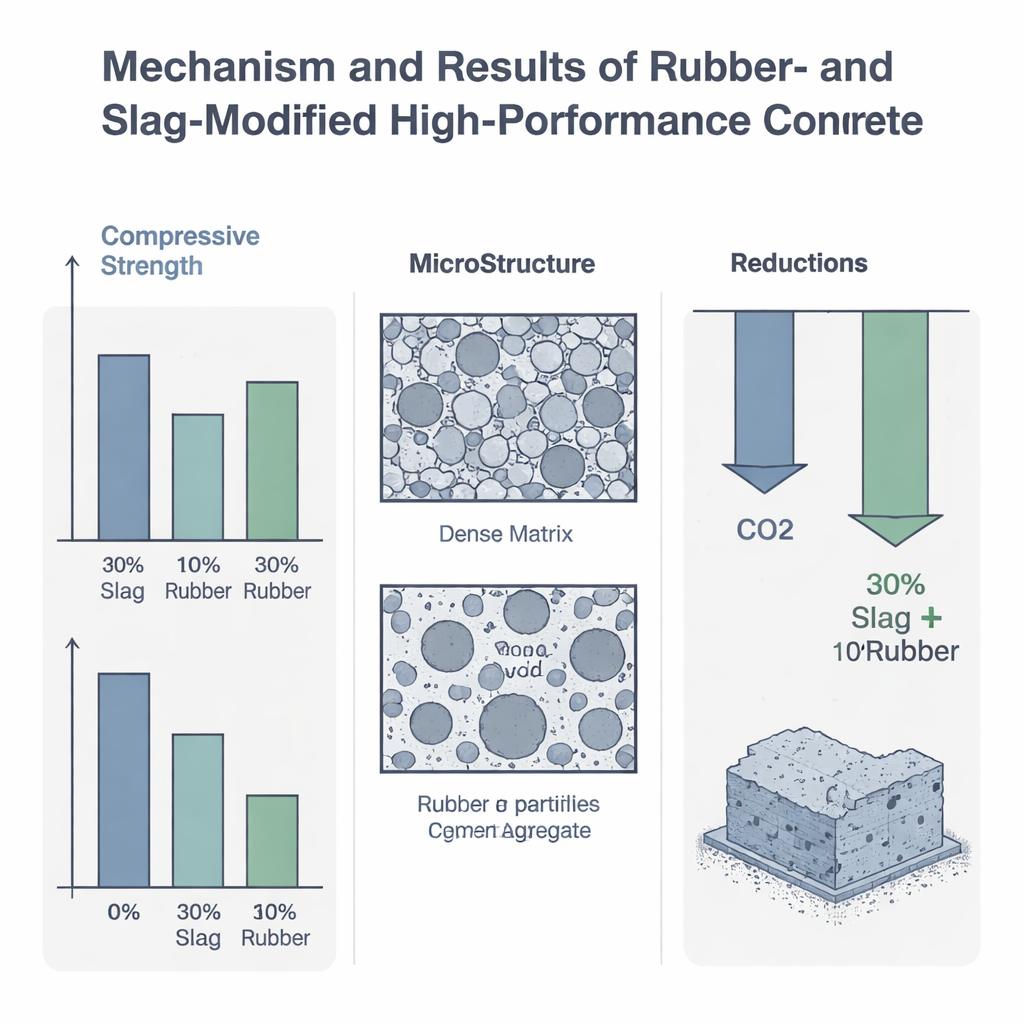
The results showed that slag is a particularly friendly substitute for cement. Replacing up to 30% of the cement with slag caused less than about a 5–10% drop in compressive, tensile, and flexural strength, while actually improving the flow of the fresh concrete and slightly reducing its weight. Beyond 30% slag, strength began to fall off more sharply. Rubber powder behaved differently: even at modest levels it reduced strength, but it made the concrete much more deformable and better at absorbing energy before breaking—qualities that could be valuable in impact‑ or earthquake‑prone settings. A 10% rubber replacement, combined with 30% slag, cut compressive strength from about 89 to 73 megapascals yet roughly doubled the displacement at failure and maximized fracture energy, indicating a tougher, less brittle material.
What Happens Inside the Material
Microscopic studies revealed why these trade‑offs occur. Slag participates in the same kind of chemical reactions that give conventional concrete its strength, forming additional binding gel that densifies the internal matrix. Rubber, in contrast, is chemically inert and water‑repellent. Tiny rubber particles interrupt the otherwise continuous cement network, creating weaker contact zones and small pockets of porosity around them. Advanced analyses showed that mixes with rubber produced fewer of the key strength‑giving phases and had a more uneven, hole‑rich texture. This explains why the material becomes more flexible and energy‑absorbing, but less able to carry extreme loads.
Climate and Cost Benefits
Beyond the laboratory, the researchers evaluated the environmental and economic implications of their recipes. Using a full life‑cycle assessment, they found that replacing cement with slag could cut the concrete’s carbon footprint by up to about 42%, while rubber additions of up to 30% lowered emissions by as much as roughly 37%, thanks to both reduced cement use and the reuse of waste tires. When material prices were taken into account, slag‑rich mixes were clearly cheaper per cubic meter than conventional high‑performance concrete, and the mix with 30% slag delivered the best strength‑to‑cost ratio. Rubber further reduced material cost, but its added strength loss meant diminishing returns for projects where very high load‑bearing capacity is essential.
What This Means for Future Buildings
For non‑specialists, the main takeaway is that concrete does not have to be an all‑or‑nothing choice between strength and sustainability. This work shows that carefully tuned blends using about 30% steelmaking slag and 10% recycled rubber powder can yield a concrete that is still strong enough for demanding applications, yet lighter, tougher, cheaper, and far less carbon intensive than traditional high‑performance mixes. With further long‑term durability studies and updates to building codes, such recipes could help turn industrial waste and scrap tires into safer bridges, buildings, and other infrastructure with a much smaller environmental footprint.
Citation: Bahmani, H., Mostafaei, H. Sustainable high-performance concrete: harnessing recycled rubber and slag for strength and eco-friendliness. Sci Rep 16, 7376 (2026). https://doi.org/10.1038/s41598-026-35362-3
Keywords: sustainable concrete, recycled rubber, blast furnace slag, low-carbon construction, high-performance concrete