Clear Sky Science · en
Higher free-roaming dog density sustains rabies virus transmission in Haiti
Why the number of street dogs matters
Rabies is almost always deadly once symptoms appear, yet it is preventable with vaccines. In Haiti and many other countries, most human rabies deaths start with a bite from a dog that roams freely through neighborhoods. This study asks a simple but crucial question with big public-health consequences: how many free-roaming dogs can an area have before rabies keeps circulating there, rather than burning out? The answer helps health officials decide where to focus precious vaccines and disease-control efforts.
Following rabies across Haiti’s communities
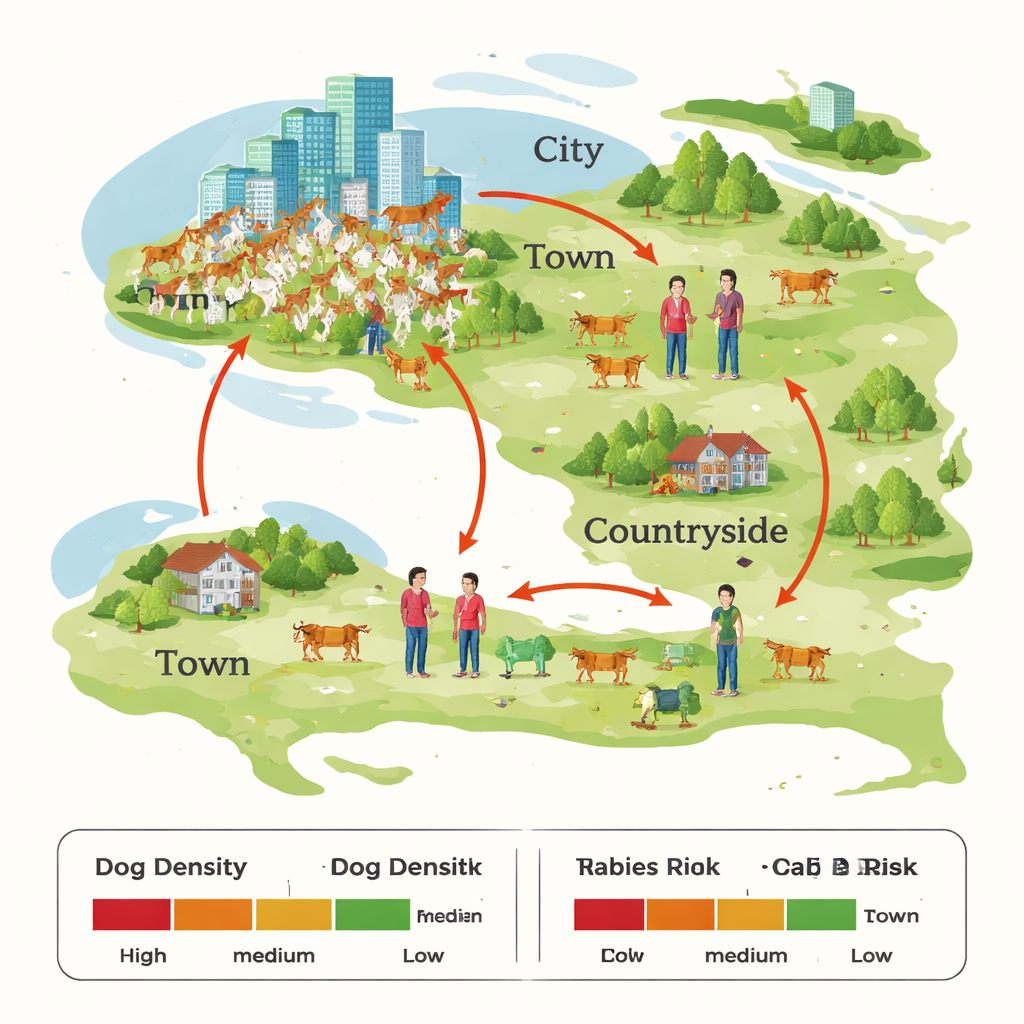
Haiti has built one of the strongest rabies surveillance systems in the developing world. Health workers and community members report suspicious animals, trained officers investigate the bites, and many animals are tested in the lab. The researchers combined six years of these investigations with detailed maps that classify every part of Haiti into urban, peri-urban, and rural zones, and also describe how well each area is connected by roads. They then estimated how many of the “suspected” animal cases were truly rabid, and corrected for the fact that only a small fraction of real cases are ever detected.
Counting unseen cases and dog populations
Because rabies surveillance never catches every case, the team assumed that only about 1 in 20 rabid dogs is found and recorded. Using this assumption and a machine-learning model that judges how likely an investigated dog was actually rabid, they calculated how many rabid dogs probably occur each year in each type of community. They paired these estimates with previous surveys of how many free-roaming dogs live in different areas of Haiti. That allowed them to compute the incidence of rabies among dogs, and to estimate the “effective reproduction number” (called Re) — essentially, the average number of new rabid dogs that each rabid dog infects under current conditions.
Where rabies thrives and where it struggles
The results show that rabies in Haiti is not mainly a “rural disease.” Most bite investigations and most likely rabid dogs were found in cities and their surrounding towns, where free-roaming dogs are packed close together. In these urban and peri-urban areas, the reproduction number of the virus was comfortably above 1, meaning the infection can sustain itself over time. By contrast, sparsely populated rural and very rural areas had far fewer rabid dogs, far lower rabies incidence, and Re values around or below 1. In those low-density settings, rabies appears only sporadically, likely after an infected dog wanders in or is transported from elsewhere, and then tends to die out instead of becoming entrenched.
A critical dog-density tipping point
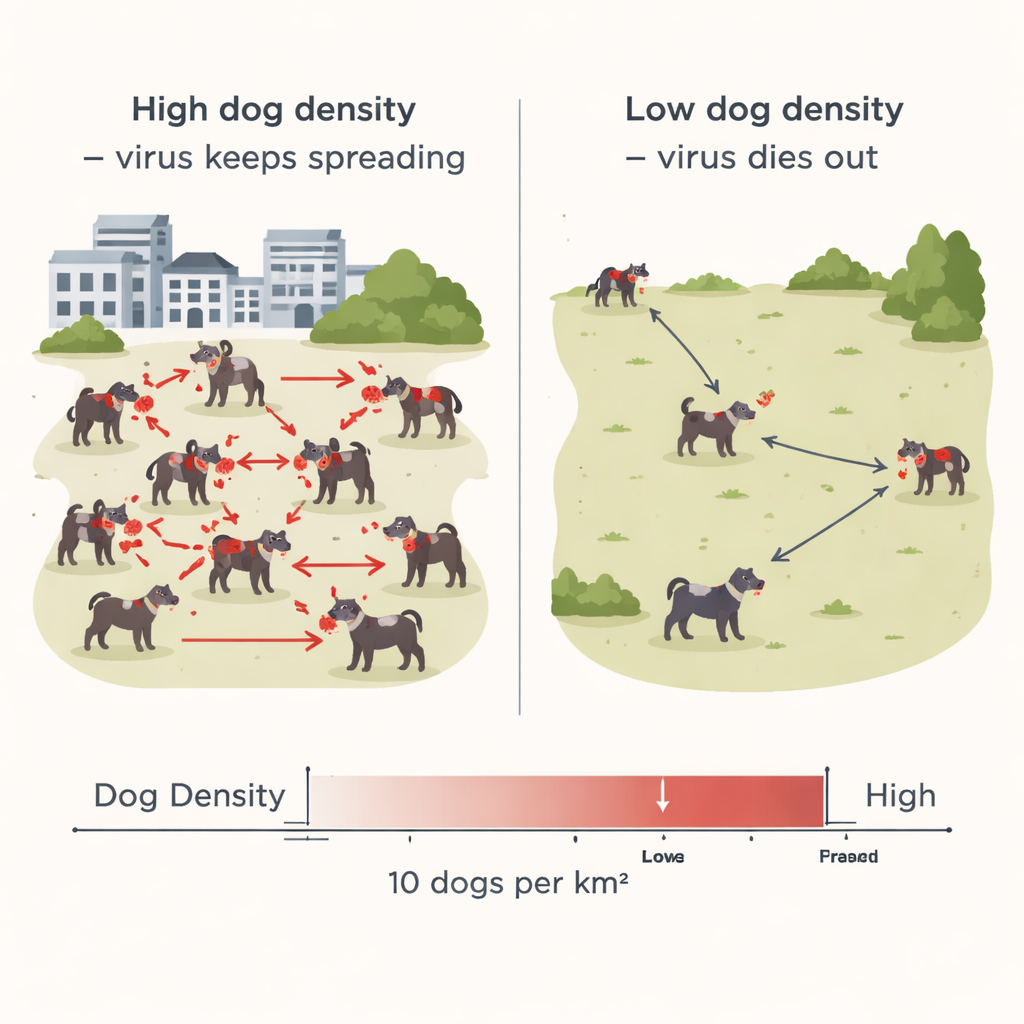
When the researchers plotted free-roaming dog density against the reproduction number, a clear pattern emerged: the denser the free-roaming dog population, the more easily rabies spreads. Their models suggest a tipping point around 10 to 12 free-roaming dogs per square kilometer. Above that range, rabies can maintain a steady foothold; below it, the virus is unlikely to persist on its own. Road connections also matter: even some dense communities that are relatively isolated by poor roads showed lower rabies activity, hinting that movement of dogs between communities helps seed and sustain outbreaks.
What this means for controlling rabies
For decades, global guidelines have emphasized vaccinating at least 70 percent of dogs to stop rabies transmission. This study does not argue against vaccination, but it suggests a more flexible, targeted strategy in places with limited resources. If public-health teams know where free-roaming dog density is highest, they can prioritize those communities for vaccination, education, and humane dog population management. In some areas, protecting enough dogs to bring the number of unvaccinated, free-roaming animals below roughly 10 per square kilometer may be sufficient to make rabies die out locally. For families and communities, the message is simple: reducing uncontrolled roaming and ensuring dogs are vaccinated not only protects individual pets and owners, it helps push whole neighborhoods below the threshold where rabies can survive.
Citation: Beron, A.J., Keshavamurthy, R., Boutelle, C. et al. Higher free-roaming dog density sustains rabies virus transmission in Haiti. Sci Rep 16, 5543 (2026). https://doi.org/10.1038/s41598-026-35359-y
Keywords: rabies, free-roaming dogs, Haiti, dog vaccination, infectious disease transmission