Clear Sky Science · en
Computational intelligence applications in predicting energy consumption, greenhouse gas emissions, and drying performance of hybrid infrared dryer
Why drying a “miracle tree” matters
Moringa oleifera, often called the “miracle tree,” is packed with vitamins, protein, and health-boosting compounds. Its leaves are widely used in powders and teas to fight malnutrition and support wellness, especially in low‑income regions. But fresh moringa leaves spoil quickly because they are mostly water. Drying them safely and cheaply—without destroying their nutrients—is a real challenge. This study explores a new way to dry moringa leaves faster, with less energy and lower climate impact, using a smart hybrid dryer guided by artificial intelligence.
A new kind of smart dryer
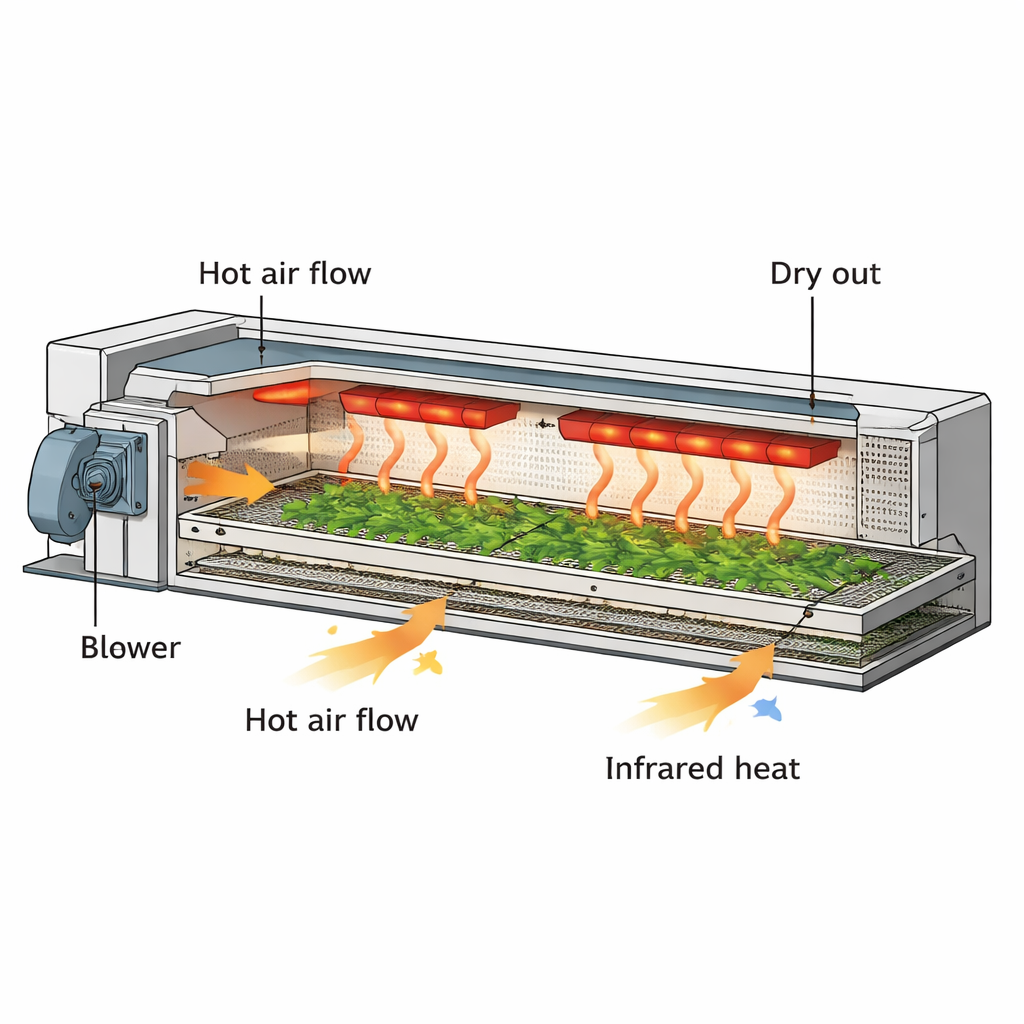
The researchers tested a continuous conveyor‑belt dryer that combines two heat sources: gentle hot air and powerful infrared light. Instead of relying only on hot air, which is slow and energy‑hungry, infrared lamps shine directly on a thin layer of moringa leaves as they ride through a steel chamber on a moving mesh belt. The team adjusted three main “knobs” to see how they changed the process: air temperature (from cool 35 °C to warm 55 °C), air speed (from 0.3 to 1.0 meters per second), and infrared intensity (from low to high). This setup mimics real industrial lines that must run continuously while protecting delicate foods.
Faster drying with less power
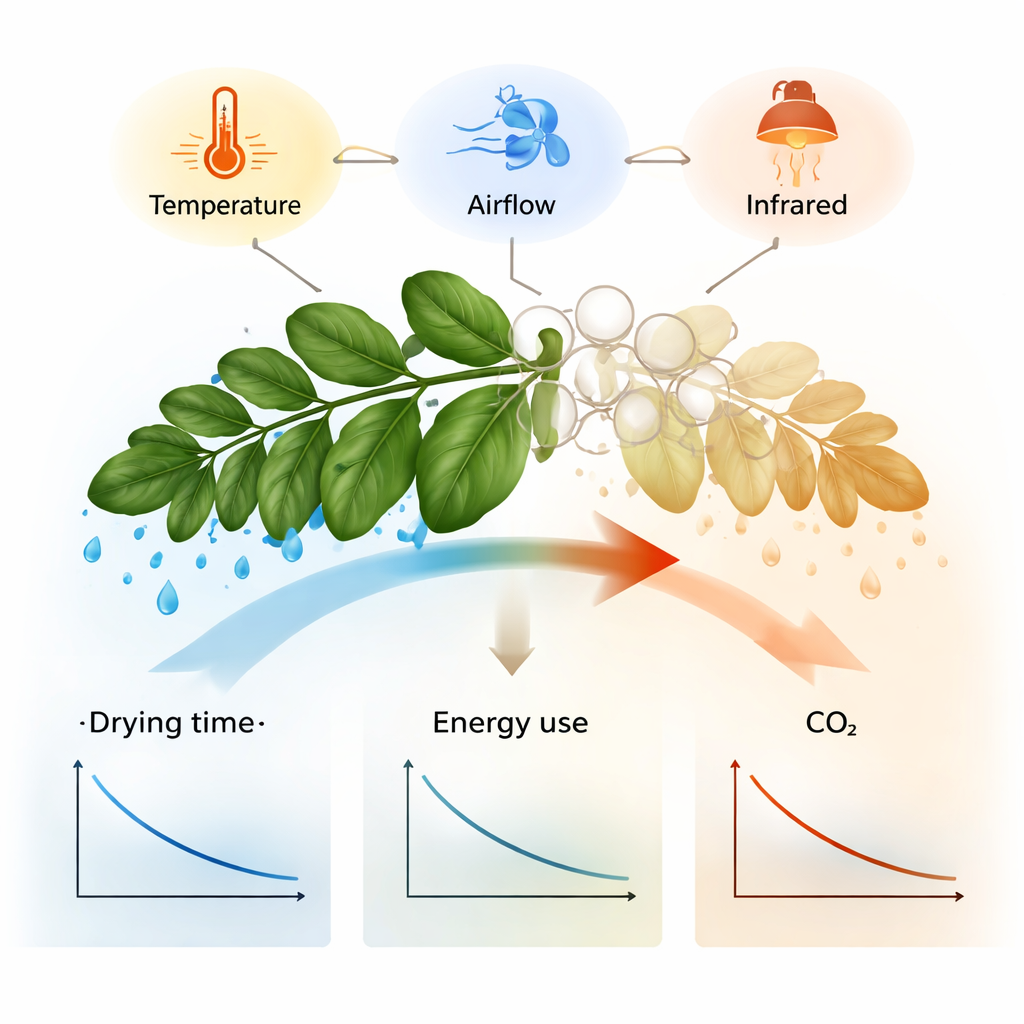
By carefully tuning those three knobs, the scientists showed that moringa leaves can be dried much more efficiently than in standard hot‑air systems. When both air temperature and infrared intensity were high, drying time dropped from about 210 minutes under mild conditions to just 95 minutes under strong conditions. At the same time, the energy needed per kilogram of dried product fell from 5.2 to 3.9 megajoules. In contrast, pushing more air through the chamber—raising the airflow speed—actually made things worse: it extended the drying period and raised energy use by up to 18 percent, likely because fast air kept cooling the leaf surface and wasting heat.
Making sense of complex drying behavior
Drying is not just about time on a clock; it involves how water moves from inside the leaf to the surface and then into the air. To capture this behavior, the team compared eleven mathematical models that describe how moisture leaves thin materials. One model, known as the Midilli–Kucuk model, matched the measurements almost perfectly, giving the most accurate predictions of how quickly the leaves lose water under different settings. The researchers then went a step further, using artificial intelligence tools—artificial neural networks, principal component analysis, and self‑organizing maps—to learn from the data. These tools helped reveal which combinations of temperature, airflow, and infrared power give quick drying, low energy use, and good thermal performance all at once.
Cutting emissions and costs
Because most industrial dryers still run on fossil‑based electricity or fuels, every kilowatt‑hour saved also cuts greenhouse gases. By focusing on specific energy consumption—the energy needed to remove a kilogram of water—the team linked dryer performance directly to carbon dioxide emissions. Under the best hybrid settings, the system reduced CO₂ emissions by about 20 percent compared to traditional hot‑air drying alone. That translates into a mitigation potential of roughly 0.45–0.52 kilograms of CO₂ saved for every kilogram of dried moringa leaves produced. At the same time, the optimized process lowered energy bills by an estimated 12–18 percent, a significant gain for large‑scale food processors.
What it means for future food drying
In simple terms, this work shows that smart, combined heat sources—infrared plus hot air—can dry sensitive leaves like moringa both faster and cheaper, while also emitting less carbon. High infrared power and moderate‑to‑high air temperature are the winning recipe; too much airflow is a bad trade‑off. By blending hands‑on experiments with artificial intelligence models, the authors provide a practical roadmap for designing “intelligent” dryers that adapt their settings for the best balance of product quality, energy savings, and climate impact. Although this study focused on moringa, the same principles could help dry many other delicate crops, making healthier, shelf‑stable foods more widely available with a smaller environmental footprint.
Citation: El-Mesery, H.S., ElMesiry, A.H., Husein, M. et al. Computational intelligence applications in predicting energy consumption, greenhouse gas emissions, and drying performance of hybrid infrared dryer. Sci Rep 16, 6757 (2026). https://doi.org/10.1038/s41598-026-35355-2
Keywords: moringa drying, infrared hot air dryer, energy efficient food processing, artificial intelligence in drying, CO2 emissions reduction