Clear Sky Science · en
Credibility measurement of cloud services based on information entropy and Markov chain
Why Trust in Cloud Services Matters
From photo backups to business-critical apps, more and more of our digital lives now run on cloud services. Yet many people and organizations still wonder: can we really trust these invisible systems with our data and daily operations? This paper tackles that question head‑on, proposing a structured way to measure how trustworthy a cloud service is, and how that trust changes over time.
Breaking Trust into Everyday Qualities
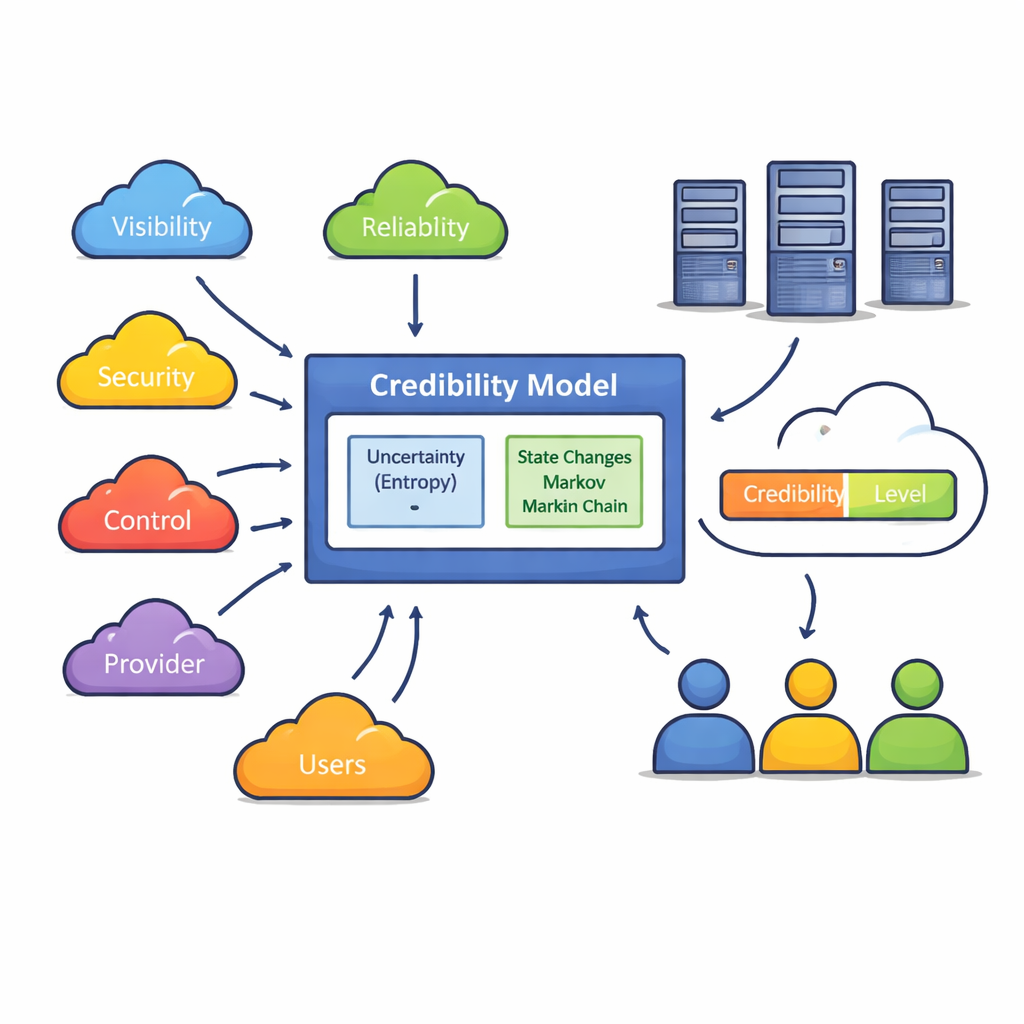
The authors start by asking what “credibility” in the cloud actually means from a user’s point of view. Instead of treating trust as a vague feeling, they break it into six easy-to-understand dimensions. Visibility is about whether you can see what the service is doing with your data – for example, where it is stored and who accessed it. Controllability reflects how much control you and the provider have over access, encryption, and system behavior. Security covers protection against data loss, attacks, and viruses. Reliability is whether the service keeps running and returns correct results over time. Provider viability concerns the health and professionalism of the company behind the service, including its finances, experience, and long‑term plans. Finally, user satisfaction measures whether real customers feel the service is fast, fairly priced, and suited to their needs.
Turning Fuzzy Concerns into Measurable Factors
To move from concepts to numbers, the team identifies 30 specific factors across these six dimensions, such as data backup and recovery, identity authentication, fault monitoring, and price. They consult 15 cloud experts and over 1,000 users, asking how often each factor leads to problems and how serious those problems are when they occur. Instead of simply averaging opinions, they use a statistical idea called information entropy to measure uncertainty. In simple terms, entropy tells you how unpredictable something is. Here, it captures how uncertain each factor is and how much it can shake users’ trust. Factors that frequently cause issues and are hard to predict carry more weight in the final trust score.
Following How Trust Shifts Over Time
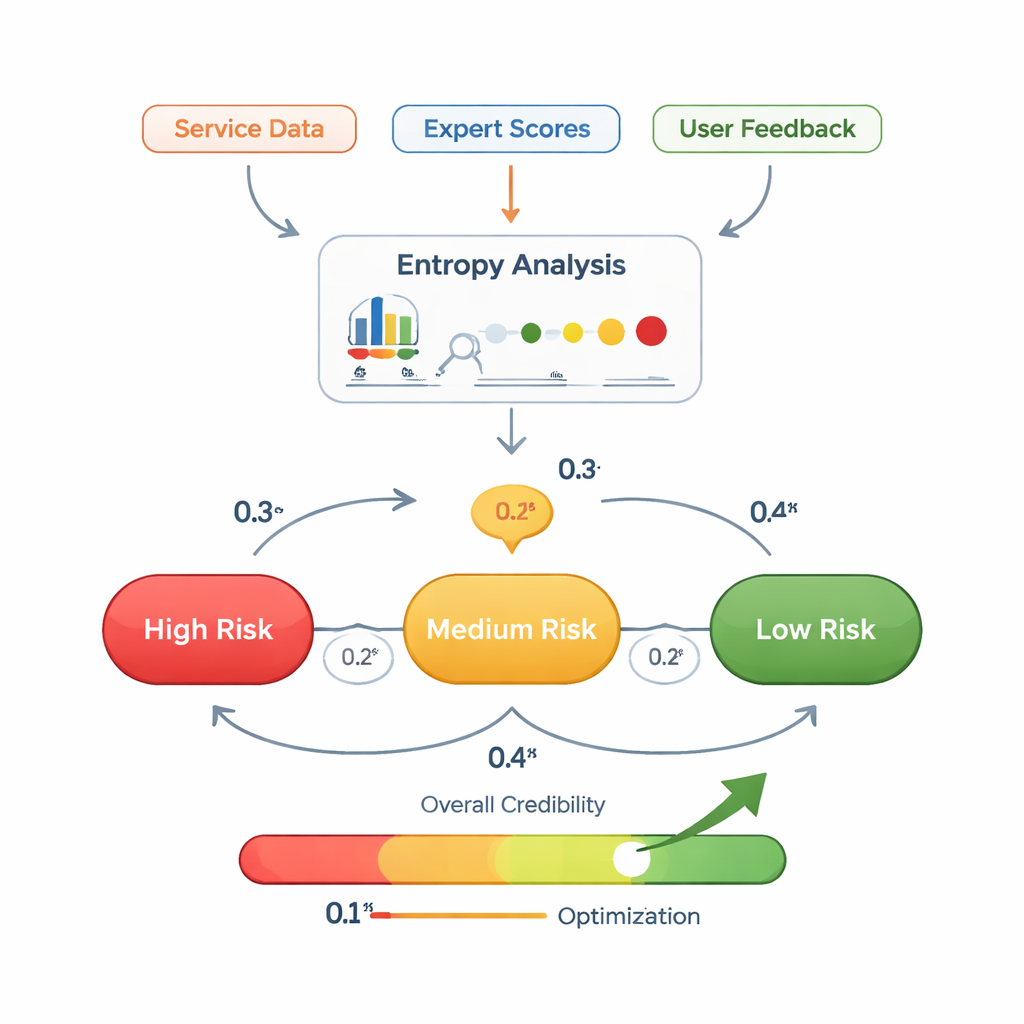
Cloud services are not static: software is updated, attacks come and go, and traffic surges at different times of day. To capture this, the authors combine entropy with another mathematical tool called a Markov chain, which models how a system moves between states. They define trust “states” such as low, medium, and high risk and use real service data, expert input, and user feedback to estimate how likely the system is to move from one state to another in each time window. By repeatedly updating these transition probabilities, they can estimate a steady pattern: how often the service will sit in safer or riskier states in the long run, and how overall trust trends across days, months, or after specific improvements.
Testing the Model on Real Cloud Providers
The researchers apply their method to three real cloud providers offering storage, office tools, and development platforms. They collect technical records, financial data, service logs, and user surveys, and then compute a trust score for each provider. In one detailed case, the initial evaluation flags particular weak spots: visibility (users cannot easily see how data is handled) and security controls. Using these insights, the provider strengthens items such as documentation, data protection measures, and user communication. Five months later, the model is run again. The new scores show lower uncertainty, smaller impact from problem factors, and a clear shift from “generally credible” to the study’s highest category, “most credible.”
How This Compares to Other Approaches
The authors also benchmark their method against several popular techniques for rating cloud services, including Analytic Hierarchy Process (AHP), multi‑criteria decision methods, grey theory models, and Bayesian networks. Under standardized tests, their combined information‑entropy and Markov‑chain (IE‑MC) model improves prediction accuracy by about 15% over classic AHP, while remaining more efficient than complex probabilistic models in large, fast‑changing cloud environments. It is especially strong at handling dynamic conditions, such as peak loads or sudden faults, where trust can rise or fall quickly.
What This Means for Everyday Cloud Users
For non-specialists, the key message is that trust in the cloud can be measured and improved in a systematic way, rather than relying on gut feeling or marketing claims. By breaking credibility into visible aspects—like uptime, security safeguards, track record, and user satisfaction—and by tracking how these evolve, the IE‑MC model offers both cloud customers and providers a kind of “trust dashboard.” While the method is mathematically sophisticated and still depends on good expert data, it shows that with the right measurements and continuous monitoring, cloud services can move from “probably okay” toward demonstrably reliable platforms that users can depend on with greater confidence.
Citation: Ou, L., Yu, J. Credibility measurement of cloud services based on information entropy and Markov chain. Sci Rep 16, 4807 (2026). https://doi.org/10.1038/s41598-026-35346-3
Keywords: cloud service trust, service reliability, security evaluation, risk modeling, user satisfaction