Clear Sky Science · en
IRF7 is a novel prognostic biomarker in kidney renal clear cell carcinoma
Why this kidney cancer story matters
Kidney cancer is common, and its most frequent form—kidney renal clear cell carcinoma—can be hard to treat once it has spread. Doctors need better ways to tell which patients are likely to do well and who might need more aggressive or different treatment. This study focuses on a single molecule in our cells, called IRF7, and asks a simple but powerful question: can measuring it help predict how kidney cancer will behave and how patients will respond to modern therapies?
A messenger from the immune system
IRF7 is a protein that normally helps the body fight viral infections by switching on antiviral defenses. Because cancer often hijacks or hides from the immune system, the authors wondered whether IRF7 might also be involved in how tumors grow and escape immune attack. They examined data from thousands of patients across 33 cancer types, combining large public datasets of gene activity, protein levels, and clinical outcomes. Their special focus was kidney renal clear cell carcinoma, the subtype that makes up 70–80% of kidney cancers worldwide.
Seeing the signal across many cancers
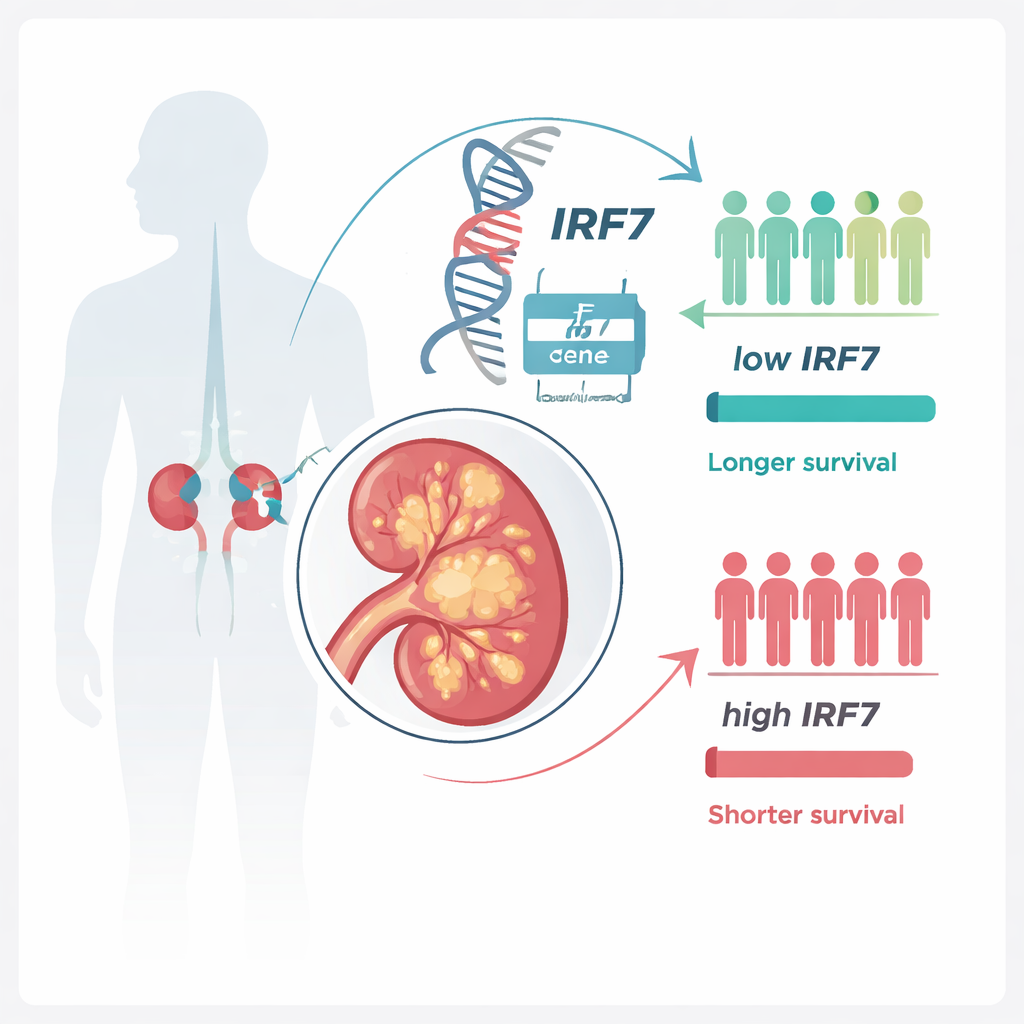
When the team compared tumor samples with normal tissues, they found that IRF7 was abnormally active in 22 different cancers, including kidney, breast, lung, and brain tumors. In kidney clear cell cancer, both the gene and the protein were clearly higher in tumors than in healthy kidney tissue. Importantly, patients whose tumors had more IRF7 tended to have more advanced disease, with higher stage and more frequent spread beyond the kidney. In several cancer types, people with high IRF7 levels had shorter overall survival and faster return of their disease, suggesting that this molecule is tied to more aggressive tumor behavior.
Linking IRF7 to immunity and tumor wiring
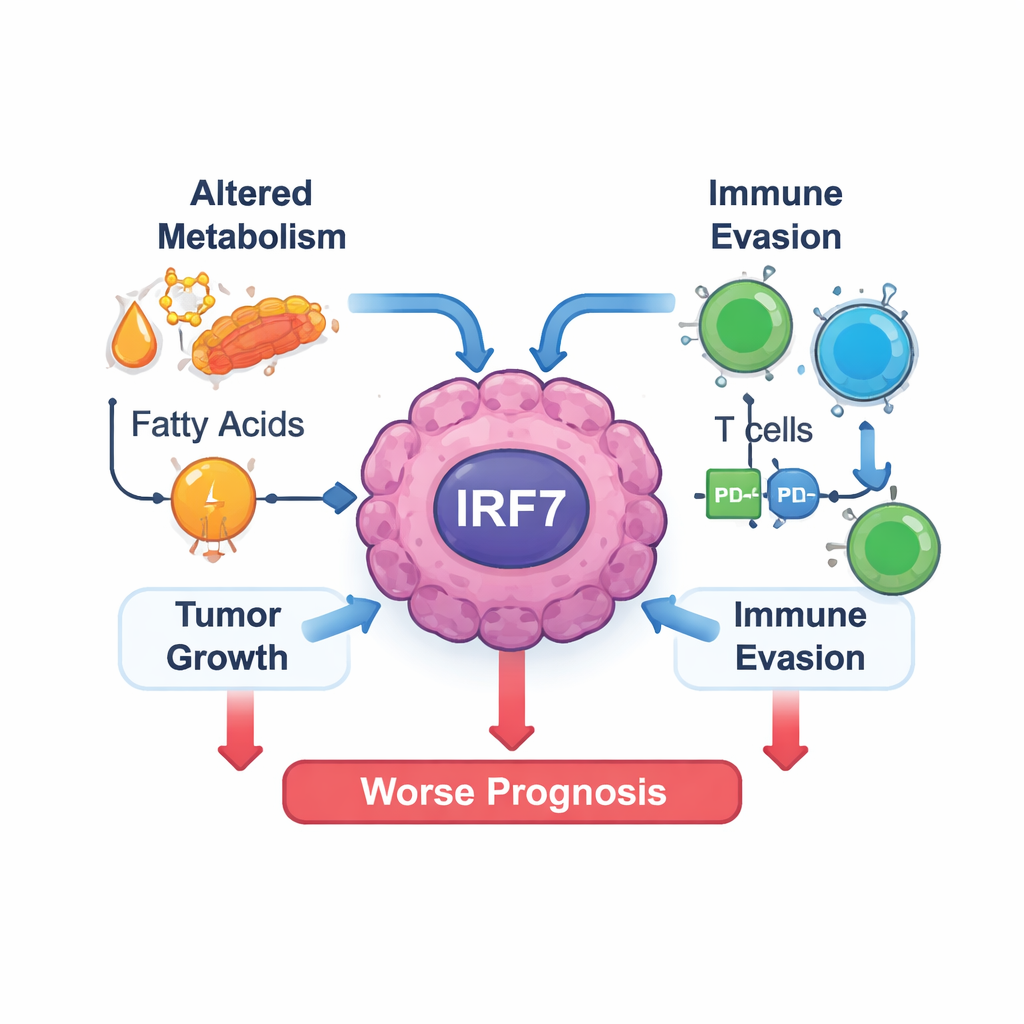
The researchers then looked at how IRF7 connects to the immune environment around tumors. High IRF7 levels often went hand-in-hand with genes that control immune checkpoints—the on–off switches that immune therapies target—as well as with many types of immune cells moving into the tumor. In kidney cancer and other tumors, IRF7 levels also tracked with measures of genetic instability, such as mutation load, which can shape how a cancer responds to immunotherapy. At the same time, computer analyses of thousands of genes pointed to another role: IRF7 was tied to pathways that control how cells process fats and generate energy in their mitochondria. This is notable because kidney clear cell cancer is increasingly viewed as a metabolic disease, where rewired energy use fuels growth and affects how the immune system reacts.
From big data to bedside tools
To see whether IRF7 could actually help doctors, the authors built a practical prediction chart, called a nomogram, for kidney clear cell cancer. This tool combines a patient’s age, tumor stage, and IRF7 level to estimate the chance of being alive at one, three, and five years. When they tested this model, its predictions matched real patient outcomes closely. The team also went beyond databases and stained tiny slices of tumor and nearby normal tissue from 43 patients. In almost every case, IRF7 protein was stronger in the cancer than in the healthy kidney, and patients with the highest IRF7 in their tumors lived for a shorter time.
What this means for patients and future care
For a non-specialist, the takeaway is straightforward: this study identifies IRF7 as a promising warning flag in kidney clear cell cancer. Tumors that crank up IRF7 tend to be more advanced, more deeply entangled with the immune system, and linked to worse survival. Because IRF7 also sits at the crossroads of immunity and cell metabolism, it could help doctors choose which patients might benefit most from immunotherapy or new drugs that target tumor energy use. While laboratory experiments are still needed to confirm exactly how IRF7 drives these changes, the work suggests that a simple test for this protein could one day help personalize treatment and improve how we manage kidney cancer.
Citation: Fu, S., Zhou, W., Yin, W. et al. IRF7 is a novel prognostic biomarker in kidney renal clear cell carcinoma. Sci Rep 16, 5523 (2026). https://doi.org/10.1038/s41598-026-35345-4
Keywords: kidney cancer, IRF7, biomarkers, immunotherapy, tumor metabolism